

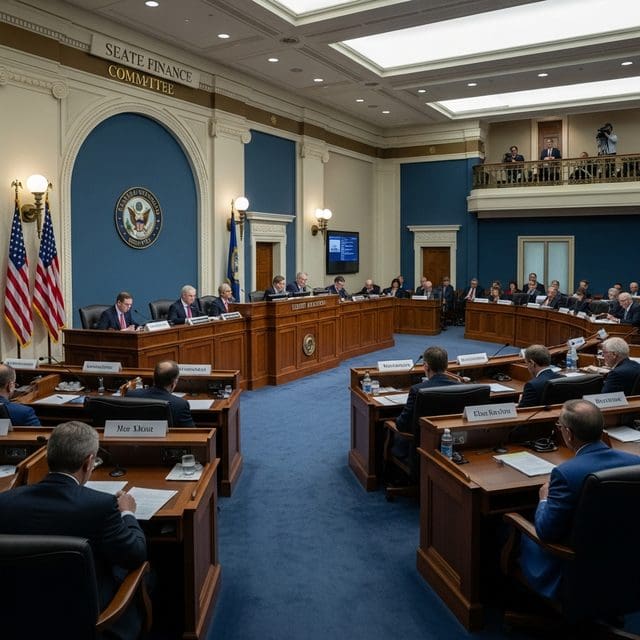
Senate Republicans defeated a Democratic amendment on Thursday that sought to dismantle a Trump administration deal shielding the president from IRS audits, opting instead for potential administrative negotiations.
The Senate Finance Committee on Thursday rejected a legislative attempt to dismantle a Trump administration plan that shields the president from Internal Revenue Service audits. In a 13-14 party-line vote during the markup of the Taxpayer Assistance and Service Act, Republicans blocked a Democratic amendment designed to codify mandatory oversight of executive branch tax filings and ensure the administrative state remains answerable to the law.
The proceedings, held at 10:00 a.m. in Room 215 of the Dirksen Senate Office Building, centered on a proposal by Ranking Member Ron Wyden. The amendment was far-reaching, seeking to bar the IRS from entering into future tax-audit immunity agreements with a sitting president, their family members, or related business entities. Beyond a simple ban, the proposal included a mechanism to extend the statute of limitations, ensuring that a future IRS could legally pursue audits that were paused or blocked during the current term. It also mandated that the Treasury Department provide transparent reporting to Congress on any such immunity deals.
Public records from the markup show that despite previous internal criticism of the immunity deal, Republican Senators John Cornyn, Thom Tillis, and Bill Cassidy joined the majority to kill the amendment. The defeat of the measure leaves the administration’s immunity framework intact, at least within the legislative record of the Finance Committee. This vote highlights a sharp partisan divide over whether the president’s tax records should be subject to the same standard of continuous vulnerability detection and reporting that the government now demands of its own digital infrastructure.
Internal discussions among GOP leadership suggest the party is not currently seeking a statutory solution to the audit controversy. Instead, reporting indicates that Republican leaders are attempting to negotiate a narrower version of the immunity deal through the Justice Department. These negotiations are reportedly being leveraged against the pending confirmation of Todd Blanche for Attorney General. This approach favors an administrative adjustment over the permanent legislative guardrails proposed by committee Democrats, leaving the final terms of presidential accountability to be settled behind closed doors rather than through public law.
This committee action occurs amid a broader period of heightened executive branch activity and institutional shifts. On the same day as the markup, the U.S. military conducted retaliatory airstrikes in Iran following a July 29 ballistic missile attack on a U.S. base in Jordan. These strikes marked the end of a brief pause in hostilities ordered by the president on July 25. Simultaneously, other branches of the administrative state are facing their own transparency hurdles; notably, Dr. Anthony Fauci invoked his Fifth Amendment right during Senate testimony on July 29 before the Homeland Security and Governmental Affairs Committee regarding pandemic-era records.
While the Taxpayer Assistance and Service Act will move forward as a broader IRS administration bill, it does so without the specific transparency requirements that would have checked the administration’s ability to self-exempt from standard audit procedures. For those who advocate for a strict document-driven approach to government oversight, the committee’s decision represents a significant gap in the public record. Without the Wyden amendment’s reporting requirements, the specifics of how the IRS handles the president’s financial disclosures remain shielded from congressional and public scrutiny.
The rejection of the amendment ensures that, for the time being, the administrative state maintains significant discretion over the financial accountability of the executive. As the Senate continues to weigh the nomination of Todd Blanche and the potential for a Justice Department-led fix, the paper trail on presidential tax immunity remains an unfinished chapter in the ongoing struggle for government transparency.

Ben Taylor serves as the Senior Correspondent and Investigations Lead for Just Right News, where he anchors the network’s commitment to government transparency and institutional accountability. With a career defined by a relentless pursuit of the facts, Taylor spearheads the acclaimed feature series “The Paper Trail,” a deep-dive investigative column that prioritizes primary source documentation over political rhetoric. Based in the heart of the nation’s capital, he has earned a reputation as one of the most formidable investigative journalists in Washington, D.C., known specifically for his mastery of public records and the Freedom of Information Act.
Taylor’s approach to journalism is deeply rooted in his upbringing in Kansas City, Missouri. Growing up in the “Show Me State,” he developed a healthy skepticism of centralized power and a profound respect for the common-sense values of the American heartland. This Midwestern foundation informs his reporting today, as he bridges the gap between the complex machinations of federal bureaucracy and the everyday concerns of citizens across the country. For Taylor, investigative reporting is not about chasing headlines; it is about ensuring that the government remains answerable to the people it serves.
As an African American man working within the conservative media landscape, Taylor brings a principled perspective to his beat. He views the Constitution and the right to information as the ultimate equalizers in a free society. His work often highlights how bureaucratic overreach and lack of transparency disproportionately affect individual liberties. By focusing on the “paper trail,” Taylor strips away the spin of partisan talking points, instead providing Just Right News readers with the raw data and internal communications that reveal how their tax dollars are spent and how policy decisions are actually made.
In his role as Investigations Lead, Taylor oversees a team dedicated to uncovering the stories that mainstream outlets often overlook. Whether he is auditing federal spending, investigating regulatory overreach, or exposing inefficiencies within the administrative state, his methodology remains consistent: follow the evidence wherever it leads. His presence in Washington, D.C., allows him to maintain a constant watch over the halls of power, yet he remains steadfastly connected to his roots, ensuring his reporting reflects the clarity and directness of his Missouri home.
Throughout his tenure at Just Right News, Taylor has become a vital voice for those who demand integrity in public office. He believes that a well-informed electorate is the strongest defense against government overreach, and he has dedicated his career to providing the public with the tools they need to hold their leaders accountable. Through “The Paper Trail” and his broader investigative work, Ben Taylor continues to set the standard for rigorous, document-driven journalism that champions the values of transparency, individual responsibility, and the rule of law.