

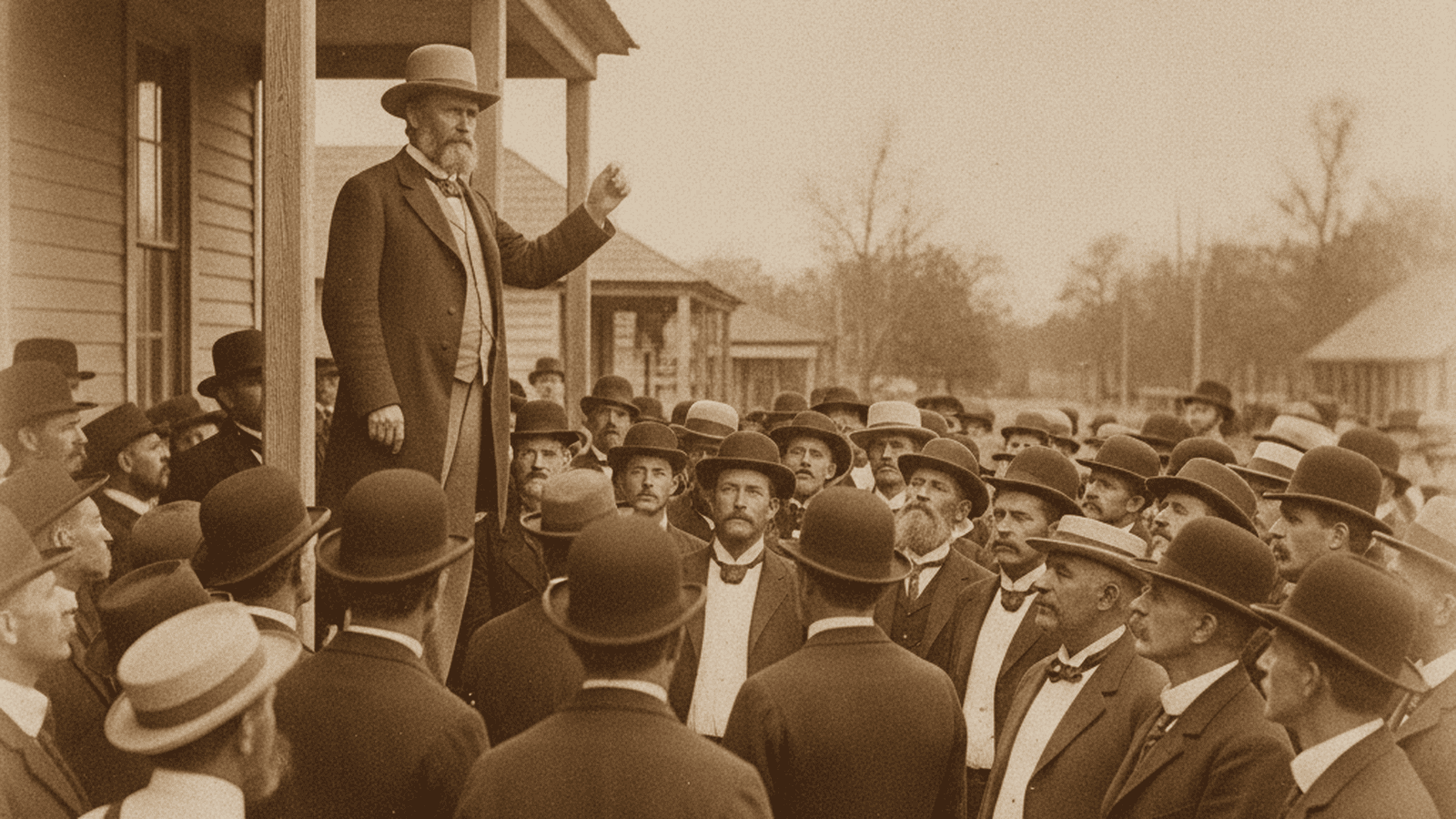
In 1893, South Carolina Governor Benjamin Tillman established a state-run liquor monopoly known as the Dispensary. This move concentrated unprecedented executive power in the United States and led to a violent 1894 confrontation between state constables and local citizens.
TLDR: Governor Benjamin Tillman’s 1893 creation of the South Carolina Dispensary established a state-run liquor monopoly that bypassed local control. The resulting 1894 “Dispensary War” saw Tillman deploy the state militia to suppress local resistance, marking a significant and controversial expansion of executive authority in the Gilded Age South.
In the early 1890s, South Carolina became the site of one of the most aggressive expansions of executive power in the history of the American South. Governor Benjamin Tillman, a populist known for his fiery rhetoric and “Pitchfork Ben” persona, sought a middle ground between the growing prohibition movement and the state’s need for tax revenue. His solution was the South Carolina State Dispensary, established in 1893. This system granted the state government a total monopoly on the bottling and sale of all alcoholic beverages, effectively turning the governor into the state’s chief liquor merchant.
The Dispensary Act bypassed local municipal authorities who had previously managed liquor licenses and collected the associated fees. By centralizing this power, Tillman aimed to fund state projects while theoretically controlling public drunkenness through state-regulated sales. However, the move was met with immediate and fierce resistance from local leaders and citizens who viewed the monopoly as a tyrannical overreach of the executive branch. Many towns refused to cooperate with the state-appointed “dispensers,” leading to a flourishing black market for “blind tiger” liquor.
Tensions reached a breaking point in March 1894. Tillman, frustrated by the lack of enforcement in the town of Darlington, dispatched a force of state constables to search for illegal alcohol. The presence of these state agents, who operated under the direct authority of the governor rather than local sheriffs, incensed the local population. On March 30, a violent confrontation erupted at the Darlington railroad station. In the ensuing gunfight, two state constables and two local citizens were killed, sparking what became known as the “Dispensary War.”
In response to the violence, Tillman exercised extraordinary executive authority. He declared martial law in Darlington and Florence counties and ordered the state militia to mobilize. In a move that foreshadowed modern debates over emergency powers, Tillman also seized control of the state’s telegraph lines to prevent the spread of news and coordination among his political opponents. This censorship was a direct assertion of executive dominance over private communication infrastructure during a domestic crisis.
The crisis deepened when several militia companies in Charleston and Columbia refused to obey Tillman’s orders. These soldiers argued that they were not bound to fire upon their own fellow citizens to enforce a liquor law they deemed unconstitutional. Tillman responded by stripping these units of their arms and commissions, eventually finding more loyal companies in the rural upstate to enforce his will. The governor’s willingness to purge the military of dissenters solidified his reputation as a leader who would brook no challenge to his executive mandates.
The Dispensary War eventually subsided as the state militia occupied the rebellious towns and restored order. However, the legal battles over the system continued for years. The South Carolina Supreme Court initially ruled the Dispensary Act unconstitutional in 1894, but Tillman simply waited for a change in the court’s composition to have the ruling overturned. The system remained in place until 1907, though it became synonymous with systemic corruption, bribery, and the enrichment of state officials.
The legacy of the South Carolina Dispensary serves as a cautionary tale regarding the centralization of commercial and police power within the executive branch. While the system was eventually abolished in favor of local option laws, the precedent of using state militia and emergency powers to override local governance left a lasting mark on Southern political culture. Later reforms in the United States focused on limiting the governor’s ability to seize private infrastructure and ensuring that state law enforcement remained subject to judicial and legislative oversight.

Miles Harrington serves as the Senior Correspondent for Federal Systems & Executive Power at Just Right News, where he brings a disciplined, constitutionalist lens to the inner workings of the American government. With a focus on the mechanics of the federal bureaucracy and the limits of executive authority, Harrington has established himself as a vital voice for readers who value transparency, accountability, and the preservation of the separation of powers.
A native of Richmond, Virginia, Harrington’s perspective is deeply rooted in the traditions of the Old Dominion. Growing up in a city defined by its historical significance and its role as a center of American jurisprudence, he developed an early appreciation for the foundational principles of the Republic. His upbringing in Richmond—a place where the legacy of the Founding Fathers is woven into the landscape—instilled in him a belief that the federal government should remain within its constitutional bounds. This background informs his skepticism of centralized overreach and his commitment to reporting on the ways in which the administrative state impacts the lives of everyday citizens.
In his current role, Harrington specializes in the complexities of federal systems. He doesn’t just report on the headlines of the day; he digs into the structural shifts within the executive branch that often go unnoticed by the mainstream press. Whether he is analyzing the implications of a new federal regulation or investigating the expansion of agency jurisdiction, his work is characterized by a rigorous adherence to the facts and a dedication to the rule of law.
Harrington is perhaps best known for his signature feature series, “How Washington Works.” Through this ongoing project, he demystifies the often-opaque processes of the nation’s capital, pulling back the curtain on the “Deep State” and the unelected officials who wield significant influence over national policy. By breaking down complex legislative maneuvers and executive orders, he empowers Just Right News readers to understand the true levers of power in Washington. His reporting serves as a necessary check on the federal government, ensuring that the actions of those in power are held up to the light of public scrutiny.
Now based in Washington, D.C., Harrington operates at the epicenter of the political world, yet he remains intentionally distanced from the “Beltway bubble.” His proximity to the halls of power allows him to maintain a robust network of sources across the federal landscape, but his heart remains in the principled conservatism of his Virginia roots. He views his role not merely as a reporter, but as a steward of the public trust, dedicated to providing the clarity and context that conservative voters need to navigate an increasingly complex political environment.
Through his sharp analysis and unwavering commitment to the truth, Miles Harrington continues to be a cornerstone of the Just Right News team. His work ensures that the principles of limited government and executive restraint remain at the forefront of the national conversation, providing a crucial service to those who believe in a government that is truly of, by, and for the people.