

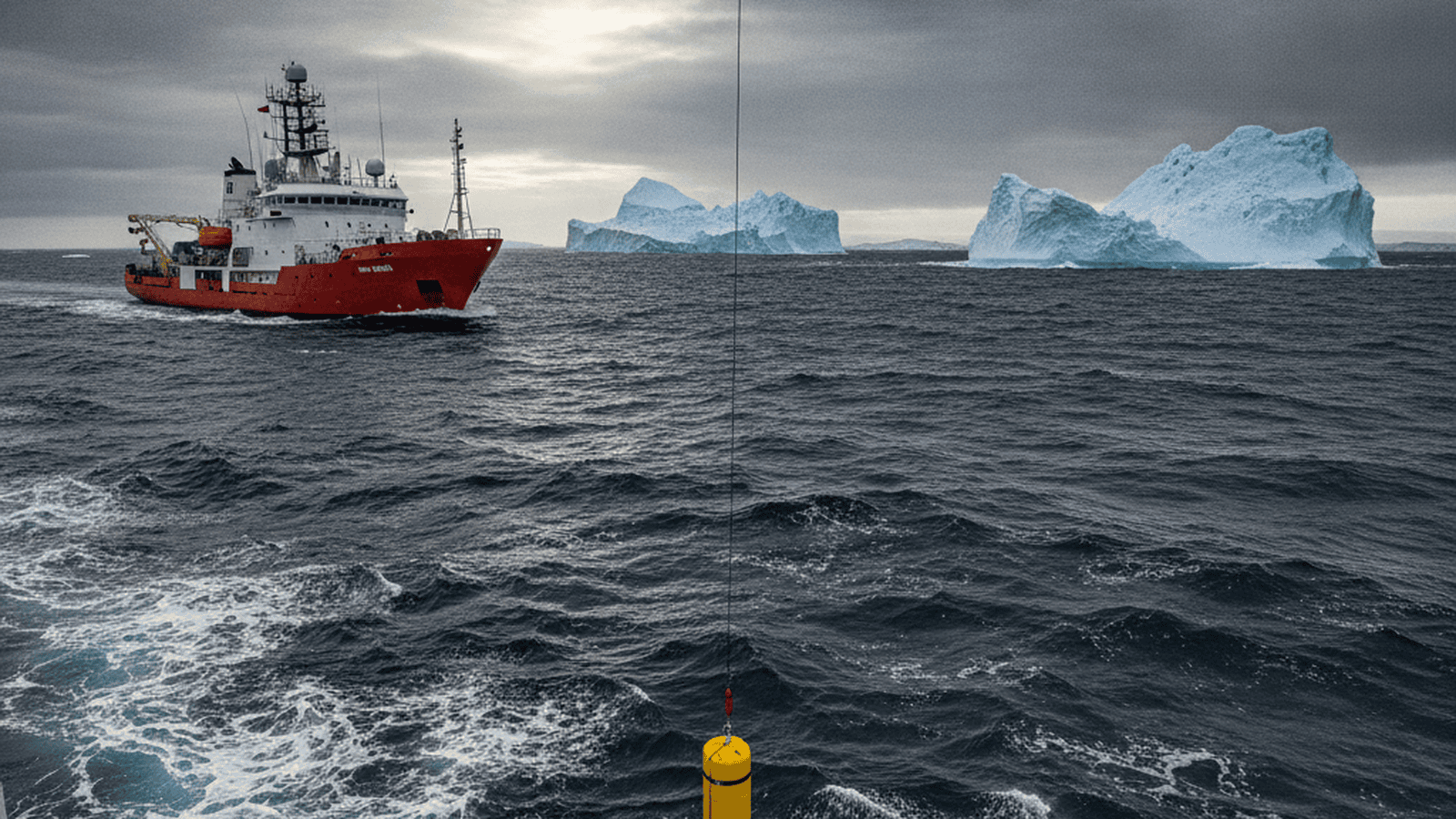
An international research team has confirmed that the Antarctic Circumpolar Current is accelerating due to rising ocean temperatures. This shift, detected through decades of satellite data and robotic sensors, threatens to destabilize Antarctic ice shelves by transporting warmer water toward the continent.
TLDR: Scientists have discovered that the Antarctic Circumpolar Current, the planet’s most powerful ocean current, is significantly speeding up. Driven by human-induced warming, this acceleration alters how heat and carbon move through the global ocean, potentially speeding up the melting of Antarctic ice and contributing to faster sea-level rise.
The Antarctic Circumpolar Current (ACC) serves as the primary engine of the global ocean circulation system. It is the only current that flows entirely around the globe, unimpeded by landmasses, connecting the Atlantic, Pacific, and Indian Oceans. Recent findings published in the journal Nature by an international team of oceanographers indicate that this massive current is accelerating at a measurable rate. This discovery provides critical evidence of how anthropogenic climate change is fundamentally altering the physical dynamics of the deep ocean.
Researchers from the Scripps Institution of Oceanography and other global institutions utilized a combination of satellite altimetry and data from the Argo program to reach these conclusions. The Argo program consists of a global network of nearly 4,000 robotic floats that measure temperature and salinity from the surface down to depths of 2,000 meters. By analyzing data spanning several decades, the team identified a clear trend of increasing kinetic energy within the ACC. This acceleration is not uniform but is concentrated in specific jets and eddies that define the current’s structure.
The primary driver of this acceleration is the warming of the Southern Ocean. As the atmosphere warms, the ocean absorbs a significant portion of the excess heat, leading to changes in water density. These density shifts, combined with intensifying westerly winds over the Southern Ocean, create a stronger pressure gradient. This gradient forces the current to move faster as it seeks to maintain equilibrium. The study highlights that the warming signal is now penetrating deep into the water column, affecting the current’s behavior far below the surface.
The implications of a faster ACC are profound for the global climate. The current acts as a buffer, largely isolating the cold waters of Antarctica from the warmer subtropical waters to the north. However, as the current speeds up, the increased kinetic energy can lead to more frequent and intense eddies. These swirling water masses can transport heat across the current’s boundaries, bringing warmer water into contact with the Antarctic continental shelf. This process is a major concern for the stability of the West Antarctic Ice Sheet, which is particularly vulnerable to basal melting from below.
Furthermore, the ACC plays a vital role in the global carbon cycle. The Southern Ocean is one of the planet’s most significant carbon sinks, absorbing approximately 40 percent of the carbon dioxide emitted by human activities. The acceleration of the current could alter the upwelling of nutrient-rich, carbon-heavy deep water. If the balance of this upwelling changes, it may reduce the ocean’s capacity to sequester atmospheric carbon, creating a feedback loop that further accelerates global warming.
This research marks a significant step in understanding the complex interactions between the atmosphere and the deep ocean. Previous models had predicted that the ACC might speed up, but the lack of long-term, high-resolution data made it difficult to confirm. The integration of satellite observations with in-situ measurements from Argo floats has provided the necessary resolution to detect these subtle but powerful shifts.
Future studies will focus on the long-term consequences of this acceleration on marine ecosystems and global sea levels. Scientists are particularly interested in how the increased current speed will affect the transport of nutrients that support the vast krill populations in the Southern Ocean. As the ACC continues to respond to a warming world, ongoing monitoring through international collaborations remains essential for predicting the trajectory of the Earth’s climate system.

Mark Davis serves as the Senior Correspondent for Energy, Climate, and Resource Economics at Just Right News. In an era where the conversation around the environment is often dominated by alarmism and top-down mandates, Mark provides a vital, market-oriented perspective on the complex forces shaping our world. As the lead voice behind the acclaimed feature series “Power and the Planet,” he explores the intersection of environmental policy, global energy markets, and the fundamental economic principles that sustain modern civilization.
Mark’s pragmatic approach to resource management was forged in the high desert of his hometown, Albuquerque, New Mexico. Growing up in a region defined by both its breathtaking natural beauty and its rugged, resource-dependent landscape, he developed an early appreciation for the delicate balance between conservation and utilization. New Mexico’s unique position as a hub for both traditional energy production and cutting-edge scientific research provided Mark with a front-row seat to the evolution of the American energy sector. This upbringing instilled in him a deep-seated belief that true environmental stewardship is inseparable from economic prosperity and technological innovation.
Now based in Boulder, Colorado, Mark operates from the heart of the nation’s climate research community. While Boulder is often seen as a bastion of environmental idealism, Mark utilizes his post to provide a necessary counterweight, grounded in the realities of resource economics. He understands that energy policy does not exist in a vacuum; it has tangible consequences for the American taxpayer, the stability of the national power grid, and the strength of the domestic manufacturing sector. By reporting from the front lines of the climate debate, he is able to challenge prevailing narratives with hard data and a commitment to the principles of the free market.
Throughout his tenure at Just Right News, Mark has distinguished himself by focusing on the “Resource Economics” aspect of his beat. He frequently highlights the hidden costs of rapid energy transitions and advocates for an “all-of-the-above” energy strategy that prioritizes American energy independence. His work often shines a light on the geopolitical implications of resource scarcity, arguing that a secure nation must first be an energy-secure nation. Whether he is analyzing the impact of federal land-use regulations or investigating the supply chains required for new technologies, Mark remains focused on how policy decisions affect the lives and livelihoods of everyday citizens.
In “Power and the Planet,” Mark continues to bridge the gap between complex scientific concepts and the economic realities facing the country. He rejects the false choice between a healthy environment and a thriving economy, instead seeking out solutions that leverage American ingenuity and private-sector competition. For Mark, reporting on the climate is not about following the latest trends, but about ensuring that the conversation remains tethered to the foundational values of liberty, property rights, and fiscal responsibility. His contributions ensure that Just Right News readers receive a comprehensive, clear-eyed view of the challenges and opportunities defining the future of our planet.