

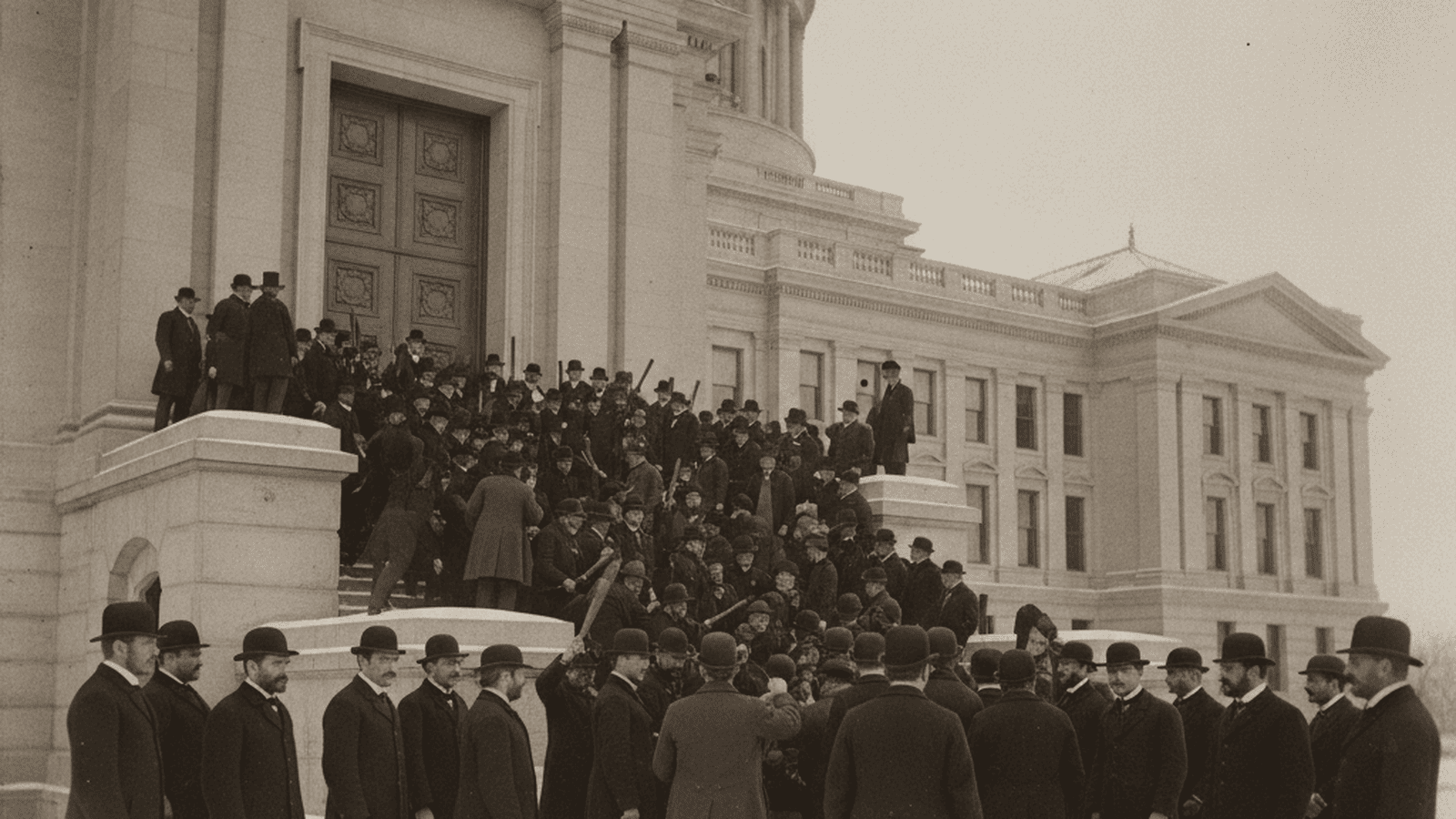
In 1893, Kansas faced a severe constitutional crisis known as the Legislative War when both Republicans and Populists claimed control of the state House of Representatives. The standoff led to the physical occupation of the statehouse and the mobilization of the militia before the Kansas Supreme Court intervened to restore order in the United States.
TLDR: The 1893 Kansas Legislative War saw rival political factions seize the statehouse in a violent dispute over election results. After Populists barricaded the chamber and the Governor called in the militia, a sledgehammer-wielding Republican mob forced entry, leading to a landmark United States judicial ruling on legislative legitimacy.
The 1892 elections in Kansas occurred against a backdrop of intense agrarian unrest and the rise of the People’s Party, commonly known as the Populists. When the votes were tallied, the results for the state House of Representatives were immediately plunged into controversy. Republicans claimed a majority of 64 seats, while Populists insisted they held the chamber through a combination of their own members and allied Democrats. This dispute set the stage for the Legislative War of 1893, a period of dual governance that tested the limits of the state’s constitutional framework.
On January 10, 1893, both factions converged on the House chamber in Topeka to organize. In an extraordinary display of political obstinacy, two separate Speakers were elected: George L. Douglass by the Republicans and J.M. Dunsmore by the Populists. For several days, both men sat on the same rostrum, attempting to out-shout one another while their respective followers conducted separate business in the same room. The two Houses even slept in the chamber to ensure they did not lose physical possession of the floor.
The situation deteriorated in February when the Populist Governor, Lorenzo D. Lewelling, recognized the Dunsmore House as the legal body. Emboldened by executive support, the Populists locked the Republicans out of the representative hall. In response, George Douglass led a group of Republicans to the statehouse, where they used a sledgehammer to smash through the locked doors. The Republicans successfully evicted the Populists and barricaded themselves inside, turning the legislative hall into a fortress.
Governor Lewelling viewed the Republican action as an insurrection and ordered the Kansas National Guard to surround the building. He commanded the militia to clear the statehouse, but the commanding officer, a Republican sympathizer, hesitated to use force against the citizens. For several tense days, the statehouse was under siege, with thousands of armed partisans from both sides flooding into Topeka. The threat of a bloody civil conflict within the capital was imminent as the militia stood between the rival mobs.
A temporary truce was eventually brokered, allowing the dispute to move from the hallways of the capitol to the chambers of the judiciary. The Republicans agreed to leave the statehouse on the condition that they would not be arrested, and both sides awaited a definitive ruling from the Kansas Supreme Court. The court, which held a Republican majority, was tasked with determining which of the two rival houses was the constitutionally valid legislative body.
In the landmark case of In re Gunn, the Kansas Supreme Court ruled in favor of the Douglass House. The justices argued that the Republican majority was legally established by the initial election returns and that the Populist attempt to organize a separate house was invalid. While the Populists decried the decision as a partisan maneuver, they ultimately yielded to the court’s authority to avoid further violence. This resolution solidified the principle of judicial supremacy in Kansas, ensuring that legal disputes over legislative legitimacy would be settled by the courts rather than by force.
The Legislative War of 1893 left a lasting mark on Kansas politics and the broader American Progressive movement. It highlighted the volatility of third-party insurgencies and the fragility of democratic institutions during periods of economic distress. In the years following the crisis, Kansas implemented more rigorous election certification procedures and strengthened the oversight of legislative organizing. The event remains a primary example of how constitutional crises at the state level can reshape the relationship between the executive, legislative, and judicial branches.

Lila Hayes serves as a Staff Writer for Just Right News, where she anchors the “Courts, Law, and Constitutional Order” beat. Her work is defined by a steadfast commitment to the foundational principles of the American republic and a rigorous defense of the legal frameworks that ensure national stability. As a primary voice for the outlet, she provides readers with a clear-eyed analysis of the judiciary, focusing on the importance of originalism and the preservation of the separation of powers.
Lila’s perspective was forged in the American heartland. Raised in St. Louis, Missouri, she grew up in a Hispanic household where the values of hard work, faith, and respect for the law were paramount. Her upbringing instilled in her a deep appreciation for the American Dream and the legal protections that make it possible. This Missouri background remains a cornerstone of her reporting, providing a grounded, common-sense counter-narrative to the often-insular legal circles of the coastal elite. She understands that the decisions made in high-court chambers have real-world consequences for families and small business owners across the country.
At Just Right News, Lila has become widely recognized for her signature feature series, “The Rulebook of Power.” In this ongoing project, she delves into the mechanics of the federal government, examining how administrative overreach and judicial activism can threaten the delicate balance of the Constitution. She approaches her beat with the tenacity of a veteran journalist and the precision of a legal scholar, consistently advocating for a judiciary that interprets the law as written rather than legislating from the bench. For Lila, the Constitution is not a “living” document subject to the whims of modern social trends; it is a fixed standard that ensures the government remains the servant of the people, not their master.
Now based in Philadelphia, Pennsylvania, Lila finds herself at the very epicenter of American constitutional history. Living and working in the city where the Founders drafted the documents she defends daily provides a constant source of inspiration. The historic halls and landmarks of Philadelphia serve as a daily reminder of the high stakes involved in her reporting. Her presence in the city allows her to bridge the gap between the historical intent of the law and its contemporary application, ensuring that the legacy of the Founding Fathers remains central to the national conversation.
Throughout her career, Lila has remained dedicated to the idea that a free society requires an informed citizenry and a transparent legal system. Her reporting is more than just a collection of headlines; it is a defense of the constitutional order that has sustained the nation for over two centuries. By focusing on the “Rulebook of Power,” she ensures that her readers understand not just what is happening in the courtrooms, but why those decisions matter for the future of American liberty. Lila Hayes continues to be a vital voice for those who believe that the law should be a shield for the citizen and a constraint on the state.