

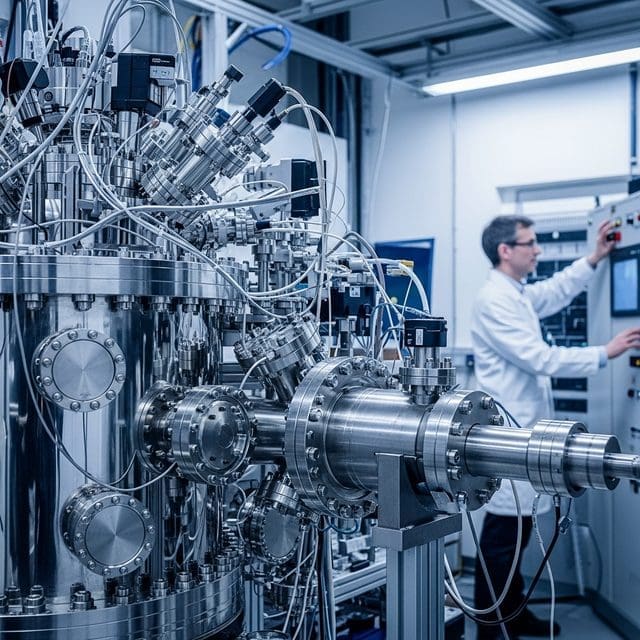
Scientists at the Paul Scherrer Institute have concluded a massive search for mirror-matter neutrons, finding no evidence of a parallel reality despite previous anomalies.
The quest to discover a parallel ‘mirror world’ has hit a significant roadblock in the Swiss Alps. Researchers at the Paul Scherrer Institute (PSI) released findings on July 28, 2026, that effectively rule out the existence of mirror neutrons—hypothetical particles that some physicists believed could explain the universe’s missing dark matter. This high-stakes search for ‘beyond-Standard-Model’ physics was conducted at the PSI Center for Neutron and Muon Sciences, where the team leveraged one of the world’s most advanced experimental setups to settle a long-standing debate in the particle physics community.
The experiment, published in Physical Review Letters, was a direct response to earlier, controversial data from the Institut Laue-Langevin (ILL) in France. Those previous measurements had suggested that neutrons might occasionally oscillate, or ‘flicker,’ into a hidden mirror state, vanishing from our detectable reality. Such a discovery would have upended our understanding of the physical laws governing the universe and suggested a complex, invisible architecture to the cosmos, potentially providing a tidy explanation for the gravitational effects of dark matter without the need for entirely new particles.
To test this theory with definitive precision, the PSI team utilized their dedicated ultracold neutron (UCN) source, a specialized spallation facility that has been operating since 2011. This facility slows neutrons down to a walking pace, allowing them to be stored and observed for several minutes. By trapping approximately 1.5 million neutrons every five minutes in a non-magnetic stainless-steel vacuum container, researchers monitored their behavior for roughly 200 seconds at a time. Over the course of the multi-month run, the team examined a staggering 25 billion neutrons, searching for any sign of disappearance that could not be explained by standard radioactive decay.
Dr. Bernhard Lauss, a lead spokesperson for the project, noted that the team meticulously varied the strength and direction of magnetic fields to scan every possible region where these oscillations might occur. The technical challenge was immense, requiring the team to maintain an environment free of magnetic interference that could mask the subtle signature of a mirror-world crossover. Despite this exhaustive search, the data showed no evidence of neutrons crossing over into a mirror state. The precision of the Swiss experiment now makes it highly probable that previous anomalies reported at the ILL were the result of experimental artifacts rather than a gateway to a parallel dimension.
While the result may seem like a disappointment to those hoping for a more exotic universe, it represents a triumph for experimental rigor and the defense of the Standard Model. By closing off this theoretical dead end, scientists can now redirect their efforts toward other dark matter candidates. The experiment also established a new global benchmark for the control of quantum particles, proving that we can now monitor the fundamental building blocks of matter with unprecedented sensitivity. This level of control is not merely academic; it is the same infrastructure that will drive future innovations in quantum information processing and high-precision sensors.
As the mirror-matter theory recedes, the infrastructure at PSI is already being repurposed for the n2EDM project. This next-generation effort will search for the neutron’s electric dipole moment, a measurement that could explain why the universe contains more matter than antimatter. For the researchers in Villigen, the lack of a mirror world is not a failure, but a necessary clarification of the boundaries of our physical reality. By stripping away the ‘ghosts’ of the mirror world, they are clearing the path for more grounded discoveries that respect the observable laws of nature.

Mason Reed serves as a Staff Writer for Just Right News, where he spearheads the Future Frontiers & Special Projects desk. In an era defined by rapid technological shifts and evolving social landscapes, Mason provides a steady, principled voice, examining the innovations of tomorrow through the lens of traditional American values. His work is most prominently featured in his signature series, “The Next Horizon,” where he explores the intersection of emerging technology, national sovereignty, and the preservation of individual liberty.
A native of San Diego, California, Mason’s worldview was shaped by the unique culture of his hometown. Growing up in a region defined by its strong military presence and its history of maritime industry, he developed a deep-seated respect for the institutions that provide national stability and the entrepreneurial spirit that drives the American economy. This upbringing instilled in him a belief that true progress is not found in discarding the past, but in building upon a foundation of proven principles. His reporting often reflects this San Diego influence, emphasizing the importance of a robust national defense and the necessity of maintaining a competitive edge in the global marketplace.
Now based in San Francisco, Mason operates from the heart of the world’s technological engine. Living and working in the Bay Area provides him with a front-row seat to the advancements—and the ideological challenges—emanating from Silicon Valley. While many in the region embrace a “move fast and break things” mentality, Mason’s reporting serves as a vital counterweight. He offers Just Right News readers a “boots on the ground” perspective, documenting how radical local policies and the concentration of tech power impact the everyday lives of citizens. His proximity to the industry allows him to cut through the marketing jargon of big tech to uncover the real-world implications for privacy, free speech, and the nuclear family.
In his “Future Frontiers” beat, Mason tackles complex subjects ranging from the ethics of artificial intelligence to the burgeoning private space race. He approaches these topics with a healthy skepticism toward centralized bureaucracy, championing instead the decentralized innovations that empower individuals. Through “The Next Horizon,” he highlights the pioneers and thinkers who are working to ensure that the future remains a place where human dignity and constitutional rights are protected. He believes that the rapid pace of change requires more than just technical expertise; it requires a moral compass rooted in the Western tradition.
Throughout his tenure at Just Right News, Mason has remained committed to the idea that the future is something to be shaped, not merely accepted. His writing is characterized by a rigorous defense of American exceptionalism and a belief that the country’s best days lie ahead, provided it remains true to its founding ideals. Whether he is investigating the impact of automation on the American workforce or profiling the next generation of aerospace engineers, Mason Reed ensures that his readers are equipped with the insights they need to navigate a changing world with confidence and clarity.