

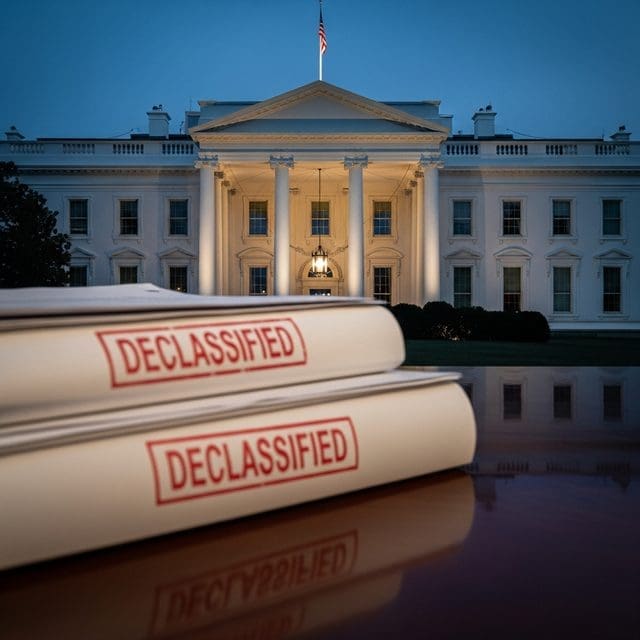
The White House released declassified records alleging massive Chinese data theft while the Department of Homeland Security threatened to withhold federal funding from states that resist new election security directives.
The White House escalated its campaign to overhaul national election procedures this week, deploying declassified intelligence and federal funding threats to pressure state officials. President Trump ordered the release of records alleging that China illicitly obtained data on 220 million U.S. voters starting in the 2020 cycle. While the administration frames this as the largest compromise of election data in history, the move has reignited friction between the executive branch and the intelligence community. Prior intelligence assessments found no evidence that foreign actors altered ballots or tabulations in 2020, and analysts note that state voter files are largely public and widely purchasable. Nevertheless, the administration is using the declassified narrative to justify a broader domestic policy shift, including a push for federalized voter-ID standards and more aggressive roll purges.
On the legislative front, House Republicans unveiled a $95 billion reconciliation package framework on July 15, which includes dedicated funding for state voter-ID implementation, defense, and farm aid. This fiscal carrot is being paired with a significant stick from the Department of Homeland Security. Secretary Markwayne Mullin has warned state officials they could face investigations or the loss of federal funding if they do not comply with the administration’s election security demands. This includes a directive to remove noncitizens from voter rolls, based on administration claims that roughly 278,000 noncitizens are registered across four key states: California, Nevada, New Jersey, and Pennsylvania. The Department of Justice has reinforced this posture, sending letters warning of potential criminal prosecution for officials who allow noncitizens to remain on active rolls.
Internationally, the rhetoric remains complex. While the President uses hostile language regarding Chinese meddling to fuel his domestic agenda, reporting indicates he continues to pursue a personal strategic bond with China’s leadership. This duality suggests the administration’s focus on Chinese interference is as much a tool for domestic legislative leverage as it is a matter of foreign policy. The Chinese Foreign Ministry has formally denied the allegations, calling them fabricated. Meanwhile, the administration is simultaneously managing escalating tensions with Iran. Following a second wave of strikes on July 15 targeting Tehran’s ability to threaten shipping in the Strait of Hormuz, the President warned that the U.S. will gradually expand strikes across Iran’s infrastructure, potentially including bridges, to curb the regime’s regional influence.
Domestically, the political landscape is further complicated by the 2026 midterm cycle. In Minnesota, the President has formally endorsed Mike Lindell for governor, while in Georgia, Senator Jon Ossoff has demonstrated significant fundraising strength, ending the second quarter with $42 million in cash for his defense against Representative Mike Collins. These political contests are unfolding against a backdrop of administrative shifts, such as the USPTO launching AI-powered image searches for trademarks and the FDA clearing new AI-based sleep analysis tools. Trade data also shows a shift in global markets, with China-CEEC trade rising 11 percent in the first half of the year, reaching 580.12 billion yuan.
The White House “Election Integrity” page and recent releases try to recast years of foreign-interference assessments as proof of a present, unprecedented security nightmare. By explicitly tying China, Russia, Iran, and Venezuela to potential compromises of U.S. infrastructure, the administration is building a case for aggressive new federal and state laws. However, fact-checking outlets and major newspapers continue to dissect the declassified documents, stressing that no evidence has been produced of changed vote totals or outcomes. As the midterms approach, the tension between the White House’s security claims and the documented findings of previous bipartisan audits remains a central flashpoint in the nation’s capital, as the administration attempts to use executive declassification to drive a fundamental shift in how American elections are managed.

Miles Harrington serves as the Senior Correspondent for Federal Systems & Executive Power at Just Right News, where he brings a disciplined, constitutionalist lens to the inner workings of the American government. With a focus on the mechanics of the federal bureaucracy and the limits of executive authority, Harrington has established himself as a vital voice for readers who value transparency, accountability, and the preservation of the separation of powers.
A native of Richmond, Virginia, Harrington’s perspective is deeply rooted in the traditions of the Old Dominion. Growing up in a city defined by its historical significance and its role as a center of American jurisprudence, he developed an early appreciation for the foundational principles of the Republic. His upbringing in Richmond—a place where the legacy of the Founding Fathers is woven into the landscape—instilled in him a belief that the federal government should remain within its constitutional bounds. This background informs his skepticism of centralized overreach and his commitment to reporting on the ways in which the administrative state impacts the lives of everyday citizens.
In his current role, Harrington specializes in the complexities of federal systems. He doesn’t just report on the headlines of the day; he digs into the structural shifts within the executive branch that often go unnoticed by the mainstream press. Whether he is analyzing the implications of a new federal regulation or investigating the expansion of agency jurisdiction, his work is characterized by a rigorous adherence to the facts and a dedication to the rule of law.
Harrington is perhaps best known for his signature feature series, “How Washington Works.” Through this ongoing project, he demystifies the often-opaque processes of the nation’s capital, pulling back the curtain on the “Deep State” and the unelected officials who wield significant influence over national policy. By breaking down complex legislative maneuvers and executive orders, he empowers Just Right News readers to understand the true levers of power in Washington. His reporting serves as a necessary check on the federal government, ensuring that the actions of those in power are held up to the light of public scrutiny.
Now based in Washington, D.C., Harrington operates at the epicenter of the political world, yet he remains intentionally distanced from the “Beltway bubble.” His proximity to the halls of power allows him to maintain a robust network of sources across the federal landscape, but his heart remains in the principled conservatism of his Virginia roots. He views his role not merely as a reporter, but as a steward of the public trust, dedicated to providing the clarity and context that conservative voters need to navigate an increasingly complex political environment.
Through his sharp analysis and unwavering commitment to the truth, Miles Harrington continues to be a cornerstone of the Just Right News team. His work ensures that the principles of limited government and executive restraint remain at the forefront of the national conversation, providing a crucial service to those who believe in a government that is truly of, by, and for the people.