

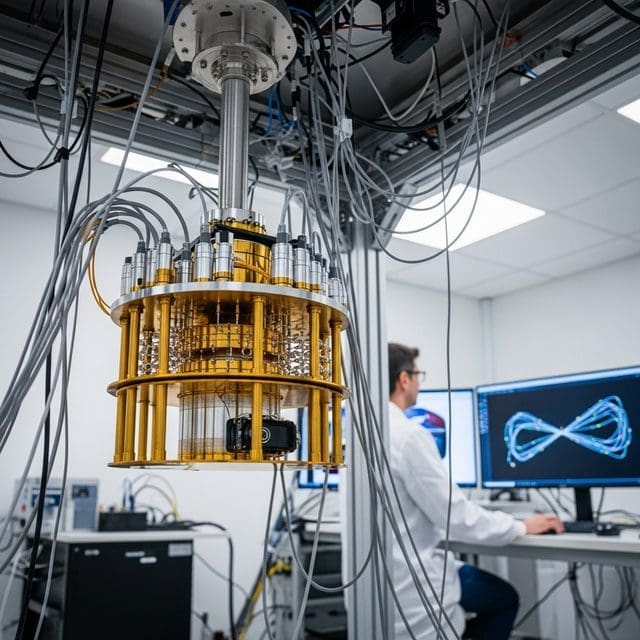
Cornell and Google researchers have successfully demonstrated non-Abelian anyons, a discovery that could finally unlock error-resistant, universal quantum computers.
In the high-stakes race for technological supremacy, the quest for a stable quantum computer has long been hindered by the extreme fragility of quantum information. This week, a landmark collaboration between Cornell University and Google Quantum AI has signaled a turning point. By successfully demonstrating the existence and control of “non-Abelian anyons” on a superconducting processor, researchers have moved a theoretical dream into the realm of experimental reality, providing a potential blueprint for the next generation of American computational power.
For nearly forty years, the scientific community has pursued these exotic, two-dimensional particles as the “holy grail” of quantum computing. Unlike standard qubits, which are easily disrupted by the slightest environmental noise or thermal fluctuation, non-Abelian anyons possess a unique topological protection. When these particles are “braided”—moved around one another in specific patterns—they create quantum states that are inherently resistant to errors. This discovery, led by Professor Eun-Ah Kim of Cornell, represents the first clear demonstration of such particles in a programmable environment, effectively bridging the gap between abstract condensed-matter theory and practical hardware engineering.
The implications for American industry and national sovereignty are significant. As decentralized innovation continues to challenge centralized bureaucratic control, the ability to process complex simulations—from fluid dynamics to advanced cryptography—becomes a matter of national importance. This week also saw Quantinuum, Rolls-Royce, and the University of Edinburgh join forces to explore how fault-tolerant quantum computing can revolutionize industrial design. These parallel tracks of discovery and application suggest that the era of “noisy” quantum devices may soon give way to a new generation of reliable, universal machines that can run any algorithm with the same versatility an ordinary laptop offers.
Beyond the headline-grabbing work at Cornell and Google, the broader physics community is seeing a surge of activity aimed at stabilizing the quantum frontier. At Aalto University, researchers demonstrated the first cyclic quantum heat engine inside a superconducting circuit, a vital step in understanding the thermodynamics of these microscopic systems. Simultaneously, the Institute of Science and Technology Austria has realized an autonomous method for distributed entanglement using a quantum bath of correlated light particles. These developments, alongside new techniques from the University of Innsbruck to certify that quantum measurements cannot be mimicked by simpler classical means, indicate a maturing field that is moving beyond mere theory into rigorous, verifiable application.
While the technical details of topological systems and Greenberger–Horne–Zeilinger states may seem abstract to the layman, the core achievement is one of order over chaos. By harnessing the laws of physics to protect information at the most fundamental level, these researchers are building a foundation for a future where American computational power is both robust and secure. This is not merely a laboratory curiosity; it is the blueprint for a decentralized technological infrastructure that resists the fragility of current digital systems. The work directly addresses the central barrier to practical quantum computing: how to build universal, error-resilient machines rather than specialized, fragile devices that require constant oversight.
Looking ahead, the challenge remains in scaling these systems while maintaining the integrity of the topological protection. However, with the successful demonstration of braiding on superconducting circuits, the path toward a universal quantum computer is now visible. As this technology matures, it will be essential to ensure that such powerful tools remain in the service of individual liberty and transparent innovation. The ability to simulate the natural world with perfect precision is a double-edged sword, but in the hands of principled American innovators, it represents a frontier that can secure our national interests and preserve the constitutional values of privacy and sovereignty in an increasingly digital world.

Mason Reed serves as a Staff Writer for Just Right News, where he spearheads the Future Frontiers & Special Projects desk. In an era defined by rapid technological shifts and evolving social landscapes, Mason provides a steady, principled voice, examining the innovations of tomorrow through the lens of traditional American values. His work is most prominently featured in his signature series, “The Next Horizon,” where he explores the intersection of emerging technology, national sovereignty, and the preservation of individual liberty.
A native of San Diego, California, Mason’s worldview was shaped by the unique culture of his hometown. Growing up in a region defined by its strong military presence and its history of maritime industry, he developed a deep-seated respect for the institutions that provide national stability and the entrepreneurial spirit that drives the American economy. This upbringing instilled in him a belief that true progress is not found in discarding the past, but in building upon a foundation of proven principles. His reporting often reflects this San Diego influence, emphasizing the importance of a robust national defense and the necessity of maintaining a competitive edge in the global marketplace.
Now based in San Francisco, Mason operates from the heart of the world’s technological engine. Living and working in the Bay Area provides him with a front-row seat to the advancements—and the ideological challenges—emanating from Silicon Valley. While many in the region embrace a “move fast and break things” mentality, Mason’s reporting serves as a vital counterweight. He offers Just Right News readers a “boots on the ground” perspective, documenting how radical local policies and the concentration of tech power impact the everyday lives of citizens. His proximity to the industry allows him to cut through the marketing jargon of big tech to uncover the real-world implications for privacy, free speech, and the nuclear family.
In his “Future Frontiers” beat, Mason tackles complex subjects ranging from the ethics of artificial intelligence to the burgeoning private space race. He approaches these topics with a healthy skepticism toward centralized bureaucracy, championing instead the decentralized innovations that empower individuals. Through “The Next Horizon,” he highlights the pioneers and thinkers who are working to ensure that the future remains a place where human dignity and constitutional rights are protected. He believes that the rapid pace of change requires more than just technical expertise; it requires a moral compass rooted in the Western tradition.
Throughout his tenure at Just Right News, Mason has remained committed to the idea that the future is something to be shaped, not merely accepted. His writing is characterized by a rigorous defense of American exceptionalism and a belief that the country’s best days lie ahead, provided it remains true to its founding ideals. Whether he is investigating the impact of automation on the American workforce or profiling the next generation of aerospace engineers, Mason Reed ensures that his readers are equipped with the insights they need to navigate a changing world with confidence and clarity.