

President Trump overruled a DHS pause on immigration traffic stops and prepared a national address amid escalating strikes in Iran and a shifting Senate majority.
The executive branch and the halls of Congress faced a series of rapid shifts this week as President Trump asserted direct control over immigration enforcement and foreign policy. On Wednesday, the President moved to reverse a Department of Homeland Security (DHS) order that had temporarily suspended vehicle and traffic stops by Immigration and Customs Enforcement (ICE). The pause, characterized by officials as a short-term review, was initiated following two fatal shooting incidents involving agents in Texas and Maine. While DHS leadership had called for a re-evaluation of training, the President framed the stops as a vital crime-fighting tool that would not be halted.
This move signals a rejection of administrative caution in favor of maintaining aggressive enforcement tactics. The administration is now moving to accelerate body-camera deployment for officers, a policy addition intended to address bipartisan concerns over transparency without sacrificing operational capacity. This enforcement push coincides with a proposed $100,000 bond requirement for certain green-card applicants abroad. This fiscal barrier, targeting foreigners with limited financial means, represents a significant restructuring of legal immigration channels toward a model based on financial capability.
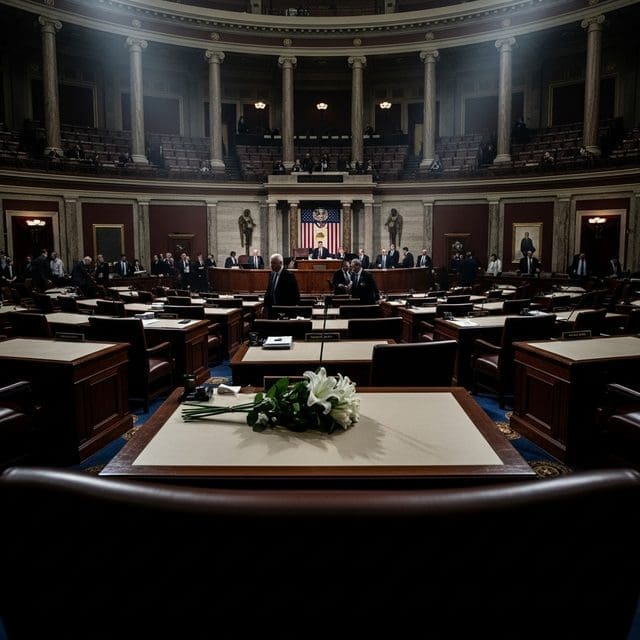
Simultaneously, the Senate underwent a somber transition. The seat of the late Senator Lindsey Graham was draped in black as his sister, Darline Graham, was sworn in to serve the remainder of his term. This appointment stabilizes the Republican majority at 51 seats during a critical summer work period, though it does not resolve the long-term uncertainty regarding the Judiciary Committee’s future leadership. The tightening of the Senate math comes as Senator Jon Ossoff (D-Ga.) reported a $20 million fundraising haul for the second quarter, signaling a high-stakes battle for chamber control in the 2026 midterms.
On the legislative front, House Republicans introduced a $95 billion reconciliation framework. The package emphasizes defense spending, farm aid, and federal support for state-level voter ID implementation. This fiscal roadmap arrives just as the President prepares for a 9 p.m. national address tonight. While the White House has not specified the topic, the President suggested the tone would mirror his previous addresses at Mount Rushmore, likely emphasizing national sovereignty and the 250th anniversary of the Declaration of Independence.
However, the backdrop of the speech is dominated by a deteriorating situation in the Middle East. Following a second wave of strikes against Iranian infrastructure on July 15, the President warned of a gradual expansion of military operations. Reports indicate the administration is weighing strikes against Iranian bridges to degrade Tehran’s ability to threaten maritime traffic in the Strait of Hormuz. These strikes specifically target Tehran’s capacity to harass shipping lanes, a move the administration argues is necessary for trade security.
As the President prepares to speak, the intersection of domestic enforcement and the specter of expanded conflict suggests a pivotal moment for executive power. The President’s decision to overrule DHS leadership on ICE tactics, combined with the aggressive posture toward Iran, underscores a preference for unilateral action as the 2026 election cycle intensifies.

Miles Harrington serves as the Senior Correspondent for Federal Systems & Executive Power at Just Right News, where he brings a disciplined, constitutionalist lens to the inner workings of the American government. With a focus on the mechanics of the federal bureaucracy and the limits of executive authority, Harrington has established himself as a vital voice for readers who value transparency, accountability, and the preservation of the separation of powers.
A native of Richmond, Virginia, Harrington’s perspective is deeply rooted in the traditions of the Old Dominion. Growing up in a city defined by its historical significance and its role as a center of American jurisprudence, he developed an early appreciation for the foundational principles of the Republic. His upbringing in Richmond—a place where the legacy of the Founding Fathers is woven into the landscape—instilled in him a belief that the federal government should remain within its constitutional bounds. This background informs his skepticism of centralized overreach and his commitment to reporting on the ways in which the administrative state impacts the lives of everyday citizens.
In his current role, Harrington specializes in the complexities of federal systems. He doesn’t just report on the headlines of the day; he digs into the structural shifts within the executive branch that often go unnoticed by the mainstream press. Whether he is analyzing the implications of a new federal regulation or investigating the expansion of agency jurisdiction, his work is characterized by a rigorous adherence to the facts and a dedication to the rule of law.
Harrington is perhaps best known for his signature feature series, “How Washington Works.” Through this ongoing project, he demystifies the often-opaque processes of the nation’s capital, pulling back the curtain on the “Deep State” and the unelected officials who wield significant influence over national policy. By breaking down complex legislative maneuvers and executive orders, he empowers Just Right News readers to understand the true levers of power in Washington. His reporting serves as a necessary check on the federal government, ensuring that the actions of those in power are held up to the light of public scrutiny.
Now based in Washington, D.C., Harrington operates at the epicenter of the political world, yet he remains intentionally distanced from the “Beltway bubble.” His proximity to the halls of power allows him to maintain a robust network of sources across the federal landscape, but his heart remains in the principled conservatism of his Virginia roots. He views his role not merely as a reporter, but as a steward of the public trust, dedicated to providing the clarity and context that conservative voters need to navigate an increasingly complex political environment.
Through his sharp analysis and unwavering commitment to the truth, Miles Harrington continues to be a cornerstone of the Just Right News team. His work ensures that the principles of limited government and executive restraint remain at the forefront of the national conversation, providing a crucial service to those who believe in a government that is truly of, by, and for the people.