

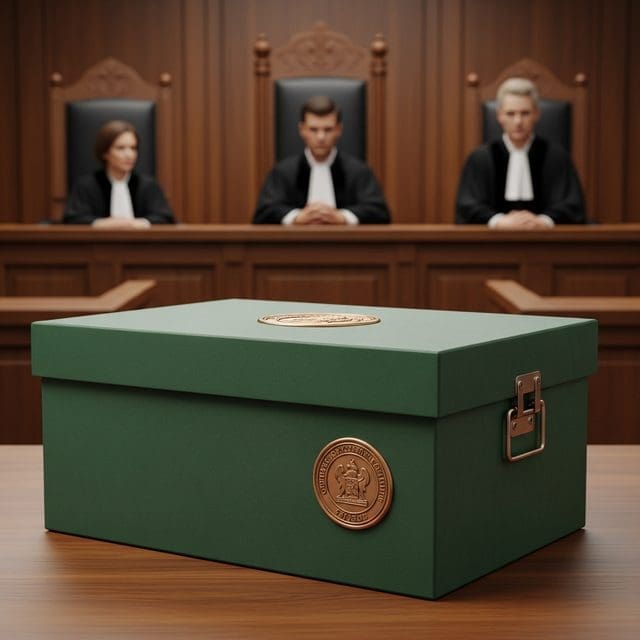
Philippine Senate judges delayed a decision on subpoenas for Vice President Sara Duterte’s bank and tax records following intense oral arguments regarding constitutional authority and privacy.
The Senate impeachment trial of Vice President Sara Duterte reached a critical procedural impasse this week as judges deferred action on a prosecutorial request to subpoena extensive financial records. Following oral arguments held on July 15, the tribunal announced it would delay its ruling until Monday, July 20, 2026. The decision will determine whether the court grants access to the Vice President’s tax filings, bank accounts, and records held by the Anti-Money Laundering Council (AMLC). This delay marks a significant pause in Day 6 of the proceedings, as the court shifts its focus from witness testimony to the legalities of document disclosure.
This latest development follows the return of a “green box” of tax records to the Bureau of Internal Revenue (BIR) earlier this month. Prosecutors, led by Chel Diokno, have now filed a fresh and broader subpoena request seeking an expanded list of documents. The request covers not only the Vice President but also her husband, Mans Carpio, and their associated business interests. Diokno argued before the court that the disclosure is a constitutional necessity to ensure the truth is made public, framing the records as essential evidence for the tribunal’s mandate. He signaled a strategic push to frame the disclosure as a constitutional duty rather than mere evidentiary housekeeping.
The defense team has moved to block the subpoenas, characterizing the request as “fatally overbroad.” Defense attorneys argued that the scope of the inquiry improperly includes years prior to Duterte’s term as Vice President, spanning back to her time in local government. Furthermore, they contended that the inclusion of Carpio is legally unsound, as he is not an impeachable officer under Philippine law. The defense maintains that the prosecution is attempting a fishing expedition that violates statutory privacy protections and exceeds the jurisdictional limits of an impeachment trial.
Adding to the legal complexity, officials from the BIR have signaled their own hesitation. According to internal documentation and trial testimony, bureau officials warned they could face criminal liability under Section 270 of the National Internal Revenue Code if they release tax records without an explicit and final order from the impeachment tribunal. This statutory conflict has placed the BIR in a precarious position between prosecutorial demands and the risk of prosecution for unauthorized disclosure. The question remains whether these records will be presented anew or if the previous sealing of the “green box” will remain the status quo.
As the Senate weighs these competing interests, the case highlights the tension between government transparency and the privacy rights of elected officials. The upcoming July 20 ruling is expected to set the evidentiary boundaries for the remainder of the trial. For now, the records remain sealed, leaving the prosecution’s primary financial narrative on hold while the court deliberates on the limits of its subpoena power. The stakes are high, as the ruling will dictate if the public gains a window into the financial history of the Duterte-Carpio family businesses.
While the Philippine Senate grapples with these domestic records, international law enforcement is engaged in its own document-heavy financial probes. Europol recently confirmed its support for a major operation led by the German Krefeld Public Prosecutor’s Office targeting amphetamine producers. These parallel developments in Germany and the Philippines underscore a global trend of prosecutorial reliance on cross-border financial and criminal records to build complex cases. In both instances, the success of the investigation hinges on the legal authority to pierce through layers of privacy and institutional resistance to access primary source documentation. Whether in Manila or North Rhine-Westphalia, the paper trail remains the ultimate arbiter of accountability.
In the Duterte trial, the shift from witness testimony to oral arguments over bank and AMLC records marks a strategic pivot. Prosecutors are no longer relying solely on verbal accounts but are instead seeking the hard data of the financial trail to substantiate their claims. The outcome of the July 20 session will signal whether the Senate intends to act as a rigorous watchdog or if the administrative protections surrounding the Vice Presidency will remain impenetrable. For those advocating for government accountability, the focus remains squarely on the documents that have yet to be seen.
Ben Taylor serves as the Senior Correspondent and Investigations Lead for Just Right News, where he anchors the network’s commitment to government transparency and institutional accountability. With a career defined by a relentless pursuit of the facts, Taylor spearheads the acclaimed feature series “The Paper Trail,” a deep-dive investigative column that prioritizes primary source documentation over political rhetoric. Based in the heart of the nation’s capital, he has earned a reputation as one of the most formidable investigative journalists in Washington, D.C., known specifically for his mastery of public records and the Freedom of Information Act.
Taylor’s approach to journalism is deeply rooted in his upbringing in Kansas City, Missouri. Growing up in the “Show Me State,” he developed a healthy skepticism of centralized power and a profound respect for the common-sense values of the American heartland. This Midwestern foundation informs his reporting today, as he bridges the gap between the complex machinations of federal bureaucracy and the everyday concerns of citizens across the country. For Taylor, investigative reporting is not about chasing headlines; it is about ensuring that the government remains answerable to the people it serves.
As an African American man working within the conservative media landscape, Taylor brings a principled perspective to his beat. He views the Constitution and the right to information as the ultimate equalizers in a free society. His work often highlights how bureaucratic overreach and lack of transparency disproportionately affect individual liberties. By focusing on the “paper trail,” Taylor strips away the spin of partisan talking points, instead providing Just Right News readers with the raw data and internal communications that reveal how their tax dollars are spent and how policy decisions are actually made.
In his role as Investigations Lead, Taylor oversees a team dedicated to uncovering the stories that mainstream outlets often overlook. Whether he is auditing federal spending, investigating regulatory overreach, or exposing inefficiencies within the administrative state, his methodology remains consistent: follow the evidence wherever it leads. His presence in Washington, D.C., allows him to maintain a constant watch over the halls of power, yet he remains steadfastly connected to his roots, ensuring his reporting reflects the clarity and directness of his Missouri home.
Throughout his tenure at Just Right News, Taylor has become a vital voice for those who demand integrity in public office. He believes that a well-informed electorate is the strongest defense against government overreach, and he has dedicated his career to providing the public with the tools they need to hold their leaders accountable. Through “The Paper Trail” and his broader investigative work, Ben Taylor continues to set the standard for rigorous, document-driven journalism that champions the values of transparency, individual responsibility, and the rule of law.