

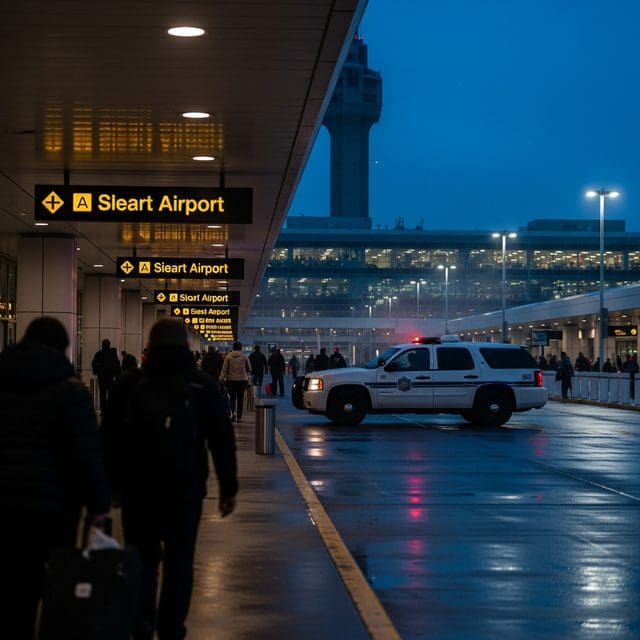
Immigration agents aborted a Las Vegas arrest after bystanders physically blocked vehicles, highlighting rising friction between federal enforcement and public obstruction in transit hubs.
A routine immigration enforcement action at Harry Reid International Airport escalated into a public confrontation this week, as bystanders reportedly intervened to prevent federal agents from taking a Vietnamese national into custody. The incident underscores the challenges faced by U.S. Immigration and Customs Enforcement (ICE) when operating in high-traffic public spaces where civil resistance can disrupt the rule of law. The disruption represents a significant moment in the ongoing tension between federal mandates and local public sentiment regarding the removal of foreign nationals who have violated entry terms.
According to agency reports, ICE agents attempted to arrest 57-year-old Phu Nguyen at the Las Vegas airport. During the encounter, bystanders reportedly moved to block the agents’ vehicles and physically intervened. To avoid escalation or potential injury, agents made the tactical decision to abort the on-site arrest. While no injuries or use of force by ICE officers were reported, federal authorities are reviewing the conduct of the bystanders. Under federal standards, while the public may record enforcement actions, physically blocking vehicles or concealing a subject can lead to criminal charges for obstruction.
Following the disruption in Las Vegas, Nguyen traveled to California, where he was taken into custody at Los Angeles International Airport (LAX) on Tuesday. ICE Los Angeles confirmed the arrest, stating that Nguyen had overstayed his visa. While the agency characterized the LAX operation as a successful follow-up, the initial failure in Las Vegas raises questions regarding the security of federal operations at major transit hubs. It remains unclear whether this interference was a spontaneous reaction from travelers or part of an organized effort to resist immigration enforcement at sensitive locations.
This incident occurs against a backdrop of complex international and domestic pressures. On July 15, 2026, Bell Integration joined the United Nations Global Compact, signaling a broader corporate commitment to responsible practices, yet the ground-level reality of migration enforcement remains fraught. Simultaneously, diplomatic tensions have risen; Mexico recently requested that U.S. state attorneys open criminal investigations into the deaths of at least 17 Mexican nationals in ICE custody during the second Trump term. These deaths have placed the agency under intense scrutiny as it attempts to maintain the integrity of the nation’s borders and visa programs.
The legal boundaries for public interaction with immigration enforcement are increasingly relevant as demographic shifts shape community character. Current public information does not yet clarify Nguyen’s full immigration history, including the specific visa category he held or whether he has any pending claims for asylum. Furthermore, there is no detailed public description of ICE’s internal guidelines for airport enforcement following recent directives on vehicle stops, leaving it unclear if field office protocols were modified in response to this event.
As the Zero Gap Fund reports sustaining over $1 billion for UN Sustainable Development Goals as of July 2026, the mechanics of the U.S. social contract are being tested. The ability of federal agencies to execute standard enforcement operations without public interference is a critical component of maintaining the rule of law. The review of the Harry Reid International Airport incident will likely serve as a benchmark for how the Department of Homeland Security balances public safety with the necessity of enforcing visa compliance in a polarized environment.

Julie Harris serves as a Staff Writer for Just Right News, where she tackles some of the most pressing and complex issues facing the nation today. As the lead reporter for the Migration, Demographics & Cultural Shifts beat, Julie provides a grounded, principled perspective on how the movement of people and the changing makeup of communities are reshaping the American landscape. Her work is defined by a commitment to exploring the long-term consequences of social change, prioritizing the stability of local institutions and the preservation of national identity.
Her deep understanding of these issues is rooted in her upbringing in Tucson, Arizona. Growing up in a prominent border state, Julie witnessed firsthand the intricate realities of migration and the profound impact it has on local infrastructure, law enforcement, and the social fabric. This early exposure instilled in her a respect for the rule of law and a keen awareness of the challenges that arise when federal policies fail to align with the needs of border communities. Her reporting often reflects this lived experience, bringing a necessary level of nuance to topics that are often treated with abstraction in coastal newsrooms.
Now based in Santa Fe, New Mexico, Julie continues to report from the heart of the American Southwest. Her location provides a unique vantage point to observe the intersection of traditional regional cultures and the modern shifts brought about by both internal and external migration. In Santa Fe, a city defined by its rich history and distinct cultural heritage, she finds a perfect environment to explore how communities strive to maintain their character while navigating the pressures of a rapidly changing world. This perspective allows her to bridge the gap between policy debates in Washington and the reality of life in the high desert.
At Just Right News, Julie’s work is characterized by a dedication to examining the data and the human stories that define the “New Mosaic” of America. Her signature feature series, “The New Mosaic,” has become a cornerstone of her reporting. Through this series, Julie explores the evolving social architecture of the United States, documenting how shifts in population affect everything from local economies to the political landscape. She brings a critical eye to the narrative of demographic inevitability, instead asking how these shifts impact the average citizen’s sense of belonging and the integrity of the American social contract.
Julie’s background and her dedication to conservative principles make her a vital voice in contemporary journalism. She understands that demographics are more than just numbers on a spreadsheet; they represent the future of the American family and the nation’s enduring legacy. Through her diligent reporting and insightful analysis, Julie Harris ensures that her readers are informed about the forces shaping their world, providing a perspective that is as thoughtful as it is necessary for the modern era.