

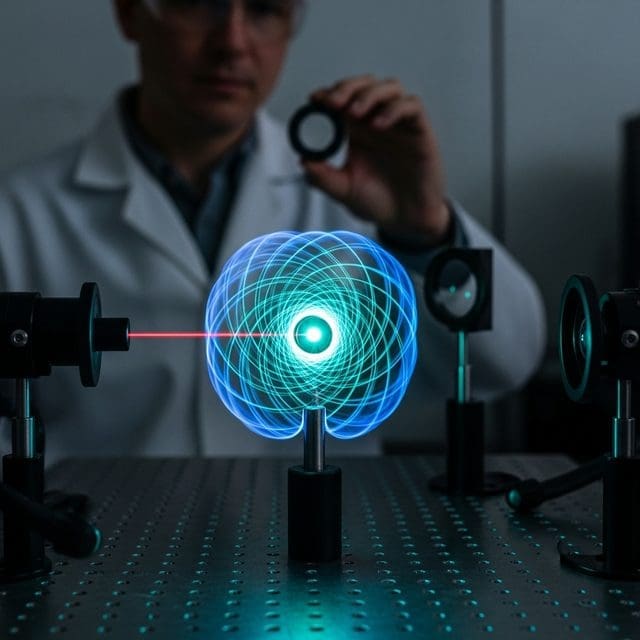
Researchers at Nanyang Technological University have simplified the creation of optical skyrmions, potentially revolutionizing data storage by repurposing a 200-year-old discovery known as the Poisson spot.
In the race for technological supremacy, the most sophisticated solutions often emerge from the most unexpected places. This week, physicists at Nanyang Technological University (NTU) in Singapore demonstrated that the path to the future of quantum computing may be paved with insights from the early 19th century. By revisiting the Poisson spot—a phenomenon first observed in 1818—researchers have unlocked a remarkably simple method for creating optical skyrmions. This finding represents a significant shift toward accessible innovation that could bypass the expensive, centralized gatekeepers of modern tech.
Optical skyrmions are exotic, swirl-like structures of light that behave like particles. Because they are incredibly stable and can be packed tightly together, they are considered a holy grail for the next generation of high-density data storage and quantum information processing. Until now, generating these structures required complex laboratory setups involving intricate laser arrays and high-precision modulators. The NTU team bypassed these hurdles by utilizing the Poisson spot, a bright point of light that appears in the center of a shadow when light travels around a circular object. This elegant use of classical physics to solve a modern quantum challenge suggests that principled innovation can still outpace bloated, high-cost projects.
This breakthrough is part of a broader wave of fundamental discoveries shaking the foundations of physics this July. While NTU simplifies the light we can see, other researchers are uncovering the complexities of the matter we cannot. New studies suggest that dark matter—the invisible substance making up the bulk of the universe’s mass—is not a single, uniform entity. Instead, it may consist of at least two distinct particle types that slowly drift apart over time, with heavier components separating from lighter ones. This finding challenges long-held assumptions about cosmic stability and underscores the importance of maintaining a rigorous approach to established scientific dogmas.
Further expanding our understanding of the extreme universe, scientists have developed a new thermodynamic framework for real, time-evolving black holes. Previous models relied on idealized, static versions of these gravitational giants. The new framework accounts for black holes that grow and change, providing a more accurate tool for testing the laws of physics under intense conditions. This theoretical leap is grounded in recent observational triumphs, such as NASA’s Hubble Space Telescope identifying the first stellar-mass black hole in the star cluster Omega Centauri using archival data and newer Webb observations. It proves that even old data yields revolutionary insights when viewed through a fresh, independent lens.
For the American innovator, these developments are a reminder that the frontiers of science remain open to those who value technical mastery. The ability to manipulate light at such a granular level using simple methods like the Poisson spot could eventually move quantum computing out of the hands of centralized tech giants and into the workshops of independent engineers. As we look toward a future of fault-tolerant quantum systems—highlighted by recent industrial agreements between Quantinuum and Rolls-Royce—the focus must remain on ensuring these technologies serve to empower the individual and secure national sovereignty.
Whether it is the realization of autonomous methods for distributed entanglement at the Institute of Science and Technology Austria or the integration of agentic web search on platforms like Gemini, the trend is clear: the quantum age is arriving faster than the regulators can track. The discovery at NTU proves that the tools of the past are often the keys to the future, provided we have the vision to use them.

Mason Reed serves as a Staff Writer for Just Right News, where he spearheads the Future Frontiers & Special Projects desk. In an era defined by rapid technological shifts and evolving social landscapes, Mason provides a steady, principled voice, examining the innovations of tomorrow through the lens of traditional American values. His work is most prominently featured in his signature series, “The Next Horizon,” where he explores the intersection of emerging technology, national sovereignty, and the preservation of individual liberty.
A native of San Diego, California, Mason’s worldview was shaped by the unique culture of his hometown. Growing up in a region defined by its strong military presence and its history of maritime industry, he developed a deep-seated respect for the institutions that provide national stability and the entrepreneurial spirit that drives the American economy. This upbringing instilled in him a belief that true progress is not found in discarding the past, but in building upon a foundation of proven principles. His reporting often reflects this San Diego influence, emphasizing the importance of a robust national defense and the necessity of maintaining a competitive edge in the global marketplace.
Now based in San Francisco, Mason operates from the heart of the world’s technological engine. Living and working in the Bay Area provides him with a front-row seat to the advancements—and the ideological challenges—emanating from Silicon Valley. While many in the region embrace a “move fast and break things” mentality, Mason’s reporting serves as a vital counterweight. He offers Just Right News readers a “boots on the ground” perspective, documenting how radical local policies and the concentration of tech power impact the everyday lives of citizens. His proximity to the industry allows him to cut through the marketing jargon of big tech to uncover the real-world implications for privacy, free speech, and the nuclear family.
In his “Future Frontiers” beat, Mason tackles complex subjects ranging from the ethics of artificial intelligence to the burgeoning private space race. He approaches these topics with a healthy skepticism toward centralized bureaucracy, championing instead the decentralized innovations that empower individuals. Through “The Next Horizon,” he highlights the pioneers and thinkers who are working to ensure that the future remains a place where human dignity and constitutional rights are protected. He believes that the rapid pace of change requires more than just technical expertise; it requires a moral compass rooted in the Western tradition.
Throughout his tenure at Just Right News, Mason has remained committed to the idea that the future is something to be shaped, not merely accepted. His writing is characterized by a rigorous defense of American exceptionalism and a belief that the country’s best days lie ahead, provided it remains true to its founding ideals. Whether he is investigating the impact of automation on the American workforce or profiling the next generation of aerospace engineers, Mason Reed ensures that his readers are equipped with the insights they need to navigate a changing world with confidence and clarity.