

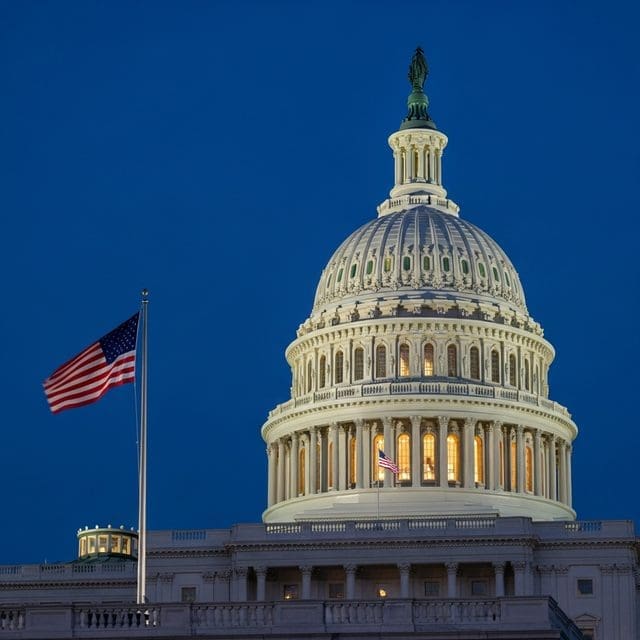
President Trump pivoted from shipping tolls to Gulf trade deals as the Iran conflict intensifies, while Supreme Court justices seek emergency security funding from Congress following a surge in threats.
The White House significantly recalibrated its economic and military posture in the Middle East this week, as President Trump announced a pivot in the administration’s strategy regarding the Strait of Hormuz. On July 15, the President scrapped a controversial proposal to levy a 20 percent toll on all cargo shipped through the waterway. This reversal comes just as the United States military reinstates a formal naval blockade of Iranian ports, a move triggered by Tehran’s repeated attacks on commercial shipping. Rather than the unilateral fee, which critics suggested might violate international law, the administration is now pursuing a framework of trade and investment deals with Gulf states to stabilize the region’s economic architecture.
This policy shift occurs against a backdrop of escalating military engagement and a rising human cost. U.S. Central Command conducted its fourth consecutive day of airstrikes against Iranian targets on July 14, aimed at neutralizing emerging threats to global energy corridors. The conflict, which has now spanned more than four months, claimed its 14th American life this week. Navy Commander Gabriel Edwards died following a crash over the Arabian Sea, a reminder of the persistent risks faced by service members as the administration continues to target Iranian infrastructure. While a temporary deal in June had briefly cooled inflation by lowering energy prices—leading to a record 0.4 percent drop in the Consumer Price Index—the collapse of that agreement and the renewed combat are once again pushing oil prices higher, threatening to undo recent economic gains.
In the halls of Congress, the focus has shifted toward institutional security and the protection of the separation of powers. In a rare and significant appearance, Supreme Court Justices Elena Kagan and Amy Coney Barrett are scheduled to testify before lawmakers to request millions of dollars in additional security funding. According to prepared testimony from Justice Kagan, the Supreme Court Police have documented a staggering 38 percent increase in threats against the judiciary this year. This request forces Congress to confront the reality of political violence and the rising costs of protecting high-profile officials in a polarized era. The hearing will likely serve as a litmus test for how lawmakers prioritize the safety of the coordinate branch amidst broader debates over the Court’s recent rulings.
The Senate also marked a historic moment of transition following the death of Senator Lindsey Graham. The veteran South Carolina lawmaker passed away on July 12 due to aortic dissection and arteriosclerotic cardiovascular disease. On July 14, Darline Graham Nordone was sworn in to fill the vacancy, marking the first time in the history of the United States Senate that a sibling has replaced a senator who died in office. This transition comes at a critical time as the chamber weighs war powers authorizations and the economic fallout of the ongoing blockade.
Domestic policy remains active despite the focus on foreign entanglements. The House of Representatives recently passed a Trump-backed bill to make daylight saving time permanent, a move intended to provide national consistency and end the twice-yearly clock changes. On the regulatory front, the FDA approved Leqembi Iqlik, a subcutaneous injection for early Alzheimer’s disease, signaling continued advancement in federal healthcare approvals. Simultaneously, new private-sector initiatives like Americans for Safe and Effective Medicines have launched to address the proliferation of counterfeit drugs, while cybersecurity organizations have begun developing new AI security certifications to keep pace with rapid technological shifts. These developments reflect a federal government operating under the dual pressures of a burgeoning foreign war and a domestic landscape defined by institutional volatility.

Miles Harrington serves as the Senior Correspondent for Federal Systems & Executive Power at Just Right News, where he brings a disciplined, constitutionalist lens to the inner workings of the American government. With a focus on the mechanics of the federal bureaucracy and the limits of executive authority, Harrington has established himself as a vital voice for readers who value transparency, accountability, and the preservation of the separation of powers.
A native of Richmond, Virginia, Harrington’s perspective is deeply rooted in the traditions of the Old Dominion. Growing up in a city defined by its historical significance and its role as a center of American jurisprudence, he developed an early appreciation for the foundational principles of the Republic. His upbringing in Richmond—a place where the legacy of the Founding Fathers is woven into the landscape—instilled in him a belief that the federal government should remain within its constitutional bounds. This background informs his skepticism of centralized overreach and his commitment to reporting on the ways in which the administrative state impacts the lives of everyday citizens.
In his current role, Harrington specializes in the complexities of federal systems. He doesn’t just report on the headlines of the day; he digs into the structural shifts within the executive branch that often go unnoticed by the mainstream press. Whether he is analyzing the implications of a new federal regulation or investigating the expansion of agency jurisdiction, his work is characterized by a rigorous adherence to the facts and a dedication to the rule of law.
Harrington is perhaps best known for his signature feature series, “How Washington Works.” Through this ongoing project, he demystifies the often-opaque processes of the nation’s capital, pulling back the curtain on the “Deep State” and the unelected officials who wield significant influence over national policy. By breaking down complex legislative maneuvers and executive orders, he empowers Just Right News readers to understand the true levers of power in Washington. His reporting serves as a necessary check on the federal government, ensuring that the actions of those in power are held up to the light of public scrutiny.
Now based in Washington, D.C., Harrington operates at the epicenter of the political world, yet he remains intentionally distanced from the “Beltway bubble.” His proximity to the halls of power allows him to maintain a robust network of sources across the federal landscape, but his heart remains in the principled conservatism of his Virginia roots. He views his role not merely as a reporter, but as a steward of the public trust, dedicated to providing the clarity and context that conservative voters need to navigate an increasingly complex political environment.
Through his sharp analysis and unwavering commitment to the truth, Miles Harrington continues to be a cornerstone of the Just Right News team. His work ensures that the principles of limited government and executive restraint remain at the forefront of the national conversation, providing a crucial service to those who believe in a government that is truly of, by, and for the people.