

CENTCOM launched a fifth night of strikes against 90 Iranian targets while President Trump threatened infrastructure destruction if Tehran refuses to reopen the Strait of Hormuz.
The United States military entered its fifth consecutive night of sustained aerial operations against Iran on July 15, marking the most significant escalation since hostilities began. U.S. Central Command confirmed that the latest sorties targeted approximately 90 sites, focusing on missile storage, drone launch facilities, and coastal radar installations near Bandar Abbas and Qeshm Island. These operations aim to degrade Tehran’s capacity to harass commercial shipping and lay mines in the Strait of Hormuz.
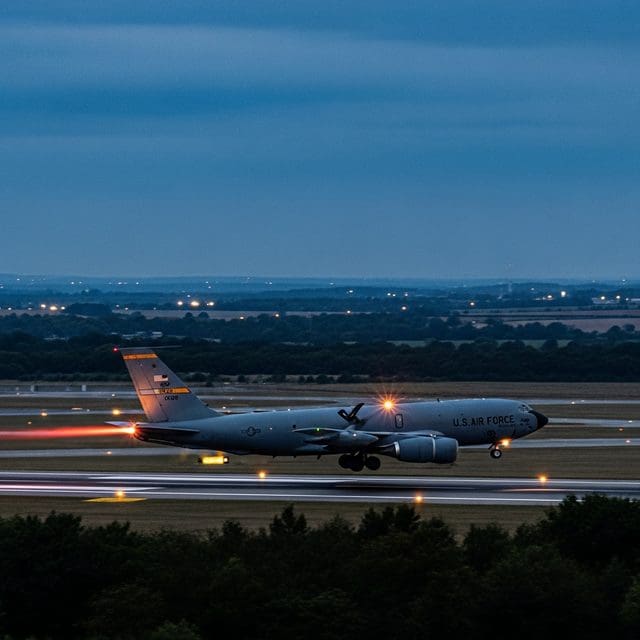
The campaign relies on integrated NATO logistics, specifically utilizing Royal Air Force stations in Suffolk, England. These facilities serve as essential in-air refueling hubs, allowing U.S. Air Force tankers to support long-range sorties toward the Persian Gulf. This cooperation underscores the strategic depth of the Western alliance as regional tensions mount following Iranian retaliatory drone strikes against U.S. partners in Bahrain, Kuwait, and Israel. The use of British basing has become a critical enabler for the Pentagon’s strike patterns, ensuring American power remains projected despite the vast distances.
On the diplomatic front, President Trump pivoted away from a July 13 proposal to reinstate a formal naval blockade and levy a 20 percent toll on cargo. By July 15, the administration signaled a preference for trade and investment deals with Gulf Arab states to stabilize the region. However, this shift does not signal a softening military posture. The President warned that if the Strait is not reopened under U.S. terms, the next phase will target Iranian civilian infrastructure, including power plants and bridges. Trump stated that operations will hit these sectors “very hard” within three weeks if Tehran refuses a broader deal.
The human cost of the engagement continues to rise. The U.S. military death toll reached 14 as of July 14, following the death of Navy Commander Gabriel Edwards in a crash over the Arabian Sea. Inside Iran, joint U.S.-Israeli strikes have resulted in dozens of casualties as the two nations coordinate to neutralize emerging threats. Iran has framed its missile attacks on neighboring states as a necessary defense against renewed U.S. pressure. Despite the violence, the President maintained that core strategic objectives are nearing completion, citing the degradation of Iran’s naval and missile assets.
Domestically, the conflict’s volatility has disrupted previous economic gains. A temporary U.S.-Iran deal had led to a 0.4 percent decline in the June consumer price index, driven by reduced energy prices. However, the collapse of that framework and the resumption of nightly barrages have introduced fresh uncertainty into global energy markets. The previous ceasefire framework is now functionally defunct, with no active diplomatic mechanism visible to limit operations.
As the Pentagon frames these actions as “self-defense strikes,” the administration is also managing domestic transitions. Jay Clayton testified on July 15 for his confirmation as Director of National Intelligence, a role pivotal in assessing Iranian capabilities. Simultaneously, the Senate sees new leadership as Darline Graham Nordone was appointed to the seat of her late brother, Senator Lindsey Graham. President Trump has dismissed FBI probes into Graham’s death as a waste of time. For now, the focus remains on the Gulf, where the lack of a diplomatic off-ramp suggests the kinetic phase of the conflict will persist until a new regional equilibrium is forced.

Olivia Kendall serves as the Senior Correspondent for Geopolitics, Defense, and Foreign Policy at Just Right News, where she provides a principled, conservative perspective on the complex forces shaping the global stage. With a career dedicated to deconstructing the intricacies of international relations, Kendall has become a trusted voice for readers who value national sovereignty, a robust military, and a foreign policy that prioritizes American interests above all else.
A native of Washington, D.C., Kendall’s professional journey is deeply rooted in her upbringing within the nation’s capital. Growing up in the epicenter of American political life, she developed an early and profound understanding of how policy is crafted and, more importantly, how it often fails to account for the values of the American heartland. This unique vantage point allowed her to witness firsthand the rise of globalist bureaucracies, fueling her commitment to reporting that champions the constitutional foundations of the United States. Her background as a British White American further informs her worldview, providing her with a keen appreciation for the Western tradition and the enduring importance of the “Special Relationship” in maintaining global stability.
Now based in Arlington, Virginia, Kendall operates from the doorstep of the Pentagon and the heart of the nation’s defense establishment. Her proximity to the decision-makers in the military and intelligence communities allows her to provide boots-on-the-ground reporting that is both timely and deeply informed. For Kendall, Arlington is more than just a base of operations; it is a daily reminder of the sacrifices made by the men and women in uniform. This connection to the defense community drives her rigorous coverage of military readiness and her advocacy for a “peace through strength” approach to diplomacy.
At Just Right News, Kendall is perhaps best known for her acclaimed feature series, “The World’s Shadow on America.” In this ongoing project, she explores the direct correlation between international developments and the daily lives of American citizens. Whether she is analyzing the encroachment of foreign adversaries in domestic supply chains or the impact of international treaties on local economies, Kendall’s work serves as a vital bridge between distant geopolitical shifts and their consequences at home. She rejects the notion that foreign policy is an abstract concern for elites, instead proving that what happens in the corridors of power in Brussels or Beijing has a tangible “shadow” that falls across every American doorstep.
Throughout her tenure, Kendall has remained a steadfast critic of international overreach and a vocal proponent of a clear-eyed, realistic foreign policy. She brings a sharp analytical mind to her beat, often challenging the prevailing narratives of the mainstream media to uncover the underlying truths that affect national security. Her reporting is characterized by a refusal to compromise on the truth and a dedication to the idea that a strong, secure America is the world’s best hope for liberty. As a Senior Correspondent, Olivia Kendall continues to lead the charge in providing the essential context and conservative insight necessary to navigate an increasingly volatile world.