

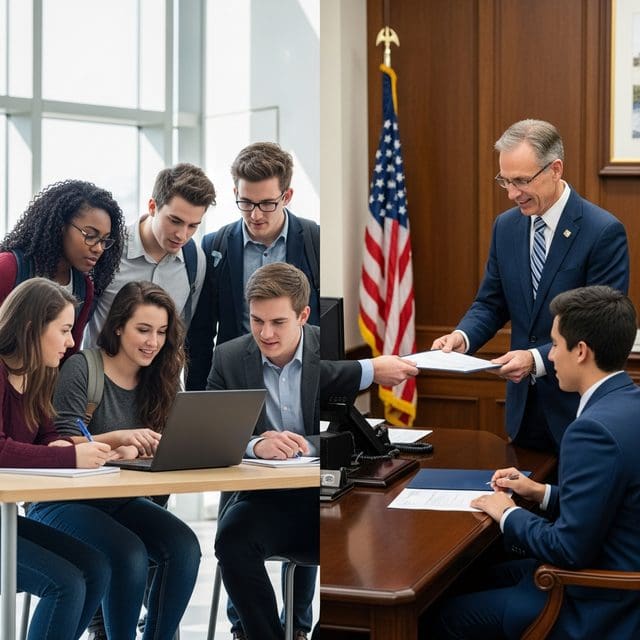
Administrative reforms and high-profile academic achievements are reshaping the transition from secondary school to the workforce through efficiency and personal responsibility.
The transition from secondary school to a career is increasingly defined by how effectively institutions can remove bureaucratic friction. In a climate where top-down government interventions often complicate the path to upward mobility, localized efforts are emerging to prioritize efficiency and personal responsibility. A recent special camp in Erode, led by the District Collector, serves as a prime example of this shift. The camp focused specifically on higher-education grievances, receiving 35 petitions from students regarding college admissions, hostel facilities, and education loans. This targeted approach aims to ensure 100% enrollment by addressing the specific hurdles faced by students who have passed, failed, or missed their Class 10 and 12 examinations.
This model of administrative directness is gaining traction as a more effective alternative to standard public grievance meetings. While general district meetings in Erode have historically seen volumes as high as 258 petitions in a single session, the specialized education camp allows for a more granular focus on human capital development. By utilizing a Petition Processing Portal and a Public Grievances Cell, the administration now provides students with unique petition IDs and SMS status updates. This digital infrastructure treats the student as a stakeholder in a market-aligned system, ensuring that the pursuit of a degree is not derailed by a lack of institutional transparency.
The success of these camps is already visible in neighboring regions. In Coimbatore, similar grievance-cum-admissions initiatives recently resulted in 33 students receiving spot college admissions and the disbursal of over 270,000 rupees in scholarships. For the pragmatic observer, these results demonstrate that when bureaucratic barriers are removed, individual achievement can flourish. These programs do not merely hand out aid; they facilitate the entry of motivated individuals into the higher education marketplace, where their personal effort determines their trajectory.
At the university level, the rewards of rigorous academic merit remain the gold standard for success. The University of Manchester recently highlighted this through its latest cohort of graduates, including high-profile examples like Olivia Stelling, who earned first-class honors. Such achievements underscore the enduring value of traditional academic excellence amidst a sea of shifting educational policies. Furthermore, the University of Manchester continues to prove its worth as a hub for industrial innovation. Researchers there recently developed a computational method to identify two-dimensional materials with flat bands hosting quantum behavior, a discovery published in Science Advances that has direct implications for the future of high-tech manufacturing.
This alignment between higher education and the modern workforce is further solidified by new fault-tolerant quantum computing agreements. A partnership involving Quantinuum, Rolls-Royce, Riverlane, and the University of Edinburgh is currently exploring fluid dynamics simulations for industrial design. This collaboration represents the ideal synergy between private industry and public research, ensuring that university curricula are driven by market needs rather than abstract theory. By focusing on industrial design and simulations, these institutions are preparing a workforce capable of driving the next wave of economic growth.
While the national conversation often drifts toward the distractions of sports recruiting or lifestyle trends, the real work of upward mobility happens in these intersections of policy and performance. Whether it is a student in Erode navigating an admission portal or a researcher in Edinburgh solving complex fluid dynamics, the focus must remain on practical solutions. By championing meritocracy and removing the administrative hurdles that stifle individual potential, society can ensure that the investment in higher education yields a tangible return for both the student and the economy.
Daniel Owens serves as a Senior Correspondent for Just Right News, where he leads the newsroom’s coverage of Education, Workforce, and Upward Mobility. In an era where the national conversation often overlooks the practical foundations of success, Owens brings a principled perspective to the forefront of the media landscape. His work is defined by a commitment to the idea that a strong society is built on the pillars of quality education, a robust work ethic, and the removal of bureaucratic barriers to individual achievement.
Born and raised in Cleveland, Ohio, Owens’s worldview was shaped by the industrial landscape of the Midwest. Growing up in a city known for its grit and resilience, he witnessed firsthand the transformative power of steady employment and the devastating effects of economic stagnation. This background instilled in him a deep respect for the American worker and a healthy skepticism toward top-down government solutions that often fail to reach the communities they intend to help. As an African American man who has navigated the path to professional success, Owens approaches his beat with a nuanced understanding of how meritocracy and personal responsibility intersect with opportunity. He frequently draws on his roots to highlight the importance of family stability and community-led initiatives in fostering the next generation of leaders.
At Just Right News, Owens is the architect of the acclaimed feature series, “The Learning Curve.” Through this platform, he explores the evolving landscape of American schooling, from the rise of the school choice movement to the revitalization of trade schools and vocational training. He frequently challenges the status quo of higher education, advocating for a return to academic rigor and the practical alignment of degrees with market demands. For Owens, education is not merely about obtaining credentials; it is about equipping young people with the tools necessary to lead self-sufficient, meaningful lives. His reporting on “The Learning Curve” has become essential reading for parents and policymakers who believe that educational competition and parental rights are the keys to a brighter future.
Now based in Raleigh, North Carolina, Owens finds himself at the heart of one of the nation’s most dynamic regions for innovation and growth. Raleigh’s unique blend of traditional values and a fast-paced economy provides the perfect backdrop for his reporting on the modern workforce. From the tech hubs of the Research Triangle to the rural communities of the South, he tracks how shifts in the economy are impacting families and local industries. His reporting often highlights the success stories of entrepreneurs and workers who are thriving by embracing the values of hard work and innovation.
Throughout his career, Daniel Owens has remained a steadfast voice for the student seeking a better path and the worker striving for a better life. His reporting for Just Right News serves as a vital resource for readers who value common-sense solutions to the challenges of the 21st-century economy. By focusing on the intersection of policy and the human spirit, Owens continues to provide a roadmap for how individuals and communities can achieve lasting upward mobility.