

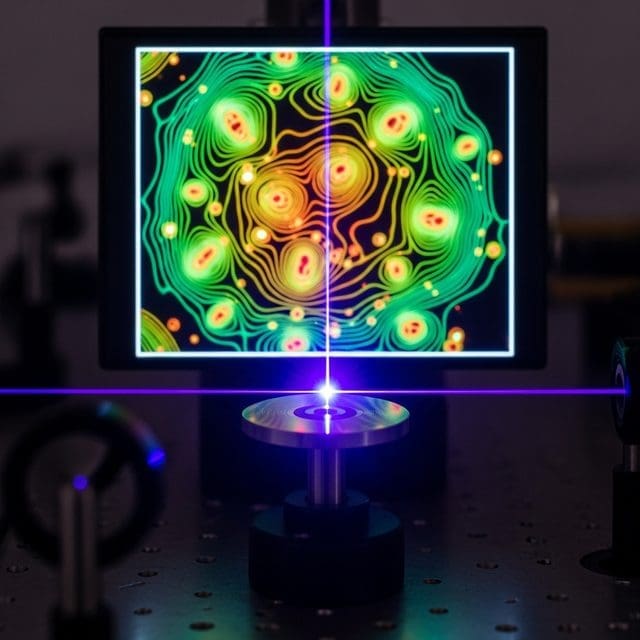
Researchers at Nanyang Technological University have utilized a 200-year-old physics experiment to create stable optical skyrmions, offering a cost-effective path toward ultra-dense data storage and resilient photonic computing.
In an era where centralized data centers face increasing energy scrutiny and regulatory freezes, a discovery from the frontiers of physics suggests a path toward more efficient, sovereign computing. Researchers at Nanyang Technological University (NTU) in Singapore have demonstrated that a 200-year-old optical phenomenon, the Poisson spot, can be used to generate exotic light structures known as optical skyrmions. Published in the journal Optica, the findings offer a surprisingly simple method to create stable, swirling textures of light that were previously thought to require expensive and highly engineered metamaterials.
The experiment involves shining a laser at a micron-scale circular disc. Through the classic effect of diffraction, the resulting shadow contains a central bright spot—the Poisson spot—surrounded by complex fields. The NTU team, led by Assistant Professor Shen Yijie, found that this setup simultaneously generates spin, Stokes, and electromagnetic skyrmions. Because these structures are defined by their topology—a mathematical property that makes them resistant to external disturbances—they are exceptionally robust. This topological stability means the information encoded in these swirls is protected from the noise and degradation that typically plague high-speed electronic signals.
For the American innovator, this represents a significant shift in the feasibility of photonic computing. By removing the requirement for specialized fabrication at the nanoscale, the barrier to entry for developing next-generation hardware is lowered. These light swirls can encode information not just through intensity, but through their stable topological shape, promising data storage densities far beyond current silicon-based limitations. Furthermore, recent research indicates these skyrmions remain intact even when passing through atmospheric turbulence, a critical factor for secure satellite-to-ground communications that bypass vulnerable terrestrial cables. This resilience is a key enabler for terrestrial links that must withstand environmental interference without losing data integrity.
This development arrives as the industrial sector begins to take quantum computing seriously. On July 14, 2026, Quantinuum and Rolls-Royce signed an agreement with the University of Edinburgh to explore fault-tolerant quantum computing for fluid dynamics. The NTU discovery complements this industrial push by providing a “skyrmion toolkit” that includes fiber-integrated generators and momentum-space skyrmions. These tools allow for the design of optical forces and light-matter interactions that were previously too complex or expensive to simulate outside of high-budget government laboratories.
While Silicon Valley remains fixated on massive, energy-hungry AI models, this discovery points toward a future of decentralized, high-speed optical logic. The ability to store and retrieve these skyrmions in atomic vapors, as demonstrated in related experiments using cold rubidium atoms, suggests that the building blocks for a topologically protected quantum memory are within reach. As the United States seeks to maintain its technological edge while protecting individual privacy and infrastructure, these robust optical textures provide a physical foundation for innovation that is both resilient and accessible.
The broader implications for national sovereignty cannot be overstated. By utilizing a 200-year-old diffraction geometry, researchers have effectively democratized the creation of advanced photonic testbeds. This reduces reliance on the centralized, high-cost manufacturing chains that currently dominate the semiconductor industry. Instead, the path is cleared for a new generation of decentralized innovation where the fundamental laws of physics, rather than bureaucratic subsidies, drive the next leap in computing power. As we look toward the launch of new missions like the Soyuz MS-29 and the continued exploration of black hole thermodynamics, it is these fundamental breakthroughs in light manipulation that will likely define the infrastructure of the coming decade.

Mason Reed serves as a Staff Writer for Just Right News, where he spearheads the Future Frontiers & Special Projects desk. In an era defined by rapid technological shifts and evolving social landscapes, Mason provides a steady, principled voice, examining the innovations of tomorrow through the lens of traditional American values. His work is most prominently featured in his signature series, “The Next Horizon,” where he explores the intersection of emerging technology, national sovereignty, and the preservation of individual liberty.
A native of San Diego, California, Mason’s worldview was shaped by the unique culture of his hometown. Growing up in a region defined by its strong military presence and its history of maritime industry, he developed a deep-seated respect for the institutions that provide national stability and the entrepreneurial spirit that drives the American economy. This upbringing instilled in him a belief that true progress is not found in discarding the past, but in building upon a foundation of proven principles. His reporting often reflects this San Diego influence, emphasizing the importance of a robust national defense and the necessity of maintaining a competitive edge in the global marketplace.
Now based in San Francisco, Mason operates from the heart of the world’s technological engine. Living and working in the Bay Area provides him with a front-row seat to the advancements—and the ideological challenges—emanating from Silicon Valley. While many in the region embrace a “move fast and break things” mentality, Mason’s reporting serves as a vital counterweight. He offers Just Right News readers a “boots on the ground” perspective, documenting how radical local policies and the concentration of tech power impact the everyday lives of citizens. His proximity to the industry allows him to cut through the marketing jargon of big tech to uncover the real-world implications for privacy, free speech, and the nuclear family.
In his “Future Frontiers” beat, Mason tackles complex subjects ranging from the ethics of artificial intelligence to the burgeoning private space race. He approaches these topics with a healthy skepticism toward centralized bureaucracy, championing instead the decentralized innovations that empower individuals. Through “The Next Horizon,” he highlights the pioneers and thinkers who are working to ensure that the future remains a place where human dignity and constitutional rights are protected. He believes that the rapid pace of change requires more than just technical expertise; it requires a moral compass rooted in the Western tradition.
Throughout his tenure at Just Right News, Mason has remained committed to the idea that the future is something to be shaped, not merely accepted. His writing is characterized by a rigorous defense of American exceptionalism and a belief that the country’s best days lie ahead, provided it remains true to its founding ideals. Whether he is investigating the impact of automation on the American workforce or profiling the next generation of aerospace engineers, Mason Reed ensures that his readers are equipped with the insights they need to navigate a changing world with confidence and clarity.