

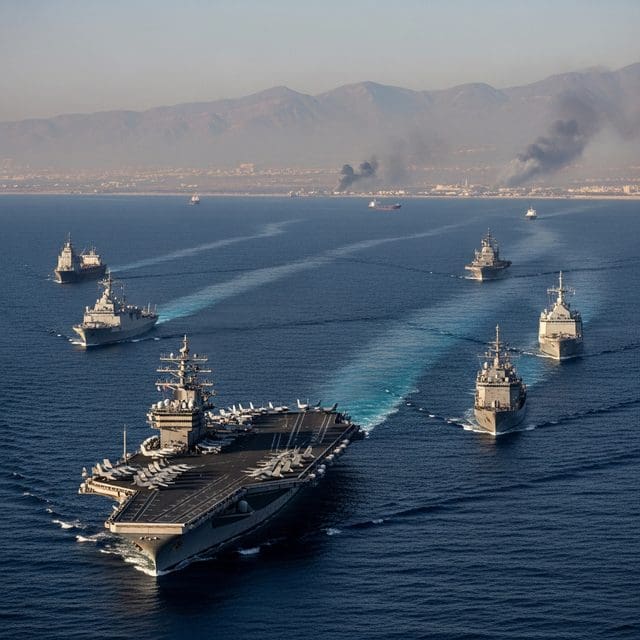
The United States launched a third round of strikes against Iranian military infrastructure as shipping traffic through the vital Strait of Hormuz collapsed to a historic low.
The United States military launched a third round of precision strikes against Iranian military targets on July 12, 2026, in a major escalation intended to reopen the Strait of Hormuz. According to CENTCOM, the operation targeted approximately 90 sites across Iran’s coastal and eastern provinces. The strikes focused on critical infrastructure including air defense systems, coastal surveillance arrays, missile and drone launch sites, and naval logistics hubs. This kinetic response follows Iran’s unilateral announcement that it would close the Strait, a move punctuated by Iranian attacks on a Cyprus-flagged container ship and two other commercial tankers.
The strategic consequences for global commerce are immediate. Shipping traffic through the Strait, which typically serves as the transit point for 125 to 140 ships per day, has fallen to a monthly low. Analysts describe the current flow as a trickle, threatening the stability of global energy markets and supply chains. By targeting Iranian surveillance and naval capabilities, the U.S. aims to restore freedom of navigation in a waterway essential to Western economic interests and heartland energy security.
In a significant diplomatic shift, the United Kingdom formally designated the Islamic Revolutionary Guard Corps (IRGC) as a foreign terrorist organization. This move aligns London with the long-standing U.S. policy established during the first Trump administration. The UK designation is expected to complicate future nuclear negotiations and restrict the IRGC’s access to European financial systems. This unified Western front comes as French President Emmanuel Macron announced a substantial boost in defense spending, signaling that European powers are moving toward greater military self-reliance.
The conflict is also impacting Iran’s economic and political architecture. U.S. strikes hit a rail bridge vital for Iranian trade with Russia and China, adding economic pressure on Tehran’s primary partners. Furthermore, the U.S. has revoked licenses that previously allowed Iran to sell oil, tightening the secondary sanctions regime. Internally, the Iranian regime faces questions regarding its command structure. Supreme Leader Mojtaba Khamenei has remained absent from public view, missing key funeral ceremonies. While reports suggest he is still making decisions from seclusion, his public absence is increasingly viewed as a political liability during active military engagement.
Tehran has responded by broadening the conflict’s geography, claiming it targeted U.S. military infrastructure in Kuwait, Qatar, and Bahrain. This expansion of the retaliation map raises the risk profile for U.S. bases across the Gulf. Iranian officials reported that earlier rounds of strikes killed 14 individuals across five provinces. Despite these claims, the U.S. remains committed to a policy of peace through strength. President Trump recently met Ukrainian President Volodymyr Zelensky at the NATO summit in Turkey to announce the purchase of Ukrainian drones, further integrating Western defense technology.
Domestic shifts in Washington are also impacting the foreign policy landscape. The death of Senator Lindsey Graham on July 12, 2026, has removed a primary architect of GOP foreign policy from the Senate. Graham was a staunch advocate for maintaining a robust military presence in the Middle East. His passing, combined with the hospitalization of 84-year-old Senator Mitch McConnell, marks a significant transition in the leadership that has long defined the American realist approach to global power dynamics. As the U.S. continues its strikes to secure the Strait, the administration faces the challenge of defining a clear victory in a region where alliances and threats are rapidly shifting.

Olivia Kendall serves as the Senior Correspondent for Geopolitics, Defense, and Foreign Policy at Just Right News, where she provides a principled, conservative perspective on the complex forces shaping the global stage. With a career dedicated to deconstructing the intricacies of international relations, Kendall has become a trusted voice for readers who value national sovereignty, a robust military, and a foreign policy that prioritizes American interests above all else.
A native of Washington, D.C., Kendall’s professional journey is deeply rooted in her upbringing within the nation’s capital. Growing up in the epicenter of American political life, she developed an early and profound understanding of how policy is crafted and, more importantly, how it often fails to account for the values of the American heartland. This unique vantage point allowed her to witness firsthand the rise of globalist bureaucracies, fueling her commitment to reporting that champions the constitutional foundations of the United States. Her background as a British White American further informs her worldview, providing her with a keen appreciation for the Western tradition and the enduring importance of the “Special Relationship” in maintaining global stability.
Now based in Arlington, Virginia, Kendall operates from the doorstep of the Pentagon and the heart of the nation’s defense establishment. Her proximity to the decision-makers in the military and intelligence communities allows her to provide boots-on-the-ground reporting that is both timely and deeply informed. For Kendall, Arlington is more than just a base of operations; it is a daily reminder of the sacrifices made by the men and women in uniform. This connection to the defense community drives her rigorous coverage of military readiness and her advocacy for a “peace through strength” approach to diplomacy.
At Just Right News, Kendall is perhaps best known for her acclaimed feature series, “The World’s Shadow on America.” In this ongoing project, she explores the direct correlation between international developments and the daily lives of American citizens. Whether she is analyzing the encroachment of foreign adversaries in domestic supply chains or the impact of international treaties on local economies, Kendall’s work serves as a vital bridge between distant geopolitical shifts and their consequences at home. She rejects the notion that foreign policy is an abstract concern for elites, instead proving that what happens in the corridors of power in Brussels or Beijing has a tangible “shadow” that falls across every American doorstep.
Throughout her tenure, Kendall has remained a steadfast critic of international overreach and a vocal proponent of a clear-eyed, realistic foreign policy. She brings a sharp analytical mind to her beat, often challenging the prevailing narratives of the mainstream media to uncover the underlying truths that affect national security. Her reporting is characterized by a refusal to compromise on the truth and a dedication to the idea that a strong, secure America is the world’s best hope for liberty. As a Senior Correspondent, Olivia Kendall continues to lead the charge in providing the essential context and conservative insight necessary to navigate an increasingly volatile world.