

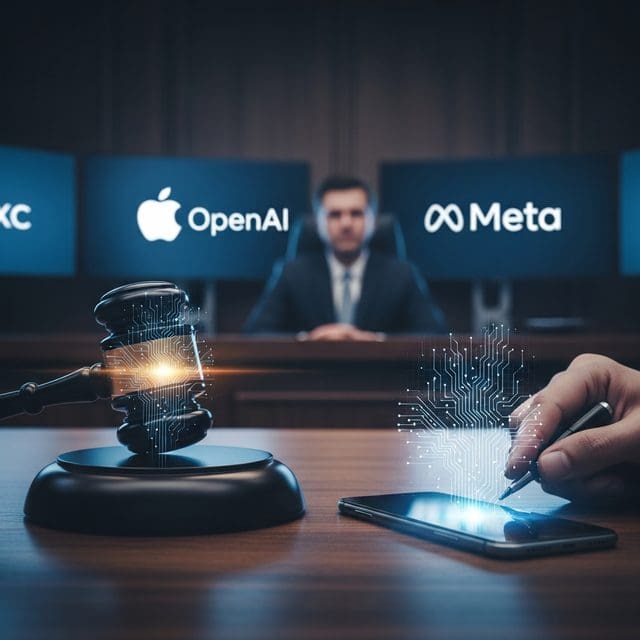
Apple’s trade-secret lawsuit against OpenAI and Meta’s abrupt Instagram AI reversals signal a volatile new chapter for corporate data sovereignty and the digital frontier.
The fragile peace between Big Tech’s dominant platforms and the frontier AI labs is fracturing under the weight of legal disputes and shifting corporate strategies. Apple has filed a blockbuster trade-secret theft lawsuit against OpenAI and two former employees, alleging a systematic misappropriation of confidential information. The complaint strikes at the heart of the partnership that integrated ChatGPT into Siri and Apple’s Image Playground, raising urgent questions about the security of proprietary data when shared across the corporate silos of the Algorithmic State. While no immediate injunctions have been reported since the initial filing, the legal battle threatens the stability of AI features currently deployed to millions of consumer devices, including Visual Intelligence and on-screen content analysis tools.
Meta is experiencing its own internal volatility, abruptly discontinuing its Muse Image feature on Instagram just three days after its debut. The reversal followed a public outcry over the company’s practice of auto-opting public accounts into AI training sets without notice. While Meta acknowledged the tool “missed the mark,” the company is not retreating from its broader AI roadmap. It continues to roll out the Muse Spark assistant across Facebook, WhatsApp, and Ray-Ban Meta glasses, signaling a strategic shift toward proprietary models that allow for tighter control over the data pipeline while replacing third-party video models.
Infrastructure providers are also tightening their offerings, impacting the tools used by developers and sovereign citizens alike. Google recently removed support for the Gemini 1.0 Pro Vision model from its AI services, forcing a migration toward newer, more opaque variants like Gemini Omni Flash and Nano Banana 2 Lite. This churn in the developer stack coincides with increased regulatory pressure, as British authorities recently designated Amazon Web Services, Google Cloud, and Microsoft as critical third-party suppliers, bringing these infrastructure giants under direct financial sector oversight to protect global stability.
In the semiconductor sector, the capital requirements for the AI revolution have reached historic levels. SK Hynix raised $26.5 billion in a U.S. equity offering, marking the second-largest equity offering in history. The company’s Nasdaq debut on July 10, 2026, saw shares jump 13% as investors flocked to the hardware backbone of the surveillance economy. Simultaneously, TSMC reported a staggering 67% surge in June revenue, reaching $13.2 billion, further cementing the concentration of power within the global chip supply chain ahead of its mid-July earnings report.
As these tech giants consolidate their hold on digital infrastructure, the reliability of their systems remains in question. A recent analysis found that Meta’s own AI image detectors failed to identify cropped images generated by its own models. This failure highlights the persistent gap between corporate marketing and the reality of algorithmic accountability. Furthermore, the emergence of specialized tools like Tomocube’s HT-T1 for 3D glass substrate analysis and VoicePing 3.0 for enterprise translation suggests that while the giants fight for the platform layer, specialized surveillance and communication tools are proliferating in the background.
Geopolitical shifts are also complicating the startup landscape. Following Beijing’s order for Meta to unwind a significant $2 billion AI acquisition, Tencent has reportedly entered talks to become the largest shareholder in the AI startup Manus. This maneuvering points to a shifting capital dynamic where state interests and platform ownership intersect, influencing cross-border deal flow and the valuation of the next generation of AI tools. For the individual user, these developments underscore a growing reality: the tools of digital sovereignty are increasingly subject to the whims of corporate litigation and centralized platform control, making the reclamation of data liberty a more complex battle than ever before.

Lisa Grant serves as a Staff Writer for Just Right News, where she spearheads the publication’s coverage of Technology, Data Capitalism, and Surveillance. With a focus on the encroaching influence of Big Tech on the American way of life, Grant brings a critical, liberty-minded perspective to the most complex digital issues of the modern era. Her reporting is defined by a deep-seated skepticism of centralized power and a commitment to protecting the privacy and autonomy of the individual against the rising tide of what she calls the “Algorithmic State.”
Grant’s unique insight into the tech industry is rooted in her upbringing in Palo Alto, California. Growing up in the epicenter of Silicon Valley, she witnessed firsthand the transformation of the technology sector from a hub of scrappy, freedom-loving innovators into a landscape dominated by monolithic corporations. This proximity to the birth of the digital revolution provided her with an insider’s understanding of the culture and motivations driving the industry. For Grant, the shift toward data capitalism—where personal information is harvested as a primary commodity—is not just a market evolution, but a fundamental challenge to traditional American values of property rights and personal privacy. She saw the “garage startup” ethos replaced by a culture of data-mining and social engineering, a transition that informs her vigilant reporting today.
Now based in Seattle, Washington, Grant operates from another of the nation’s primary technological frontiers. Her location in the Pacific Northwest allows her to observe the real-world consequences of the tech industry’s expansion, from the implementation of invasive surveillance technologies in urban centers to the growing partnership between corporate entities and municipal governance. By reporting from the ground in Seattle, she bridges the gap between the abstract world of coding and the tangible impact it has on citizens’ daily lives, often highlighting how local policies serve as a testing ground for broader national surveillance initiatives.
At the heart of her work for Just Right News is her acclaimed feature series, “The Algorithmic State.” Through this series, Grant explores the ways in which automated systems and artificial intelligence are increasingly used to bypass traditional legislative processes and social norms. She argues that the reliance on opaque algorithms to manage society threatens to erode the transparency and accountability essential to a free republic. Her work meticulously documents how data-driven governance can lead to a “soft” surveillance state that penalizes traditional viewpoints and rewards digital conformity.
Grant’s reporting is a vital resource for readers who are wary of the “nanny state” and the unchecked power of digital gatekeepers. She views the defense of the digital frontier as the next great battle for constitutional conservatives. By exposing the mechanisms of data capitalism and the quiet expansion of surveillance networks, she empowers her audience to reclaim their digital sovereignty. In an era where information is often weaponized by those in power, Lisa Grant remains a steadfast advocate for the truth, ensuring that the principles of liberty and individual agency are not lost in the transition to an increasingly digital world.