

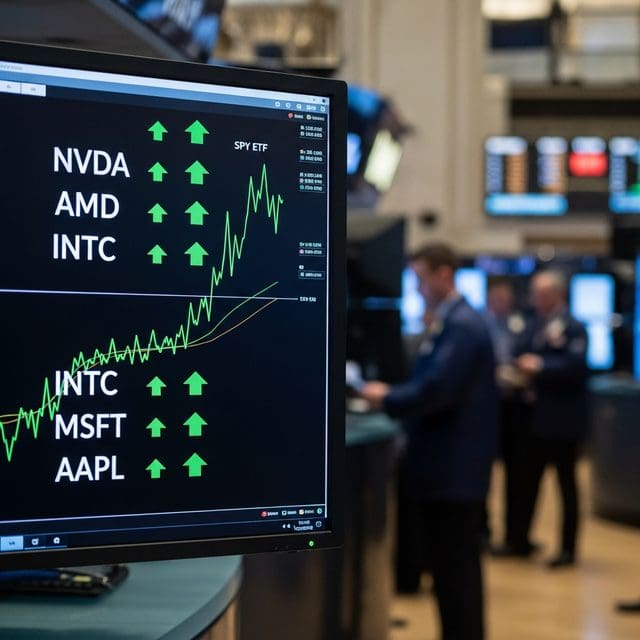
The S&P 500 benchmark SPY rose 0.45% Monday as investors balanced a historic semiconductor equity offering against local market volatility in Seoul and persistent Middle East tensions.
Wall Street maintained its upward momentum on Monday, with the SPY benchmark advancing 0.45% in a session characterized by sectoral rotation and a quiet economic calendar. The modest gains across the S&P 500, Dow, and Nasdaq reflect a market attempting to digest a massive influx of semiconductor capital while keeping a wary eye on the Strait of Hormuz. This steady climb follows a week where the Nasdaq Composite gained 1.74% and the S&P 500 rose 1.23%, signaling that the appetite for risk remains intact despite a lack of fresh domestic data catalysts.
The primary catalyst for the current risk-on sentiment remains the artificial intelligence infrastructure trade. SK Hynix made history on July 10 with a $26.5 billion U.S. equity offering—the second-largest in history—which saw its American depositary receipts surge 13% on their Nasdaq debut. This massive liquidity event has anchored optimism for the broader semiconductor complex, even as the frenzy cooled slightly during Monday’s trading. However, the enthusiasm was not universal; local shares of SK Hynix in Seoul plummeted 15% on July 13, a stark reminder of the geopolitical and regulatory pressures that can decouple foreign listings from their home-market realities. This divergence highlights the premium investors place on U.S.-regulated exchanges over regional markets currently facing heightened tension.
For American households, the stability of the Treasury market offers a reprieve from recent volatility. U.S. Treasury yields remained largely unchanged to slightly lower, with the 10-year yield hovering near 4.56% and the 2-year yield at 4.21%. This “wait-and-see” posture suggests that institutional investors are not yet pricing in a fresh inflationary shock, despite ongoing tensions involving the U.S. and Iran. The U.S. dollar remained fractionally firmer at 100.95 on the DXY index, but the lack of a decisive “risk-off” bid indicates that the market views Middle Eastern headlines as a manageable risk premium rather than a systemic threat to domestic growth.
While the headline indices drift higher, the underlying “Invisible Economy” shows signs of strategic consolidation and corporate maneuverings. Corporate activity remains robust, evidenced by the OCI N.V. Board of Directors recommending an unsolicited all-cash offer from NNS at EUR 4.10 per share. In the real estate and infrastructure space, Skanska recently divested a major rental multifamily project in Sollentuna, Sweden, to Folksam Group for approximately SEK 570 million. These moves, alongside AEON’s expansion of AEON Pay into Zambia to integrate mobile money for digital asset settlement, suggest that while central banks remain cautious, private capital is still seeking out meritocratic growth opportunities globally.
Further down the cap-table, the market is seeing a push for alternative equity structures. The partnership between Reins and ProfitWorks, announced in late June, aims to provide new equity programs for independent business owners, reflecting a shift toward decentralized ownership models. Meanwhile, legal scrutiny remains a factor in corporate consolidation, as seen in the Synaptics and onsemi transaction, which faces shareholder litigation regarding fair pricing. These developments underscore the complexity of the current financial landscape, where high-level index gains often mask the granular legal and structural shifts occurring beneath the surface.
Ultimately, Monday’s session was a study in resilience. With no major U.S. data catalysts scheduled, the market’s ability to hold a 0.45% gain suggests that the “AI-memory” theme is providing a sturdy floor for valuations. Working families should note that while global headlines remain volatile, the domestic financial system is currently prioritizing the long-term technological shift over short-term geopolitical noise. As long as Treasury yields remain contained and the dollar avoids a sharp spike, the path of least resistance for the American equity market appears to be a continued, albeit cautious, grind higher.

Jordan Lee serves as the Senior Correspondent for Wall Street, Finance, and Monetary Systems at Just Right News. Based in the heart of the world’s financial capital, New York City, Lee brings a sharp, principled eye to the complex mechanisms that drive the global economy. His reporting is defined by a commitment to fiscal responsibility, the defense of the free market, and a deep-seated belief that a transparent monetary system is the bedrock of a free society.
Raised in Portland, Oregon, Lee’s perspective was forged in a city that has undergone significant cultural and economic shifts. His upbringing in the Pacific Northwest instilled in him a profound appreciation for the industriousness of small business owners and the importance of local economic stability. Watching the evolution of his hometown’s landscape sparked an early interest in how federal fiscal policy and large-scale financial trends eventually trickle down to the average citizen. This background provides him with a unique vantage point; he understands the growing disconnect between the policy-making elite and the reality of Main Street, a theme that frequently resonates throughout his work.
Now operating from his base in New York City, Lee bridges the gap between the high-stakes trading floors of Manhattan and the households of everyday Americans. He views the financial sector not merely as a collection of numbers and tickers, but as a vital engine of American prosperity that requires constant vigilance and accountability. His reporting often highlights the dangers of centralized financial control and the necessity of maintaining a system that rewards merit, risk-taking, and innovation.
As the creator and lead of the featured series, “The Invisible Economy,” Lee pulls back the curtain on the often-opaque world of monetary systems. He specializes in translating the dense jargon of central banking and international finance into actionable insights for the Just Right News audience. His work explores the “invisible” forces—such as inflationary pressures, regulatory creep, and the expansion of the administrative state—that erode the purchasing power of American families. By focusing on these systemic issues, Lee empowers readers to understand the hidden forces shaping their financial independence.
Lee’s journalistic philosophy is rooted in a steadfast commitment to traditional American values. As an Asian American professional who has navigated the competitive corridors of the financial world, he is a vocal advocate for meritocracy and the preservation of the American Dream. He believes that a stable currency and a predictable regulatory environment are essential for national sovereignty and individual liberty. His reporting frequently warns against the risks of government overreach in the private sector, arguing that the most effective solutions to economic challenges arise from competition and individual enterprise rather than bureaucratic mandates.
At Just Right News, Jordan Lee remains dedicated to providing a clear-eyed defense of the taxpayer. Whether he is analyzing market volatility or investigating the long-term implications of national debt, his mission is to provide the truth about where the money is going and what it means for the future of the country. Through his rigorous analysis and principled stance, Lee has become a trusted voice for those who value a strong, sovereign, and fiscally sound America.