

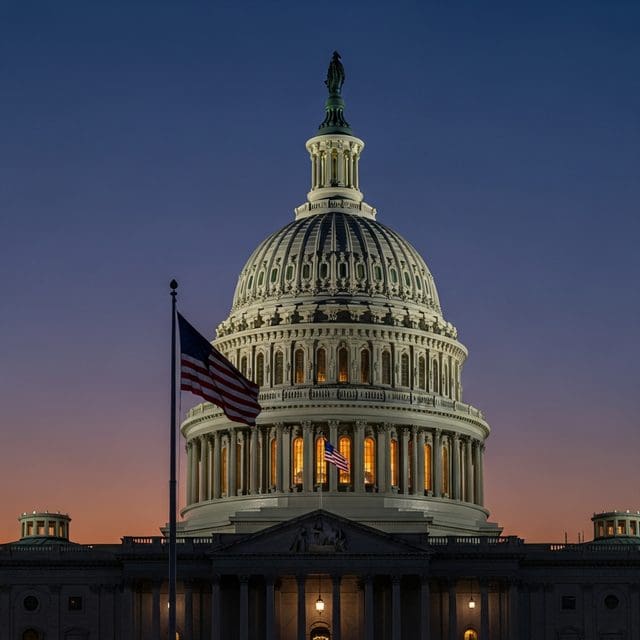
The federal government faces a volatile week as the White House responds to Iranian naval strikes while Congress navigates the sudden death of Senator Lindsey Graham.
The administrative state and the halls of Congress are navigating a convergence of foreign military engagement and significant domestic political shifts this week. Following the provocative announcement by Iran that it would close the Strait of Hormuz, the U.S. military initiated a third round of strikes against Iranian targets on July 12. This escalation followed a kinetic strike on a Cyprus-flagged container ship, signaling a significant hardening of the regional conflict that now demands the immediate attention of the White House and the National Security Council. The closure of the Strait, a critical global energy artery, has forced the administration to pivot toward a more aggressive posture to maintain maritime freedom of navigation.
On the diplomatic front, President Trump met with Ukrainian President Volodymyr Zelensky on July 8 during the NATO summit in Turkey. The primary outcome of this high-level meeting was a strategic procurement agreement where the United States will purchase Ukrainian-manufactured drones. This move comes as President Zelensky continues a significant reshuffling of his administration, marked by the July 12 resignation of Ukrainian Prime Minister Yulia Svyrydenko. The procurement deal suggests a shift toward integrating Ukrainian defense technology into the U.S. supply chain as the invasion by Russia persists. For the American taxpayer, this represents a documentable shift in how foreign aid and defense cooperation are structured, moving toward a transactional model of military hardware acquisition.
Domestic policy saw a rare moment of bipartisan consensus with the enactment of the 21st Century ROAD to Housing Act on July 11. While the White House live-feed remained largely procedural on Monday, the legislative impact of this housing bill is expected to influence zoning and development frameworks nationwide. The American Planning Association has already applauded the measure, which aims to address systemic supply issues. However, the mood in the Capitol remains somber following the death of Senator Lindsey Graham on July 12. The Washington, D.C., chief medical examiner confirmed the cause of death as aortic dissection resulting from arteriosclerotic cardiovascular disease. Graham’s passing creates a critical vacancy in the Senate, with Representative Nancy Mace already reportedly considering a run for the seat. Polling for that potential vacancy is expected to begin as early as the week of July 12.
As the House of Representatives reconvened at noon on July 13, the legislative agenda shifted toward the Fiscal Year 2027 budget and the National Defense Authorization Act. These proceedings are occurring against a backdrop of public health and labor concerns that impact the broader electorate. The American Red Cross declared an emergency blood shortage on July 13 after the national supply plummeted by 25 percent in June. Simultaneously, the labor market saw the resolution of the Mass General Brigham Home Care clinicians’ strike, which ended at 6:59 a.m. on July 13 after MNA nurses conducted a solidarity walk-in following a lockout. These events underscore the domestic pressures facing the federal government even as international crises take center stage.
Finally, the influence of decentralized finance on political forecasting has reached a new milestone that warrants closer inspection by regulators and the public alike. As of July 13, users on prediction platforms Kalshi and Polymarket have wagered over $197 million on the upcoming midterm elections. This surge in speculative activity highlights a growing public reliance on market-based data to gauge political sentiment, even as the administrative state grapples with active military operations and the loss of a long-standing legislative figure. The sheer volume of these wagers suggests that prediction markets are becoming a primary source of political intelligence for many Americans, rivaling traditional polling as the midterm cycle intensifies.

Ben Taylor serves as the Senior Correspondent and Investigations Lead for Just Right News, where he anchors the network’s commitment to government transparency and institutional accountability. With a career defined by a relentless pursuit of the facts, Taylor spearheads the acclaimed feature series “The Paper Trail,” a deep-dive investigative column that prioritizes primary source documentation over political rhetoric. Based in the heart of the nation’s capital, he has earned a reputation as one of the most formidable investigative journalists in Washington, D.C., known specifically for his mastery of public records and the Freedom of Information Act.
Taylor’s approach to journalism is deeply rooted in his upbringing in Kansas City, Missouri. Growing up in the “Show Me State,” he developed a healthy skepticism of centralized power and a profound respect for the common-sense values of the American heartland. This Midwestern foundation informs his reporting today, as he bridges the gap between the complex machinations of federal bureaucracy and the everyday concerns of citizens across the country. For Taylor, investigative reporting is not about chasing headlines; it is about ensuring that the government remains answerable to the people it serves.
As an African American man working within the conservative media landscape, Taylor brings a principled perspective to his beat. He views the Constitution and the right to information as the ultimate equalizers in a free society. His work often highlights how bureaucratic overreach and lack of transparency disproportionately affect individual liberties. By focusing on the “paper trail,” Taylor strips away the spin of partisan talking points, instead providing Just Right News readers with the raw data and internal communications that reveal how their tax dollars are spent and how policy decisions are actually made.
In his role as Investigations Lead, Taylor oversees a team dedicated to uncovering the stories that mainstream outlets often overlook. Whether he is auditing federal spending, investigating regulatory overreach, or exposing inefficiencies within the administrative state, his methodology remains consistent: follow the evidence wherever it leads. His presence in Washington, D.C., allows him to maintain a constant watch over the halls of power, yet he remains steadfastly connected to his roots, ensuring his reporting reflects the clarity and directness of his Missouri home.
Throughout his tenure at Just Right News, Taylor has become a vital voice for those who demand integrity in public office. He believes that a well-informed electorate is the strongest defense against government overreach, and he has dedicated his career to providing the public with the tools they need to hold their leaders accountable. Through “The Paper Trail” and his broader investigative work, Ben Taylor continues to set the standard for rigorous, document-driven journalism that champions the values of transparency, individual responsibility, and the rule of law.