

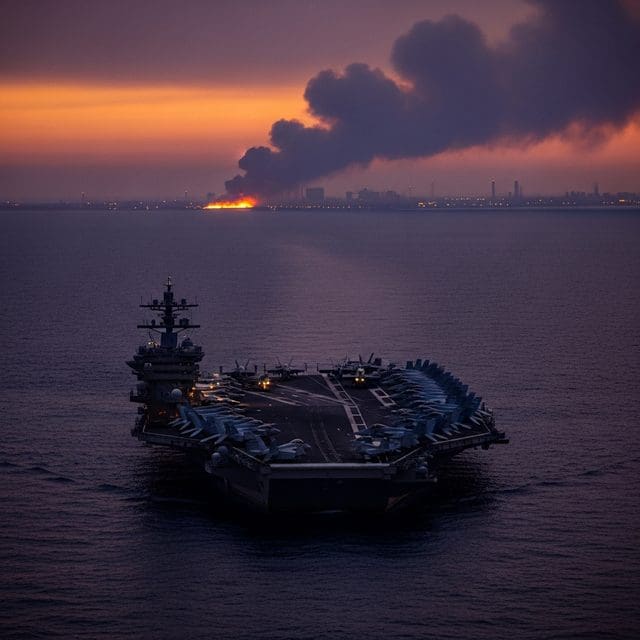
U.S. Central Command launched massive strikes across southern Iran following maritime threats, prompting Tehran to retaliate against Gulf states hosting American forces and causing hundreds of millions in damage.
U.S. Central Command (CENTCOM) conducted a massive aerial campaign against approximately 140 targets in southern Iran overnight, marking a significant escalation in the confrontation between Washington and Tehran. The operation focused on Iranian surveillance, radar, and military sites near Bandar Abbas and the Strait of Hormuz. This surge in kinetic activity follows Iranian claims that the vital waterway is closed to international traffic. The scale of the response aligns with recent rhetoric from President Trump, who stated on July 10 that he authorized unprecedented force should Tehran continue its aggression. On July 11, the President cautioned that 1,000 missiles are locked and loaded, with thousands more prepared to follow if assassination plots against U.S. leadership are pursued.
Despite the strikes, CENTCOM reports that commercial vessels continue to transit the Strait of Hormuz, contradicting Iranian authorities who insist the passage is shut. Tehran has responded by launching missile and drone strikes against neighboring Gulf states hosting American personnel. Bases in Bahrain, Kuwait, Jordan, Qatar, and the UAE have sustained roughly $800 million in damages over the last two weeks. These retaliatory strikes have also resulted in collateral damage; Omani authorities recently summoned the Iranian ambassador to protest strikes on their territory after a U.S. missile killed three Indian sailors near Oman and Iranian UAVs targeted Qatari gas tankers off Musandam.
The regional instability has strained diplomatic channels. Oman’s Foreign Ministry condemned the U.S.-Israeli strikes as a violation of international law, calling for an emergency UN Security Council session. Meanwhile, the U.S. demands that Iran formally affirm the Strait of Hormuz remains open and cease all fire on maritime vessels. The situation is further complicated by domestic legal developments, including a federal grand jury subpoenaing New York Times reporters regarding Air Force One stories and the dismissal of remaining Proud Boys seditious conspiracy convictions following executive clemency.
Domestically, the Republican foreign policy establishment is mourning the sudden loss of Senator Lindsey Graham, a pivotal figure in the ‘peace through strength’ coalition. Graham died on July 11 after a brief illness at age 71. President Trump paid tribute to the South Carolina senator, calling him a true patriot at a time when his hawkish counsel is most sought. Graham’s death leaves a void as lawmakers also grapple with whistleblower allegations regarding construction problems at the Kennedy Center and the fallout of Representative Ro Khanna’s recent detention by Israeli forces in the West Bank.
As the Pentagon assesses the damage, the stakes for American power remain high. Maintaining the free flow of energy through the Strait of Hormuz is a cornerstone of Western economic security. However, the rising cost of defending these lanes—now exceeding $1.1 billion in total infrastructure damage across the region—poses a challenge to the realist doctrine of calibrated escalation. While CENTCOM has declined detailed public comment on Iranian damage claims, the administration remains focused on ensuring that Tehran’s attempts to hold the global economy hostage are met with decisive force.

Olivia Kendall serves as the Senior Correspondent for Geopolitics, Defense, and Foreign Policy at Just Right News, where she provides a principled, conservative perspective on the complex forces shaping the global stage. With a career dedicated to deconstructing the intricacies of international relations, Kendall has become a trusted voice for readers who value national sovereignty, a robust military, and a foreign policy that prioritizes American interests above all else.
A native of Washington, D.C., Kendall’s professional journey is deeply rooted in her upbringing within the nation’s capital. Growing up in the epicenter of American political life, she developed an early and profound understanding of how policy is crafted and, more importantly, how it often fails to account for the values of the American heartland. This unique vantage point allowed her to witness firsthand the rise of globalist bureaucracies, fueling her commitment to reporting that champions the constitutional foundations of the United States. Her background as a British White American further informs her worldview, providing her with a keen appreciation for the Western tradition and the enduring importance of the “Special Relationship” in maintaining global stability.
Now based in Arlington, Virginia, Kendall operates from the doorstep of the Pentagon and the heart of the nation’s defense establishment. Her proximity to the decision-makers in the military and intelligence communities allows her to provide boots-on-the-ground reporting that is both timely and deeply informed. For Kendall, Arlington is more than just a base of operations; it is a daily reminder of the sacrifices made by the men and women in uniform. This connection to the defense community drives her rigorous coverage of military readiness and her advocacy for a “peace through strength” approach to diplomacy.
At Just Right News, Kendall is perhaps best known for her acclaimed feature series, “The World’s Shadow on America.” In this ongoing project, she explores the direct correlation between international developments and the daily lives of American citizens. Whether she is analyzing the encroachment of foreign adversaries in domestic supply chains or the impact of international treaties on local economies, Kendall’s work serves as a vital bridge between distant geopolitical shifts and their consequences at home. She rejects the notion that foreign policy is an abstract concern for elites, instead proving that what happens in the corridors of power in Brussels or Beijing has a tangible “shadow” that falls across every American doorstep.
Throughout her tenure, Kendall has remained a steadfast critic of international overreach and a vocal proponent of a clear-eyed, realistic foreign policy. She brings a sharp analytical mind to her beat, often challenging the prevailing narratives of the mainstream media to uncover the underlying truths that affect national security. Her reporting is characterized by a refusal to compromise on the truth and a dedication to the idea that a strong, secure America is the world’s best hope for liberty. As a Senior Correspondent, Olivia Kendall continues to lead the charge in providing the essential context and conservative insight necessary to navigate an increasingly volatile world.