

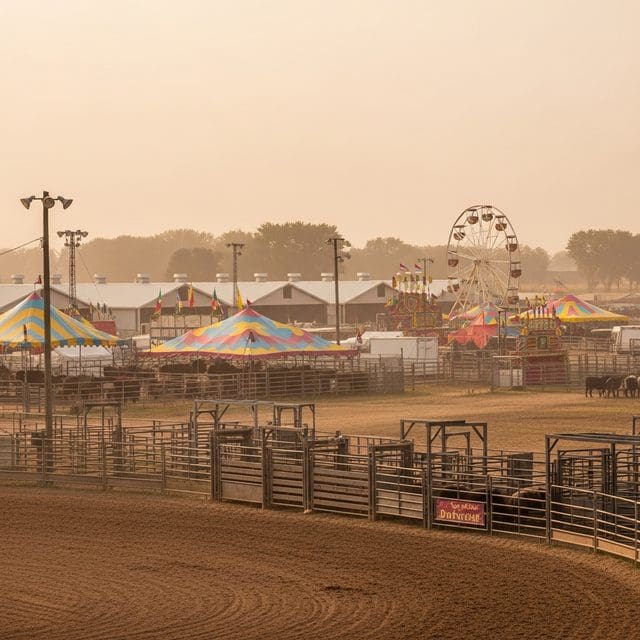
The Old Farmer’s Almanac warns of a sweltering fall, placing increased pressure on local water systems and food safety protocols at major agricultural events like the Berlin Fair.
The arrival of the Berlin Fair and the Southpoint Ranch & Rodeo in Michigan marks a celebration of the American agricultural spirit, yet this year’s festivities are shadowed by a sobering long-range outlook. The Old Farmer’s Almanac recently released its fall 2026 update, predicting a “sizzling, sweltering” conclusion to the summer followed by a warmer-than-normal, mostly dry autumn across the vast majority of the United States. For the families and producers who form the backbone of the San Joaquin Valley and the Heartland, these are not merely weather reports; they are warnings of impending strain on our food and water infrastructure.
While the Almanac is a traditional forecasting tool rather than a regulatory agency, its projections of below-normal precipitation from California to Maine align with growing concerns over regional drought. In the agricultural sector, prolonged heat and dry spells do more than wither crops; they concentrate contaminants. When water tables drop, the risk of nitrate and pesticide concentration in well water increases, requiring vigilant oversight from local health departments and state agencies that are often stretched thin. This is particularly critical in regions like the High Plains and the Atlantic Corridor, where the Almanac urges residents to monitor local conditions as lack of moisture leads to soil compaction and increased dust.
At events like the Berlin Fair, which emphasizes youth and agriculture, the intersection of livestock and public dining creates unique environmental health challenges. High temperatures accelerate the breakdown of organic waste, and dry conditions can lead to dust-borne pathogens. Maintaining rigorous food safety protocols and ensuring the integrity of temporary water lines becomes a matter of public safety, particularly as the EPA and FDA face criticism for prioritizing federal mandates over practical support for rural infrastructure. Local organizers must now account for weather contingencies that include heat and dust-related respiratory issues for both animals and visitors.
The forecast also highlights a persistent threat from the Atlantic, with above-average hurricane activity expected through November. This creates a volatile environment for farmers who must navigate the extremes of drought-induced crop failure and flash-flooding risks associated with late-season tropical storms. Such flooding often leads to agricultural runoff, where fertilizers and livestock effluent bypass traditional filtration, threatening local watersheds that families rely on for drinking water. The contrast between today’s local fair forecasts and the expected volatility of the coming months underscores the need for localized sovereignty in managing water resources.
Economic pressures on the agricultural sector are compounded by broader geopolitical shifts. While oil prices dropped over 10% following the reopening of the Strait of Hormuz, providing some relief in fuel costs for farm machinery, the long-term stability of the supply chain remains a concern. Sanctions relief and maritime transit agreements may ease the cost of fertilizer imports, but they do little to solve the immediate problem of a parched Heartland. The 21st Century ROAD to Housing Act, recently signed into law, may modernize manufactured housing, but for the rural family, the primary concern remains the viability of the land itself under a sweltering summer sun.
As the Southpoint Ranch & Rodeo showcases the grit of cowboy life, the broader reality for American agriculture remains one of self-reliance. With federal regulators often focusing on distant policy goals, the responsibility for maintaining clean water and safe food during this projected heatwave falls squarely on local operators and county officials. Practical stewardship—ensuring well-head protection, managing livestock runoff, and maintaining the cold chain for produce—remains the most effective defense against the environmental volatility predicted for the months ahead.

Eric Nolan serves as the Senior Correspondent for Food, Water, and Environmental Health at Just Right News, where he brings a principled, common-sense perspective to the most fundamental issues facing the American public. With a career dedicated to uncovering the truth behind the policies that govern our natural resources, Eric has become a trusted voice for readers who value traditional stewardship over bureaucratic overreach. His reporting is defined by a commitment to the idea that true environmentalism is rooted in the protection of the American family and the preservation of the nation’s agricultural heritage.
Raised in Fresno, California, Eric’s worldview was shaped in the heart of the San Joaquin Valley. Growing up in one of the world’s most productive agricultural hubs, he witnessed firsthand the vital connection between the land, the water, and the dinner table. In Fresno, he saw the resilience of farmers and the devastating impact that distant, top-down regulations can have on local communities. This upbringing instilled in him a deep respect for the producers who feed the country and a lifelong skepticism toward the alarmist narratives often pushed by mainstream media. For Eric, environmental health is not an abstract political talking point; it is a matter of ensuring that the people who work the land have the freedom and the resources to do so effectively.
Now based in Eugene, Oregon, Eric operates from a unique vantage point in the Pacific Northwest. Living in a region often defined by intense environmental debate, he provides a necessary counter-narrative to the prevailing trends of the area. From his base in Eugene, he monitors the shifting tides of federal and state policies, ensuring that the voices of rural citizens and property owners are not drowned out by urban activism. His reporting often bridges the gap between the rugged realities of the outdoors and the legislative halls where decisions are made, offering a grounded perspective that prioritizes local sovereignty and practical solutions.
As the lead for the acclaimed feature series “Earth on the Table,” Eric explores the intricate journey of the American food supply. He tackles critical issues such as water rights, soil health, and food security through a lens of national stability and individual liberty. He believes that a healthy environment and a thriving economy are not mutually exclusive, but rather two sides of the same coin of national prosperity. His work consistently highlights how innovation and private-sector ingenuity are the most effective tools for ensuring clean water and a safe food supply, rather than the expansion of the administrative state.
At Just Right News, Eric’s reporting serves as a vital resource for those who seek accountability and transparency. Whether he is investigating the impact of federal land management on local economies or examining the safety of the national food infrastructure, his work remains anchored in the values of heritage and hard work. Eric Nolan continues to be a leading voice in environmental journalism, championing the belief that the best way to protect our natural resources is to empower the people who live and work closest to them.