

Researchers have developed a multimodal framework that allows large language models to compile and manipulate quantum circuits by treating quantum states as visual data.
A significant barrier to the advancement of quantum computing has long been the sheer complexity of translating abstract mathematical operations into physical instructions for hardware. This week, researchers from MIT and the IBM-MIT Watson AI Lab announced a breakthrough that bridges the gap between human language and the quantum realm. By treating quantum operators as visual inputs, the team has successfully integrated quantum logic into the latent space of large language models, providing a new way to interact with the most complex machines ever built. This innovation arrives as labs worldwide struggle to integrate AI into the control stacks of both near-term and future fault-tolerant machines.
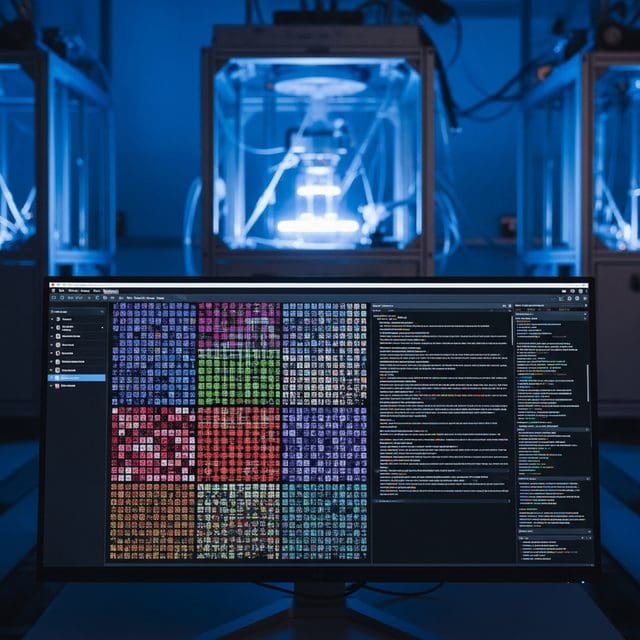
The framework, detailed in a paper for the IEEE QCE 2026 conference titled “Aligning Quantum Operators with Large Language Models,” utilizes Pauli Transfer Matrices (PTMs) to represent quantum unitary operators as image-like grids. These 256×256 grids are divided into smaller 16×16 patches, allowing a multimodal AI to process quantum data much like it would a photograph or a digital scan. This approach enables what the researchers call language-conditioned circuit synthesis, where a user can provide text-based instructions to guide how a quantum circuit is built, optimized, and mapped onto physical qubits. Specifically, the architecture was tested for 4-qubit Clifford+T unitary synthesis, proving that general-purpose foundation models can handle structured quantum data beyond simple text.
From a technical standpoint, the innovation moves away from traditional, rigid symbolic optimization. Instead, it treats quantum compilation as a multimodal learning problem. By training on these visual representations, the AI can identify patterns and efficiencies that human-tuned heuristics often miss. The results are measurable: the system achieved higher compilation success rates than traditional methods, particularly when dealing with the inherent noise and constraints of current hardware. This is a vital step forward for the industry, as the bottleneck in scaling quantum computers is no longer just the number of qubits, but the software tools required to manage them. The researchers noted that the model’s performance scales consistently with training data and inference-time compute, showing no signs of saturation, which suggests this is a new class of model rather than a one-off demo.
This development is particularly relevant for those concerned with national technological sovereignty and the future of American innovation. As the global race for quantum supremacy intensifies, the ability to simplify the interface between human operators and complex machines becomes a strategic necessity. By leveraging existing generative AI architectures to solve physics-based problems, the project demonstrates a path toward decentralized innovation where high-level quantum programming becomes accessible to a broader range of engineers, rather than being locked behind a small cadre of specialized physicists. It ensures that the control of these powerful systems remains intuitive and grounded in human-readable instructions, rather than opaque, centralized black-box algorithms.
Beyond the MIT-IBM project, other institutions are also pushing the boundaries of quantum hardware and memory. For instance, ETH Zurich recently demonstrated a vibrating quantum RAM that stores information as acoustic vibrations using mechanical resonators. This hybrid design separates processing from memory on-chip, increasing storage density and extending coherence times. Similarly, the startup EeroQ has validated CMOS-controlled electron shuttling on superfluid helium, a method that could allow for routing up to one million qubits with fewer than fifty control lines. These collective advancements, particularly the integration of AI into the quantum stack, ensure that the next generation of computing remains grounded in efficient, reliable engineering.
By reducing the reliance on human-tuned heuristics and moving toward automated, language-driven synthesis, the scientific community is laying the groundwork for a future where quantum power is not just a laboratory curiosity, but a functional tool for solving the world’s most difficult computational problems. The MIT and IBM framework proves that the language of the future is not just code, but a synthesis of human intent and quantum reality. As these technologies mature, they will likely become the backbone of a new era of American industrial and scientific leadership, provided they are developed with the transparency and accessibility that these multimodal frameworks promise.

Mason Reed serves as a Staff Writer for Just Right News, where he spearheads the Future Frontiers & Special Projects desk. In an era defined by rapid technological shifts and evolving social landscapes, Mason provides a steady, principled voice, examining the innovations of tomorrow through the lens of traditional American values. His work is most prominently featured in his signature series, “The Next Horizon,” where he explores the intersection of emerging technology, national sovereignty, and the preservation of individual liberty.
A native of San Diego, California, Mason’s worldview was shaped by the unique culture of his hometown. Growing up in a region defined by its strong military presence and its history of maritime industry, he developed a deep-seated respect for the institutions that provide national stability and the entrepreneurial spirit that drives the American economy. This upbringing instilled in him a belief that true progress is not found in discarding the past, but in building upon a foundation of proven principles. His reporting often reflects this San Diego influence, emphasizing the importance of a robust national defense and the necessity of maintaining a competitive edge in the global marketplace.
Now based in San Francisco, Mason operates from the heart of the world’s technological engine. Living and working in the Bay Area provides him with a front-row seat to the advancements—and the ideological challenges—emanating from Silicon Valley. While many in the region embrace a “move fast and break things” mentality, Mason’s reporting serves as a vital counterweight. He offers Just Right News readers a “boots on the ground” perspective, documenting how radical local policies and the concentration of tech power impact the everyday lives of citizens. His proximity to the industry allows him to cut through the marketing jargon of big tech to uncover the real-world implications for privacy, free speech, and the nuclear family.
In his “Future Frontiers” beat, Mason tackles complex subjects ranging from the ethics of artificial intelligence to the burgeoning private space race. He approaches these topics with a healthy skepticism toward centralized bureaucracy, championing instead the decentralized innovations that empower individuals. Through “The Next Horizon,” he highlights the pioneers and thinkers who are working to ensure that the future remains a place where human dignity and constitutional rights are protected. He believes that the rapid pace of change requires more than just technical expertise; it requires a moral compass rooted in the Western tradition.
Throughout his tenure at Just Right News, Mason has remained committed to the idea that the future is something to be shaped, not merely accepted. His writing is characterized by a rigorous defense of American exceptionalism and a belief that the country’s best days lie ahead, provided it remains true to its founding ideals. Whether he is investigating the impact of automation on the American workforce or profiling the next generation of aerospace engineers, Mason Reed ensures that his readers are equipped with the insights they need to navigate a changing world with confidence and clarity.