

President Trump declares the Iran ceasefire over and refuses to sign a bipartisan housing bill, signaling a period of heightened friction between the White House and congressional leadership.
The delicate balance of power between the executive and legislative branches faced significant strain this week as President Donald Trump declared an end to the interim ceasefire with Iran and signaled his refusal to sign a bipartisan housing package. These maneuvers, punctuated by the abrupt dismissal of leadership at the Election Assistance Commission (EAC), suggest a White House increasingly willing to bypass traditional consensus in favor of unilateral executive action. The President’s recent rhetoric and administrative directives indicate a principled skepticism toward established diplomatic and legislative processes, favoring instead a direct, confrontational approach to both foreign adversaries and domestic political opponents.
On July 10, the President publicly stated that the ceasefire with Tehran is officially “over,” suggesting the United States should “finish the job.” This declaration followed intelligence reports shared by Israel regarding a reported Iranian plot to assassinate the President. While the administration has agreed to continue high-level talks, the President has reportedly left instructions for unprecedented retaliatory strikes should an assassination attempt occur. This shift toward potential military escalation in the Strait of Hormuz raises immediate constitutional questions regarding war powers and the necessity of congressional authorization for sustained kinetic operations. As the U.S. Navy maintains a heavy presence in this critical oil chokepoint, the prospect of renewed hostilities places the burden on Congress to decide whether to authorize or constrain the Commander-in-Chief’s expanding theater of operations.
Domestically, the President has adopted a similarly confrontational stance toward the legislative branch. Despite the successful passage of the 21st Century ROAD to Housing Act—a bipartisan effort intended to address national housing shortages and streamline local governance policy—the President announced he would not sign the measure. The refusal is framed as a protest against the Senate’s failure to pass the Safeguard American Voter Eligibility (SAVE America) Act. Under Article I, Section 7 of the Constitution, the housing bill became law at midnight on July 11 without the President’s signature, as he declined to exercise a formal veto. This rare occurrence highlights a growing rift where the executive uses routine legislative enactments as leverage for unrelated policy demands, specifically those involving federal election rules.
Further complicating the administrative landscape is the sudden removal of the EAC leadership. As the agency responsible for providing security guidance and funding to state election officials, the EAC is central to the nation’s electoral infrastructure. The White House communicated the firings via email, a move that will likely trigger intense oversight from congressional committees concerned with election integrity and the stability of federal agencies. By removing these officials, the administration has signaled a desire for a total overhaul of the federal government’s role in state-level voting administration, a move that critics argue oversteps the boundaries of executive oversight and threatens the continuity of election security protocols.
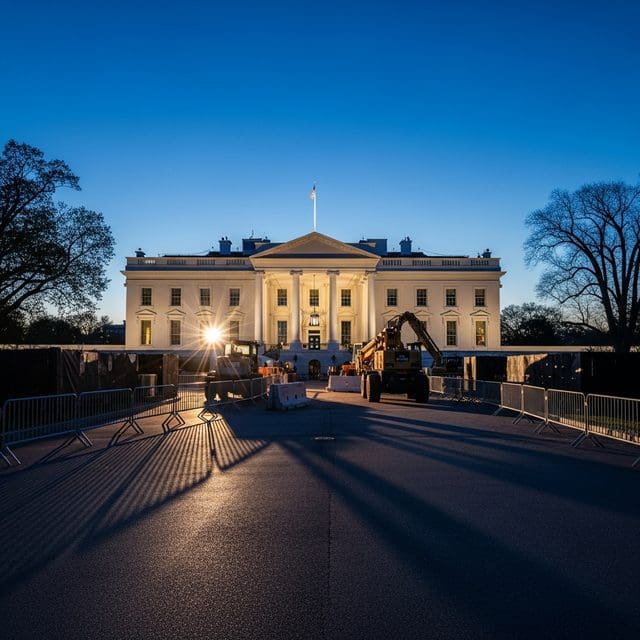
These developments occur against a backdrop of heightened security at the White House itself, where officials have begun a multi-month project to fortify the executive mansion’s entrance. From the Strait of Hormuz to the halls of the EAC, the administration appears to be retrenching, prioritizing executive prerogative and physical security over the collaborative frameworks traditionally expected by the Beltway establishment. For those who view the federal government through a lens of limited executive power, these actions represent a significant test of the constitutional guardrails designed to prevent the concentration of authority within the West Wing. As the fiscal year 2027 National Defense Authorization Act debates loom, the tension between the President’s “finish the job” doctrine and the legislative branch’s power of the purse will likely define the coming months in Washington.

Miles Harrington serves as the Senior Correspondent for Federal Systems & Executive Power at Just Right News, where he brings a disciplined, constitutionalist lens to the inner workings of the American government. With a focus on the mechanics of the federal bureaucracy and the limits of executive authority, Harrington has established himself as a vital voice for readers who value transparency, accountability, and the preservation of the separation of powers.
A native of Richmond, Virginia, Harrington’s perspective is deeply rooted in the traditions of the Old Dominion. Growing up in a city defined by its historical significance and its role as a center of American jurisprudence, he developed an early appreciation for the foundational principles of the Republic. His upbringing in Richmond—a place where the legacy of the Founding Fathers is woven into the landscape—instilled in him a belief that the federal government should remain within its constitutional bounds. This background informs his skepticism of centralized overreach and his commitment to reporting on the ways in which the administrative state impacts the lives of everyday citizens.
In his current role, Harrington specializes in the complexities of federal systems. He doesn’t just report on the headlines of the day; he digs into the structural shifts within the executive branch that often go unnoticed by the mainstream press. Whether he is analyzing the implications of a new federal regulation or investigating the expansion of agency jurisdiction, his work is characterized by a rigorous adherence to the facts and a dedication to the rule of law.
Harrington is perhaps best known for his signature feature series, “How Washington Works.” Through this ongoing project, he demystifies the often-opaque processes of the nation’s capital, pulling back the curtain on the “Deep State” and the unelected officials who wield significant influence over national policy. By breaking down complex legislative maneuvers and executive orders, he empowers Just Right News readers to understand the true levers of power in Washington. His reporting serves as a necessary check on the federal government, ensuring that the actions of those in power are held up to the light of public scrutiny.
Now based in Washington, D.C., Harrington operates at the epicenter of the political world, yet he remains intentionally distanced from the “Beltway bubble.” His proximity to the halls of power allows him to maintain a robust network of sources across the federal landscape, but his heart remains in the principled conservatism of his Virginia roots. He views his role not merely as a reporter, but as a steward of the public trust, dedicated to providing the clarity and context that conservative voters need to navigate an increasingly complex political environment.
Through his sharp analysis and unwavering commitment to the truth, Miles Harrington continues to be a cornerstone of the Just Right News team. His work ensures that the principles of limited government and executive restraint remain at the forefront of the national conversation, providing a crucial service to those who believe in a government that is truly of, by, and for the people.