

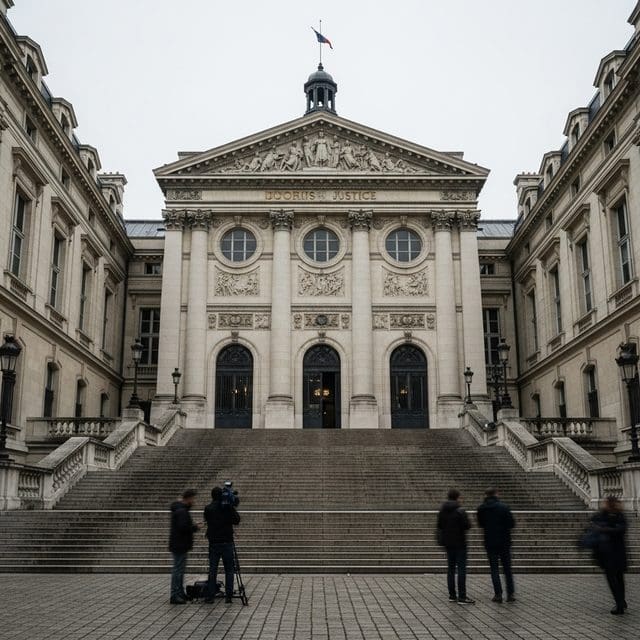
A Paris appeals court ruling on embezzlement charges will determine if Marine Le Pen is legally barred from contesting the 2027 presidential election.
The French judiciary stands at a critical juncture as a Paris appeals court prepares to deliver a verdict that could fundamentally reshape the 2027 presidential landscape. At issue is the appeal of Marine Le Pen, the National Rally leader convicted of embezzling European Parliament funds. The court’s decision will provide immediate doctrinal clarity on whether her five-year disqualification from public office remains in force, a move that would effectively strip her of the right to contest the nation’s highest office.
Prosecutors have urged the appellate panel to uphold the March 31, 2025, conviction, which centered on allegations that Le Pen and her party diverted approximately 4 to 5 million euros in European Parliament funds between 2004 and 2016. The underlying case, investigated by the European Parliament and the anti-fraud office OLAF, alleged that party staff were listed as parliamentary assistants to secure EU funding while they actually performed domestic political work. Beyond financial restitution, the prosecution seeks a four-year prison sentence—comprising one year of electronic monitoring and three years suspended—alongside the five-year ineligibility period.
The chronological math of the sentence is the primary hurdle for Le Pen’s political future. Because the original five-year ban has been running since March 31, 2025, any upheld disqualification exceeding two years from that start date would bar her from the April 18, 2027, presidential first round. Conversely, if the court reduces the ban to two years or less, she would technically remain eligible to stand. Le Pen has signaled that a sentence involving house arrest or electronic tagging would likely preclude a formal campaign, though she intends to remain active in the political sphere regardless of the outcome.
This case highlights the tension between judicial oversight and democratic participation. While transparency advocates note that over 100 lawmakers have faced similar clawbacks for budget abuses since 2019, the severity of the ineligibility penalty in this instance raises significant questions about the court’s role in vetting candidates through criminal law. Should the ruling go against her, Le Pen has a 10-day window to lodge a further challenge at the Cour de Cassation, France’s highest court. However, a final ruling close to the spring of 2027 could upend campaign planning even if judges ultimately shorten or lift the ban.
The National Rally has signaled a commitment to institutional continuity despite the legal pressure. Jordan Bardella, the 30-year-old party president, is positioned as a contingency candidate. Early polling suggests Bardella could match or exceed Le Pen’s support in some scenarios, limiting the electoral damage to the party even if its longtime figurehead is sidelined by the bench. This suggests that while the court may determine the fate of an individual, the underlying political movement remains resilient.
The French electorate now awaits a determination on whether the rule of law will permit Le Pen a third run for the Elysee Palace. The ruling serves as a reminder that in a system governed by the separation of powers, the judiciary remains the final arbiter of eligibility. The decision today will not only settle a personal legal battle but will also define the boundaries of political accountability for years to come.

Lila Hayes serves as a Staff Writer for Just Right News, where she anchors the “Courts, Law, and Constitutional Order” beat. Her work is defined by a steadfast commitment to the foundational principles of the American republic and a rigorous defense of the legal frameworks that ensure national stability. As a primary voice for the outlet, she provides readers with a clear-eyed analysis of the judiciary, focusing on the importance of originalism and the preservation of the separation of powers.
Lila’s perspective was forged in the American heartland. Raised in St. Louis, Missouri, she grew up in a Hispanic household where the values of hard work, faith, and respect for the law were paramount. Her upbringing instilled in her a deep appreciation for the American Dream and the legal protections that make it possible. This Missouri background remains a cornerstone of her reporting, providing a grounded, common-sense counter-narrative to the often-insular legal circles of the coastal elite. She understands that the decisions made in high-court chambers have real-world consequences for families and small business owners across the country.
At Just Right News, Lila has become widely recognized for her signature feature series, “The Rulebook of Power.” In this ongoing project, she delves into the mechanics of the federal government, examining how administrative overreach and judicial activism can threaten the delicate balance of the Constitution. She approaches her beat with the tenacity of a veteran journalist and the precision of a legal scholar, consistently advocating for a judiciary that interprets the law as written rather than legislating from the bench. For Lila, the Constitution is not a “living” document subject to the whims of modern social trends; it is a fixed standard that ensures the government remains the servant of the people, not their master.
Now based in Philadelphia, Pennsylvania, Lila finds herself at the very epicenter of American constitutional history. Living and working in the city where the Founders drafted the documents she defends daily provides a constant source of inspiration. The historic halls and landmarks of Philadelphia serve as a daily reminder of the high stakes involved in her reporting. Her presence in the city allows her to bridge the gap between the historical intent of the law and its contemporary application, ensuring that the legacy of the Founding Fathers remains central to the national conversation.
Throughout her career, Lila has remained dedicated to the idea that a free society requires an informed citizenry and a transparent legal system. Her reporting is more than just a collection of headlines; it is a defense of the constitutional order that has sustained the nation for over two centuries. By focusing on the “Rulebook of Power,” she ensures that her readers understand not just what is happening in the courtrooms, but why those decisions matter for the future of American liberty. Lila Hayes continues to be a vital voice for those who believe that the law should be a shield for the citizen and a constraint on the state.