

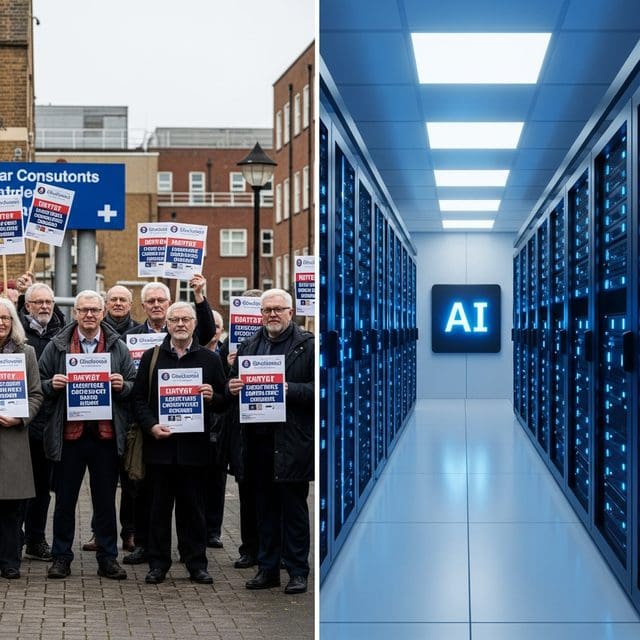
English consultants authorize a year-long strike mandate while Google debuts self-healing AI training, highlighting the growing divide between public sector labor disputes and private sector automation.
The global labor landscape is witnessing a profound divergence as high-skilled public sector workers in England move toward historic work stoppages while private sector technology firms achieve new milestones in automated resilience. In the United Kingdom, senior doctors have officially voted for strike action, granting consultants a 12-month mandate after a ballot returned a 76% majority in favor. This escalation stems from a long-standing dispute over pay and pensions, signaling a breakdown in the traditional social contract between the state and its medical professionals.
The British government has responded by hardening its policy stance. Officials at GOV.UK confirmed that previously planned specialty training posts—intended to add 4,500 positions over three years—can no longer be accelerated. The government cited the financial impact of industrial action as the reason for withdrawing the offer to bring 1,000 posts forward this year. This friction highlights a core tension: as governments attempt to link pay to NHS productivity, workers are increasingly willing to withdraw labor to protect their standard of living.
While healthcare remains mired in human-centric negotiations, the tech industry is pursuing productivity through automation that requires less human oversight. Google has introduced “elastic training” via its MaxText and JAX libraries, solving a persistent headache in AI development. Historically, the failure of a single Tensor Processing Unit (TPU) during a training run would crash the entire job, forcing manual intervention. Google’s new system now recovers from a killed TPU run in under two minutes, using Kubernetes to reschedule replacement pods automatically. This leap ensures multi-million dollar projects continue without around-the-clock technician monitoring.
However, this automation is not without hurdles. Google researchers noted that recovery can fail if checkpoints exceed memory limits when routed through proxies, requiring direct persistence from TPU hosts to Cloud Storage. This serves as a reminder that even as automation replaces routine oversight, it creates a demand for higher-level technical troubleshooting. For the American worker, these developments in Silicon Valley are not just abstract news; they represent a fundamental shift in how productivity is achieved in a competitive global market.
Closer to home, the industrial heartland continues to see a resurgence in labor organization. In Glen Dale, West Virginia, 201 drivers and warehouse workers at Highline Warren voted on July 2 to join Teamsters Local 697. This move occurs against a backdrop of cooling semiconductor markets and rising costs. Samsung Electronics recently proposed a 20% increase in the price of DRAM chips, citing industry bottlenecks. These supply chain disruptions, combined with Morgan Stanley’s analysis of a bumpy market, place pressure on American manufacturing workers navigating fluctuating demand.
The domestic healthcare sector is also feeling the heat. Mass General Brigham Home Care clinicians authorized a seven-day strike starting July 8 after negotiations stalled. This mirrors the unrest in England, suggesting that the service and care sectors are reaching a breaking point. As automation like MaxText streamlines the digital economy, the physical economy—from West Virginia warehouses to Massachusetts home care—remains a battleground for wage dignity. The challenge will be ensuring gains from high-tech productivity do not further squeeze the manual trades that keep the country running.

Tom Blake serves as the Senior Correspondent for Labor, Wages, and Automation at Just Right News, where he brings a grounded, principled perspective to the most pressing economic issues facing the American heartland. As the lead voice behind the acclaimed feature series “The Price of Work,” Tom focuses his reporting on the intersection of traditional industry and the rapidly evolving technological landscape, always prioritizing the dignity of the individual worker and the health of the American family.
Tom’s deep understanding of the labor market is not merely academic; it is rooted in his upbringing in Detroit, Michigan. Growing up in the shadow of the automotive industry, he witnessed firsthand the triumphs and tribulations of the American blue-collar workforce. He saw how the stability of a manufacturing job could build a community and, conversely, how the erosion of those industries could tear the social fabric apart. This background instilled in him a lifelong respect for the trades and a healthy skepticism toward economic policies that prioritize globalist interests over the well-being of local communities.
Now based in Pittsburgh, Pennsylvania, Tom continues to report from the front lines of the shifting economy. Pittsburgh, a city that has reinvented itself while maintaining its gritty, industrious spirit, provides the perfect vantage point for his beat. From the steel mills that remain to the high-tech robotics labs reshaping the city’s future, Tom explores how automation is changing the nature of employment. His reporting often highlights the tension between innovation and tradition, arguing that while progress is inevitable, it must not come at the expense of the American worker’s ability to provide for their family through honest, meaningful labor.
In his role at Just Right News, Tom has become a vital voice for those who feel overlooked by mainstream economic coverage. He rejects the notion that the decline of American manufacturing is an unavoidable casualty of the modern era. Instead, his work often examines how regulatory overreach, rising energy costs, and the unchecked rise of automation impact the take-home pay of everyday citizens. Through “The Price of Work,” Tom delves into the true cost of economic shifts, looking beyond the raw data to tell the stories of the people behind the statistics.
Tom’s reporting is characterized by a commitment to the conservative values of self-reliance, fiscal responsibility, and the preservation of the American dream. He believes that a strong nation is built on a foundation of stable jobs and fair wages, and his work seeks to hold both government and corporate entities accountable to that standard. Whether he is interviewing a shop floor manager about the implementation of new AI technology or analyzing the impact of wage inflation on small businesses, Tom provides a clear-eyed analysis that resonates with readers who value hard work and common sense.
Through his dedicated coverage, Tom Blake remains a steadfast advocate for the American workforce, ensuring that the voices of those in the industrial heartland are heard loud and clear in the national conversation. His perspective is essential for anyone seeking to understand the complex realities of labor and automation in the twenty-first century.