

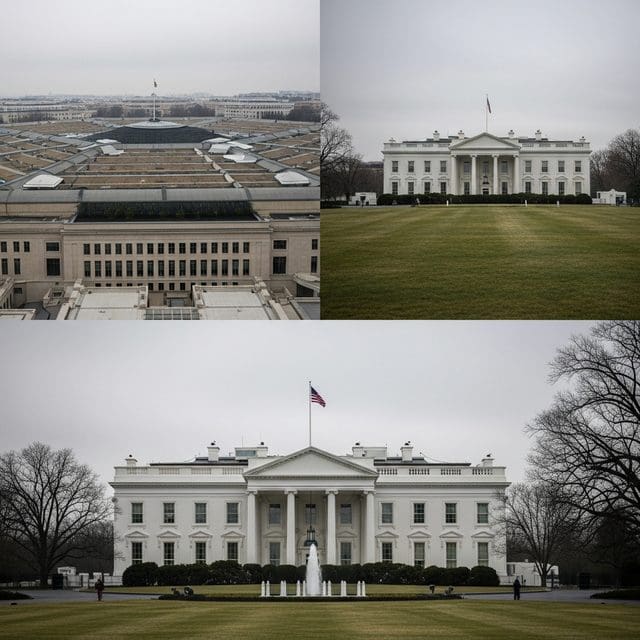
President Trump’s musing on cutting U.S. forces in Europe by one-third has evolved into a formal six-month review, testing the limits of executive power and congressional oversight.
As the July 9 NATO summit in Ankara approaches, the Trump administration has transitioned from rhetorical pressure to a formal administrative review of the United States’ military footprint in Europe. Defense Secretary Pete Hegseth recently announced a six-month study of U.S. forces, following President Trump’s private musings regarding a one-third reduction in troop levels. This strategic pivot appears rooted in executive frustration over the refusal of certain NATO allies to support U.S. military operations in Iran, marking a significant departure from traditional post-war consensus. The review serves as a demystification of the administrative state’s role in foreign policy, where bureaucratic assessments are now being leveraged to challenge the ‘Beltway bubble’ regarding permanent overseas deployments.
The administrative state is already executing preliminary drawdowns that signal this is more than mere posturing. The administration has halted a scheduled troop rotation through Poland and removed 5,000 personnel from Germany, leaving approximately 30,000 troops in the country. While a total withdrawal from the alliance would likely require congressional consent, the President retains significant authority over troop deployments and base closures. Current reporting suggests the White House is considering reallocating resources away from nations critical of U.S. foreign policy toward more supportive partners such as Romania, Lithuania, and Greece. This reallocation strategy treats military presence as a reward for diplomatic alignment rather than a static commitment.
On Capitol Hill, Speaker Mike Johnson faces a complex legislative landscape as he attempts to navigate the President’s agenda through a fractured Republican conference. Although Johnson recently secured a major legislative victory, internal feuds over border security provisions continue to threaten the administration’s momentum. To bypass procedural hurdles and internal GOP revolts, Johnson has indicated he will utilize the budget reconciliation process to advance signature voter ID legislation. This move highlights the increasing reliance on technical maneuvers to achieve policy goals in a divided Washington, as the anti-incumbent mood sweeping the nation puts both parties on notice ahead of the midterms. The use of reconciliation allows the House to bypass the traditional filibuster, though it remains a tool of last resort for a leadership struggling to maintain order.
The judiciary also remains a critical check on executive action. A federal judge recently ruled that the administration’s broad January 6 pardons do not extend to a Virginia man accused of planting pipe bombs, asserting that clemency power—while expansive—is not a shield for conduct falling outside the specific scope of the pardon’s language. This ruling reinforces the constitutional reality that presidential clemency applies strictly to federal offenses and cannot be applied to impeachment cases. Meanwhile, the Supreme Court has allowed Texas to enforce age-verification requirements for mobile apps, a decision that may force Congress to move beyond its current stalemate on national tech regulation and parental consent laws.
Beyond these high-level maneuvers, the administration continues to engage in domestic projects that blend populist appeal with federal oversight. The launch of ‘Trump Accounts’—federal savings accounts for newborns—represents a new frontier in federal social policy, targeting children born between 2025 and 2028. Simultaneously, Interior Secretary Doug Burgum’s announcement regarding the $14.6 million renovation of the Lincoln Memorial Reflecting Pool underscores a focus on maintaining national symbols. As the President prepares for high-stakes meetings with Ukrainian President Volodymyr Zelensky and Syrian President Ahmed al-Sharaa in Turkey, the interplay between executive mandates, judicial limits, and a restless Congress will define the remainder of the summer session.

Miles Harrington serves as the Senior Correspondent for Federal Systems & Executive Power at Just Right News, where he brings a disciplined, constitutionalist lens to the inner workings of the American government. With a focus on the mechanics of the federal bureaucracy and the limits of executive authority, Harrington has established himself as a vital voice for readers who value transparency, accountability, and the preservation of the separation of powers.
A native of Richmond, Virginia, Harrington’s perspective is deeply rooted in the traditions of the Old Dominion. Growing up in a city defined by its historical significance and its role as a center of American jurisprudence, he developed an early appreciation for the foundational principles of the Republic. His upbringing in Richmond—a place where the legacy of the Founding Fathers is woven into the landscape—instilled in him a belief that the federal government should remain within its constitutional bounds. This background informs his skepticism of centralized overreach and his commitment to reporting on the ways in which the administrative state impacts the lives of everyday citizens.
In his current role, Harrington specializes in the complexities of federal systems. He doesn’t just report on the headlines of the day; he digs into the structural shifts within the executive branch that often go unnoticed by the mainstream press. Whether he is analyzing the implications of a new federal regulation or investigating the expansion of agency jurisdiction, his work is characterized by a rigorous adherence to the facts and a dedication to the rule of law.
Harrington is perhaps best known for his signature feature series, “How Washington Works.” Through this ongoing project, he demystifies the often-opaque processes of the nation’s capital, pulling back the curtain on the “Deep State” and the unelected officials who wield significant influence over national policy. By breaking down complex legislative maneuvers and executive orders, he empowers Just Right News readers to understand the true levers of power in Washington. His reporting serves as a necessary check on the federal government, ensuring that the actions of those in power are held up to the light of public scrutiny.
Now based in Washington, D.C., Harrington operates at the epicenter of the political world, yet he remains intentionally distanced from the “Beltway bubble.” His proximity to the halls of power allows him to maintain a robust network of sources across the federal landscape, but his heart remains in the principled conservatism of his Virginia roots. He views his role not merely as a reporter, but as a steward of the public trust, dedicated to providing the clarity and context that conservative voters need to navigate an increasingly complex political environment.
Through his sharp analysis and unwavering commitment to the truth, Miles Harrington continues to be a cornerstone of the Just Right News team. His work ensures that the principles of limited government and executive restraint remain at the forefront of the national conversation, providing a crucial service to those who believe in a government that is truly of, by, and for the people.