

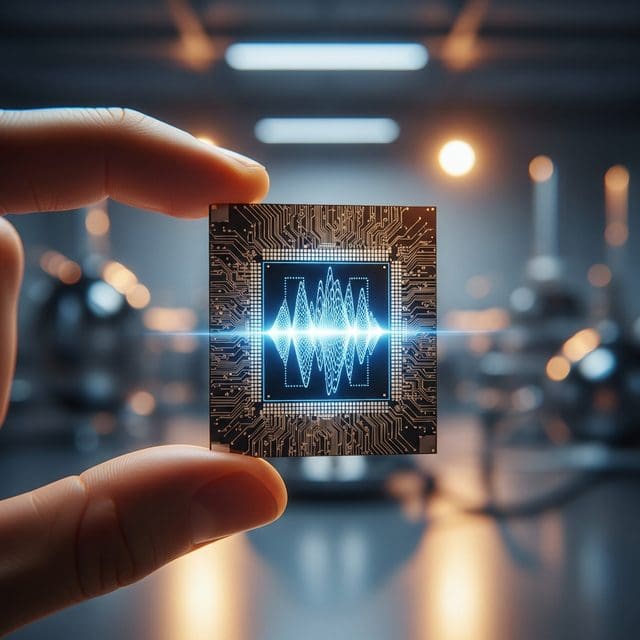
Researchers have extended the lifespan of magnons by nearly 100 times, paving the way for miniaturized quantum processors that replace bulky cryogenic systems with chip-scale magnetic wave technology.
The quest for a practical quantum computer has long been a battle against time and scale. For years, the promise of quantum supremacy has been confined to massive, liquid-helium-cooled refrigerators housed in specialized laboratories, creating a centralized bottleneck for one of the most transformative technologies of the century. However, a significant breakthrough in condensed-matter physics reported this week suggests that the future of decentralized, high-performance computing may eventually fit in the palm of a hand, returning the power of advanced computation to the individual level.
At the heart of this shift are magnons—quanta of spin waves within magnetic materials. Previously, these tiny magnetic excitations were dismissed as too fleeting for serious computational use, with lifespans measured in mere hundreds of nanoseconds. New research highlighted by ScienceDaily reveals that by utilizing ultra-pure yttrium iron garnet at millikelvin temperatures, scientists have extended magnon lifetimes by nearly 100 times, reaching up to 18 microseconds. This leap in stability transforms magnons from short-lived anomalies into viable quantum information buses, capable of holding state long enough to perform complex logic operations.
Because magnons possess nanometer-scale wavelengths, they can carry data across a chip far more efficiently than the bulky microwave resonators used in current quantum architectures. This allows for the integration of quantum logic and interconnects on smartphone-sized chips, moving away from the centralized, mainframe-style bureaucracy of today’s quantum prototypes. The University of Chicago and Argonne National Laboratory have already demonstrated direct control over the interaction between microwave photons and magnons, essentially creating a tunable quantum channel. This burgeoning field, branded as magnonics, represents a new domain where spin waves act as the primary architecture for information transfer.
While the physics remains complex, the implications for American innovation are clear. The development of magnonics offers a path toward hardware that is not only more powerful but also more portable and resilient. By proving that the primary limitation to magnon longevity was material purity rather than a fundamental law of physics, researchers have handed the baton to American engineers and manufacturers to refine these materials for commercial use. This aligns with broader efforts in the sector, such as the Fraunhofer ILT development of laser-optical systems that control 2,000 Rydberg atoms with submicrometer precision, further proving that the tools for high-precision quantum manufacturing are rapidly maturing.
Parallel advancements are also challenging our fundamental understanding of the universe at the largest scales. While some researchers focus on the microscopic, others are questioning the cosmological principle—the long-held assumption that the universe is statistically uniform and isotropic in all directions. New evidence of a puzzling mismatch in measurements of the cosmic microwave background suggests that the universe may have a directional dependence. If the universe is not perfectly uniform, the standard models of dark energy and cosmic evolution that have guided federal research for decades may require a total re-evaluation.
In the realm of immediate application, the push for room-temperature quantum devices is also gaining ground. Recent work at Stanford University has successfully used twisted light to entangle photons and electrons without the need for extreme cooling. This complements the magnon breakthrough by addressing the cooling requirements that currently make quantum computers inaccessible to the average citizen. Whether looking at the vast reaches of space or the microscopic oscillations of a magnetic wave, these discoveries underscore a vital truth: the frontier of knowledge is never settled. For the American innovator, the transition from massive, centralized quantum vats to coin-sized, chip-scale processors represents the next great step in maintaining technological sovereignty and individual liberty in the digital age.

Mason Reed serves as a Staff Writer for Just Right News, where he spearheads the Future Frontiers & Special Projects desk. In an era defined by rapid technological shifts and evolving social landscapes, Mason provides a steady, principled voice, examining the innovations of tomorrow through the lens of traditional American values. His work is most prominently featured in his signature series, “The Next Horizon,” where he explores the intersection of emerging technology, national sovereignty, and the preservation of individual liberty.
A native of San Diego, California, Mason’s worldview was shaped by the unique culture of his hometown. Growing up in a region defined by its strong military presence and its history of maritime industry, he developed a deep-seated respect for the institutions that provide national stability and the entrepreneurial spirit that drives the American economy. This upbringing instilled in him a belief that true progress is not found in discarding the past, but in building upon a foundation of proven principles. His reporting often reflects this San Diego influence, emphasizing the importance of a robust national defense and the necessity of maintaining a competitive edge in the global marketplace.
Now based in San Francisco, Mason operates from the heart of the world’s technological engine. Living and working in the Bay Area provides him with a front-row seat to the advancements—and the ideological challenges—emanating from Silicon Valley. While many in the region embrace a “move fast and break things” mentality, Mason’s reporting serves as a vital counterweight. He offers Just Right News readers a “boots on the ground” perspective, documenting how radical local policies and the concentration of tech power impact the everyday lives of citizens. His proximity to the industry allows him to cut through the marketing jargon of big tech to uncover the real-world implications for privacy, free speech, and the nuclear family.
In his “Future Frontiers” beat, Mason tackles complex subjects ranging from the ethics of artificial intelligence to the burgeoning private space race. He approaches these topics with a healthy skepticism toward centralized bureaucracy, championing instead the decentralized innovations that empower individuals. Through “The Next Horizon,” he highlights the pioneers and thinkers who are working to ensure that the future remains a place where human dignity and constitutional rights are protected. He believes that the rapid pace of change requires more than just technical expertise; it requires a moral compass rooted in the Western tradition.
Throughout his tenure at Just Right News, Mason has remained committed to the idea that the future is something to be shaped, not merely accepted. His writing is characterized by a rigorous defense of American exceptionalism and a belief that the country’s best days lie ahead, provided it remains true to its founding ideals. Whether he is investigating the impact of automation on the American workforce or profiling the next generation of aerospace engineers, Mason Reed ensures that his readers are equipped with the insights they need to navigate a changing world with confidence and clarity.