

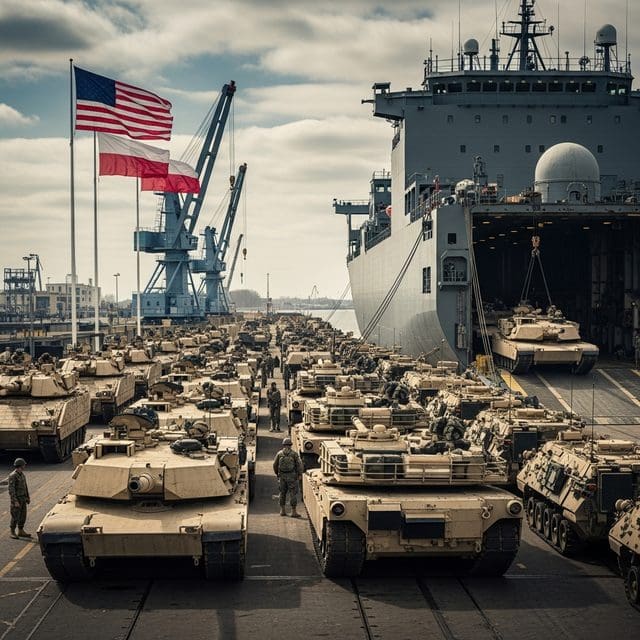
The Pentagon resumed troop rotations to Poland this week amid warnings of a Russian provocation, while Iran manages a leadership transition following the death of its Supreme Leader.
The Pentagon has officially resumed the rotation of U.S. troops into Poland, a strategic move intended to stabilize NATO’s eastern flank as intelligence reports warn of a looming Russian provocation. U.S. officials have informed Polish counterparts that Moscow may be preparing an armed incident involving missiles, drones, or a limited border incursion originating from the Kaliningrad exclave or Belarus. This tactical shift comes after the Trump administration previously reversed a 4,000-troop delay, ultimately committing an additional 5,000 personnel to the region in May. The live question for defense planners is whether the current rotation merely restores the earlier footprint or represents a permanent expansion of the American presence in the Suwalki Gap.
The heightened alert follows a devastating Russian assault on Ukraine that has tested the limits of Western air defenses. On July 2, Moscow launched a massive barrage of 74 missiles and 496 drones at Kyiv, resulting in at least 30 deaths and widespread infrastructure damage. Subsequent strikes across Dnipropetrovsk, Zaporizhzhia, and Sumy claimed additional lives, signaling the Kremlin’s intent to maintain maximum pressure on the West’s resolve. NATO Secretary-General Mark Rutte, facing pressure at a July 5 summit, has had to navigate demands for increased loyalty and burden-sharing from Washington while the alliance weighs direct responses to potential incursions. The Pentagon is reportedly considering direct action against Kaliningrad assets should Russia initiate a border violation.
In the Middle East, the geopolitical landscape is shifting as Iran navigates a sensitive succession period. Following the death of the Supreme Leader, a week-long sequence of state funerals has drawn millions to the streets, with the schedule moving through Qom on Tuesday and Najaf/Kerbala on Wednesday before a final burial in Mashhad this Thursday. However, the notable absence of Mojtaba Khamenei from public view since March has fueled speculation regarding a power struggle. Analysts suggest the Islamic Revolutionary Guard Corps (IRGC) may be consolidating influence to ensure regime continuity, even as Russia’s Rosatom plans to return personnel to the Bushehr nuclear plant in mid-July, a move that could signal a stabilization of energy cooperation despite the regional turmoil.
The security of the Strait of Hormuz remains a central concern for global markets and defense planners, with the issue expected to dominate the remainder of the NATO summit. Recent discussions have prioritized maritime security as the ongoing conflict continues to disrupt international supply chains, forcing industries from fashion to energy to reassess their resilience. While the White House remains focused on internal policy shifts—including a recent report branding Smithsonian leadership as radical activists and the FBI’s ongoing investigation into Georgia’s 2020 election—the administration’s foreign policy is increasingly defined by the ‘peace through strength’ doctrine on two fronts.
Domestically, the administration’s focus on national priorities has led to significant shifts, such as the July 5 decision not to seek new bids for the Reflecting Pool repairs on the National Mall. This occurs as the political landscape shifts at home; Democrat Mallory McMorrow suspended her Michigan Senate campaign on July 5, and the FBI has directed hundreds of analysts to its Georgia election probe. These domestic maneuvers provide the backdrop for a robust foreign policy that prioritizes American interests and Western tradition. The administration has also maintained a hardline stance on trade, recently granting tariff relief to the diamond industry, which resulted in a lavish gift for the President from a Belgian diamond group.
As the funeral sequence for Iran’s leader concludes, the Pentagon remains focused on the possibility of a multi-theater escalation. The alignment of Russian aggression in Eastern Europe and Iranian instability presents a complex challenge for American power. The coming months will determine if the reinforced presence in Poland is sufficient to deter a Russian move that could force NATO into a direct kinetic confrontation. With the EPA proposing new herbicides and labor unions like the Teamsters winning votes in West Virginia, the administration is balancing a complex domestic agenda against the urgent need for a credible deterrent against the Kremlin’s expansionist ambitions.

Olivia Kendall serves as the Senior Correspondent for Geopolitics, Defense, and Foreign Policy at Just Right News, where she provides a principled, conservative perspective on the complex forces shaping the global stage. With a career dedicated to deconstructing the intricacies of international relations, Kendall has become a trusted voice for readers who value national sovereignty, a robust military, and a foreign policy that prioritizes American interests above all else.
A native of Washington, D.C., Kendall’s professional journey is deeply rooted in her upbringing within the nation’s capital. Growing up in the epicenter of American political life, she developed an early and profound understanding of how policy is crafted and, more importantly, how it often fails to account for the values of the American heartland. This unique vantage point allowed her to witness firsthand the rise of globalist bureaucracies, fueling her commitment to reporting that champions the constitutional foundations of the United States. Her background as a British White American further informs her worldview, providing her with a keen appreciation for the Western tradition and the enduring importance of the “Special Relationship” in maintaining global stability.
Now based in Arlington, Virginia, Kendall operates from the doorstep of the Pentagon and the heart of the nation’s defense establishment. Her proximity to the decision-makers in the military and intelligence communities allows her to provide boots-on-the-ground reporting that is both timely and deeply informed. For Kendall, Arlington is more than just a base of operations; it is a daily reminder of the sacrifices made by the men and women in uniform. This connection to the defense community drives her rigorous coverage of military readiness and her advocacy for a “peace through strength” approach to diplomacy.
At Just Right News, Kendall is perhaps best known for her acclaimed feature series, “The World’s Shadow on America.” In this ongoing project, she explores the direct correlation between international developments and the daily lives of American citizens. Whether she is analyzing the encroachment of foreign adversaries in domestic supply chains or the impact of international treaties on local economies, Kendall’s work serves as a vital bridge between distant geopolitical shifts and their consequences at home. She rejects the notion that foreign policy is an abstract concern for elites, instead proving that what happens in the corridors of power in Brussels or Beijing has a tangible “shadow” that falls across every American doorstep.
Throughout her tenure, Kendall has remained a steadfast critic of international overreach and a vocal proponent of a clear-eyed, realistic foreign policy. She brings a sharp analytical mind to her beat, often challenging the prevailing narratives of the mainstream media to uncover the underlying truths that affect national security. Her reporting is characterized by a refusal to compromise on the truth and a dedication to the idea that a strong, secure America is the world’s best hope for liberty. As a Senior Correspondent, Olivia Kendall continues to lead the charge in providing the essential context and conservative insight necessary to navigate an increasingly volatile world.