

President Trump celebrates America’s 250th birthday with new currency and policy launches while Congress struggles to advance defense spending and investors face massive losses from a presidential memecoin.
The United States marked its 250th anniversary this week with a series of high-profile executive actions and symbolic gestures, even as the gears of the legislative branch ground to a halt. President Trump utilized the Independence Day milestone to launch ‘Trump Accounts,’ a new federal savings initiative for children born between 2025 and 2028. The rollout coincided with Treasury Secretary Scott Bessent’s unveiling of new U.S. currency featuring the President’s signature, signaling an effort to weave the current administration’s identity into the national celebration. These accounts, available to children with Social Security numbers under age 18, represent a significant expansion of the federal administrative footprint.
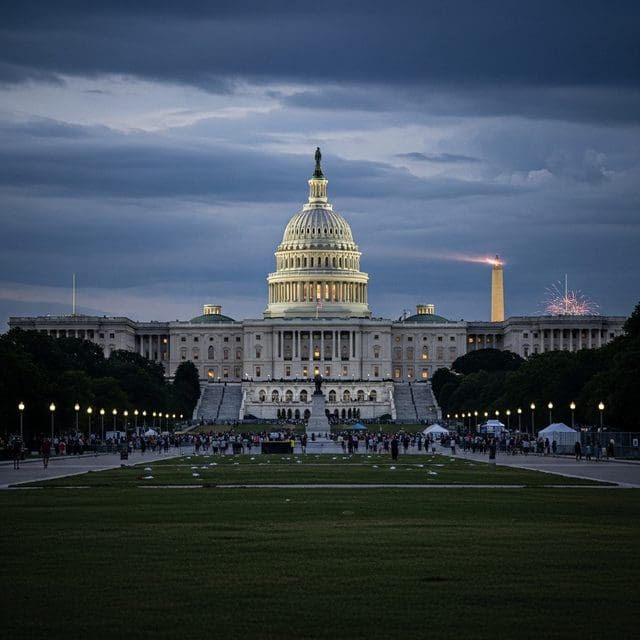
Festivities were tempered by severe weather and financial fallout for the President’s supporters. In Washington, D.C., a 107-degree heatwave delayed entry to the National Mall, while inclement weather pushed the President’s address past 11 p.m. Earlier, Trump delivered a speech at Mount Rushmore, framing national history as a bulwark against communism. While the administration projected strength, data from crypto firm Nansen revealed a darker reality: nearly one million investors in the $TRUMP memecoin have seen $3.81 billion in losses. Financial disclosures indicate that while retail investors suffered as the token dropped 97% from its peak, Trump-linked entities netted approximately $636 million in royalties through transaction fees regardless of price direction.
On Capitol Hill, the administrative state faced its own transitions. The Department of Government Efficiency (DOGE), a cost-cutting commission established by executive order in January 2025, officially reached its sunset date on July 4, 2026. While the commission was criticized for creating bureaucratic friction during its tenure, its functions have largely been absorbed into existing agencies. This quiet integration suggests that while the ‘DOGE’ brand may be expiring, the administration’s internal influence over the civilian workforce remains embedded within the federal architecture. The sunsetting marks a shift from high-profile disruption to a quieter institutionalization of its directives.
Legislative progress remains elusive as the House entered an early recess following a breakdown in negotiations over the National Defense Authorization Act (NDAA). Speaker Mike Johnson’s attempt to merge the defense bill with the SAVE America Act was blocked by more than a dozen House Republicans, forcing a premature end to the session. Despite this, the House Appropriations Committee advanced a $1.1 trillion defense spending bill for fiscal year 2027. This measure, which passed on a party-line vote, includes a proposal to rename the Pentagon as the ‘Department of War’ and carries riders aimed at restricting abortion access and targeting LGBTQ+ personnel within the military.
This legislative impasse, coupled with the lack of a ‘top line’ spending agreement in the Senate, sets the stage for a volatile autumn. Senate Appropriations Chair Patty Murray and Ranking Member Susan Collins remain billions of dollars apart, threatening the September 30 funding deadline. Beyond Congress, the nation faces diverse challenges, from a seven-day strike by Mass General Brigham Home Care clinicians to record drowning deaths in Florida. For the constitutionalist, the current landscape offers a reminder of the tension between executive showmanship and the disciplined, deliberative process required to fund the republic’s essential functions.

Miles Harrington serves as the Senior Correspondent for Federal Systems & Executive Power at Just Right News, where he brings a disciplined, constitutionalist lens to the inner workings of the American government. With a focus on the mechanics of the federal bureaucracy and the limits of executive authority, Harrington has established himself as a vital voice for readers who value transparency, accountability, and the preservation of the separation of powers.
A native of Richmond, Virginia, Harrington’s perspective is deeply rooted in the traditions of the Old Dominion. Growing up in a city defined by its historical significance and its role as a center of American jurisprudence, he developed an early appreciation for the foundational principles of the Republic. His upbringing in Richmond—a place where the legacy of the Founding Fathers is woven into the landscape—instilled in him a belief that the federal government should remain within its constitutional bounds. This background informs his skepticism of centralized overreach and his commitment to reporting on the ways in which the administrative state impacts the lives of everyday citizens.
In his current role, Harrington specializes in the complexities of federal systems. He doesn’t just report on the headlines of the day; he digs into the structural shifts within the executive branch that often go unnoticed by the mainstream press. Whether he is analyzing the implications of a new federal regulation or investigating the expansion of agency jurisdiction, his work is characterized by a rigorous adherence to the facts and a dedication to the rule of law.
Harrington is perhaps best known for his signature feature series, “How Washington Works.” Through this ongoing project, he demystifies the often-opaque processes of the nation’s capital, pulling back the curtain on the “Deep State” and the unelected officials who wield significant influence over national policy. By breaking down complex legislative maneuvers and executive orders, he empowers Just Right News readers to understand the true levers of power in Washington. His reporting serves as a necessary check on the federal government, ensuring that the actions of those in power are held up to the light of public scrutiny.
Now based in Washington, D.C., Harrington operates at the epicenter of the political world, yet he remains intentionally distanced from the “Beltway bubble.” His proximity to the halls of power allows him to maintain a robust network of sources across the federal landscape, but his heart remains in the principled conservatism of his Virginia roots. He views his role not merely as a reporter, but as a steward of the public trust, dedicated to providing the clarity and context that conservative voters need to navigate an increasingly complex political environment.
Through his sharp analysis and unwavering commitment to the truth, Miles Harrington continues to be a cornerstone of the Just Right News team. His work ensures that the principles of limited government and executive restraint remain at the forefront of the national conversation, providing a crucial service to those who believe in a government that is truly of, by, and for the people.