

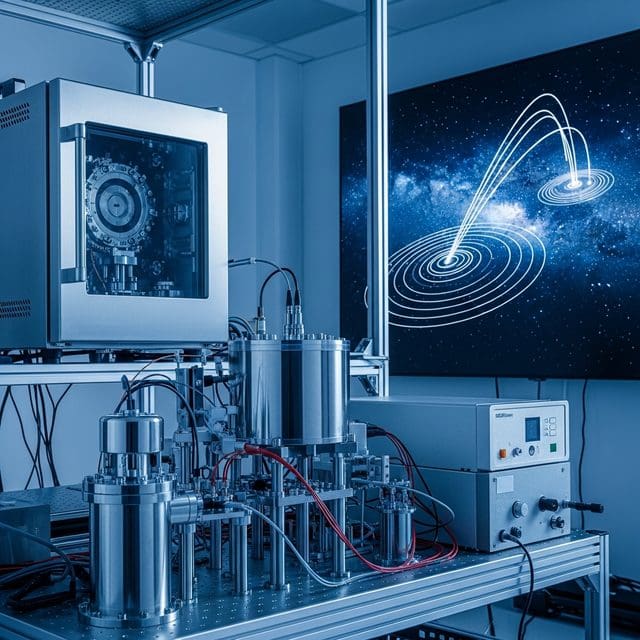
Recent physics discoveries, from CERN anomalies to new black hole theories, suggest the long-standing Standard Model may finally be giving way to a more complex understanding of the universe.
The foundational pillars of modern physics are showing significant cracks as a series of recent discoveries suggests the universe is far more complex than the current Standard Model allows. From the high-energy corridors of CERN to theoretical breakthroughs at the University of Waterloo, researchers are uncovering evidence of a reality that defies traditional bureaucratic consensus in the scientific community. These developments represent a shift toward a more nuanced understanding of the cosmos, one that values empirical anomaly over the comfort of established doctrine.
At the Large Hadron Collider (LHC), scientists have reported what they describe as the strongest hints yet of physics beyond the Standard Model. These observations involve “strange particle behavior” that aligns with previous tensions regarding muon-g-2 and flavor anomalies. For decades, the Standard Model has served as the definitive map for fundamental particles and forces, yet these new results suggest the existence of undiscovered particles or interactions. If these anomalies are confirmed as new physics rather than calculation errors, it would signal the end of an era of theoretical stagnation and the beginning of a new frontier in particle discovery.
Simultaneously, the long-standing black hole information paradox may have finally met its match. New theoretical work published this July suggests that black holes do not fully evaporate via Hawking radiation until they vanish into nothingness. Instead, they appear to halt their evaporation at the final stages, leaving behind tiny, Planck-scale remnants. Crucially, these remnants are believed to encode all the information that originally fell into the black hole using seven-dimensional geometry. This discovery preserves the principle of information conservation, a vital concept for maintaining the predictability and sovereignty of physical laws in our universe, ensuring that the history of matter is never truly erased by the void.
Cosmology is also facing a reckoning. Researchers at the University of Waterloo have proposed a new Big Bang scenario that replaces a singular point of beginning with a universe emerging from quantum gravity effects. This model moves away from the idea of a chaotic explosion and toward a more structured emergence, providing a concrete institutional challenge to established early-universe theories. This shift is complemented by recent LIGO gravitational-wave signals, which some physicists interpret as evidence of primordial black holes—relics from the dawn of time that could finally explain the mystery of dark matter in the Milky Way without the need for exotic, unobservable particles.
On the practical frontier, the rise of quantum-inspired algorithms is already yielding results that challenge the limits of centralized supercomputing. A new algorithm recently solved a materials science problem previously deemed “impossible” in mere seconds. While Silicon Valley often focuses on the cryptographic implications of quantum computing, these hybrid quantum-classical breakthroughs are proving their worth in condensed-matter physics, such as understanding why carbon black makes rubber so incredibly durable. This focus on tangible, materials-based progress reflects a return to practical innovation that serves the real-world needs of industry and infrastructure.
As these discoveries mount, the scientific community is moving toward a multi-messenger framework where gravitational waves, atomic spectroscopy, and particle accelerators work in tandem. New models suggest that gravitational waves might even modulate atomic emission lines, offering a surprising new way to detect ripples in spacetime by observing shifts in the light emitted by atoms. This decentralized approach to observation ensures that no single theory or institution can gatekeep the truth of the cosmos. The pursuit of these Future Frontiers continues to demonstrate that the universe favors complexity and individual discovery over rigid, centralized models, promising a future where the laws of nature are understood with greater clarity and less dogma.

Mason Reed serves as a Staff Writer for Just Right News, where he spearheads the Future Frontiers & Special Projects desk. In an era defined by rapid technological shifts and evolving social landscapes, Mason provides a steady, principled voice, examining the innovations of tomorrow through the lens of traditional American values. His work is most prominently featured in his signature series, “The Next Horizon,” where he explores the intersection of emerging technology, national sovereignty, and the preservation of individual liberty.
A native of San Diego, California, Mason’s worldview was shaped by the unique culture of his hometown. Growing up in a region defined by its strong military presence and its history of maritime industry, he developed a deep-seated respect for the institutions that provide national stability and the entrepreneurial spirit that drives the American economy. This upbringing instilled in him a belief that true progress is not found in discarding the past, but in building upon a foundation of proven principles. His reporting often reflects this San Diego influence, emphasizing the importance of a robust national defense and the necessity of maintaining a competitive edge in the global marketplace.
Now based in San Francisco, Mason operates from the heart of the world’s technological engine. Living and working in the Bay Area provides him with a front-row seat to the advancements—and the ideological challenges—emanating from Silicon Valley. While many in the region embrace a “move fast and break things” mentality, Mason’s reporting serves as a vital counterweight. He offers Just Right News readers a “boots on the ground” perspective, documenting how radical local policies and the concentration of tech power impact the everyday lives of citizens. His proximity to the industry allows him to cut through the marketing jargon of big tech to uncover the real-world implications for privacy, free speech, and the nuclear family.
In his “Future Frontiers” beat, Mason tackles complex subjects ranging from the ethics of artificial intelligence to the burgeoning private space race. He approaches these topics with a healthy skepticism toward centralized bureaucracy, championing instead the decentralized innovations that empower individuals. Through “The Next Horizon,” he highlights the pioneers and thinkers who are working to ensure that the future remains a place where human dignity and constitutional rights are protected. He believes that the rapid pace of change requires more than just technical expertise; it requires a moral compass rooted in the Western tradition.
Throughout his tenure at Just Right News, Mason has remained committed to the idea that the future is something to be shaped, not merely accepted. His writing is characterized by a rigorous defense of American exceptionalism and a belief that the country’s best days lie ahead, provided it remains true to its founding ideals. Whether he is investigating the impact of automation on the American workforce or profiling the next generation of aerospace engineers, Mason Reed ensures that his readers are equipped with the insights they need to navigate a changing world with confidence and clarity.