

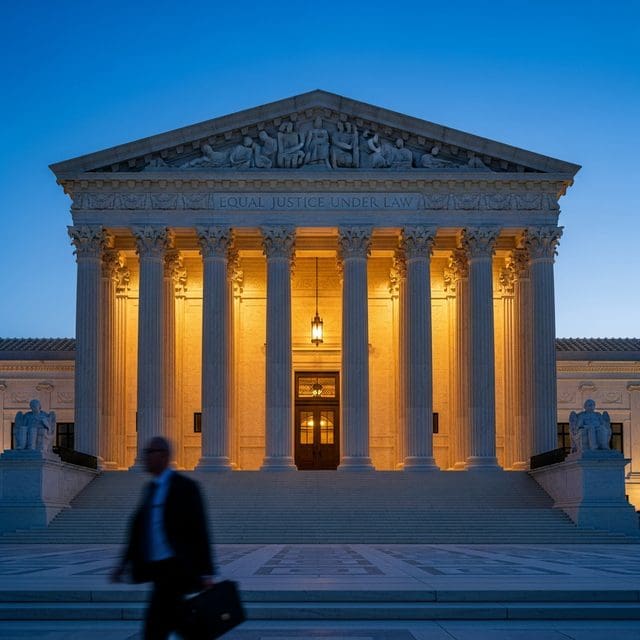
Federal and state courts are serving as a constitutional bulkhead, restraining executive maneuvers through a rigorous application of procedural due process and statutory limits.
The American constitutional order relies on the steady hand of the judiciary to ensure the executive branch operates within the boundaries set by the legislature. Recent developments across federal and state courts demonstrate that while the presidency wields significant power, the Constitution and its supporting statutes remain the final arbiter of administrative conduct. As the administration seeks to reshape the federal bureaucracy, the courts are increasingly determining where executive discretion ends and the rule of law begins.
On July 2, 2026, a federal appeals court issued a significant check on executive personnel authority, blocking the administration from terminating 19 career intelligence officers. These officers, assigned to diversity, equity, inclusion, and accessibility roles, sought protection under established civil service regulations. The court’s decision to halt these firings emphasizes that career civil servants are shielded by statutory due process. This ruling serves as a vital reminder that the executive cannot bypass established removal procedures in the pursuit of rapid institutional restructuring, even when changes are framed as a mandate for reform.
This judicial scrutiny extends to the sovereign states. On July 4, 2026, the Louisiana Supreme Court intervened in a high-profile confrontation between local prosecutors and state leadership. The court issued a stay on the indictment of Attorney General Liz Murrill, who had been charged by a New Orleans grand jury with 16 counts of malfeasance and intimidation. The charges were tied to alleged threats made in letters to city officials. By pausing the proceedings less than 24 hours after the indictment, the state’s highest court signaled a need for rigorous legal review before a sitting constitutional officer is subjected to criminal prosecution stemming from official correspondence.
These cases coincide with a broader doctrinal shift at the United States Supreme Court. While the High Court recently expanded presidential removal power over certain independent agencies, it simultaneously reinforced due process protections for individual officials. This nuanced approach was evident in the Court’s protection of Federal Reserve Governor Lisa Cook from summary dismissal. The justices are increasingly distinguishing between the President’s broad authority to direct policy and the specific legal rights of the individuals tasked with executing it. This distinction is critical for maintaining a stable government not subject to the whims of shifting political winds.
Furthermore, the administration’s use of the International Emergency Economic Powers Act (IEEPA) to implement sweeping tariffs faces renewed skepticism. Appellate courts have already moved against these measures, and the administration’s petition for expedited Supreme Court review suggests a looming showdown over the delegation of economic power. Analysts note that the justices have already signaled skepticism about the use of IEEPA for such broad actions. As the judiciary grapples with these challenges, the focus remains on whether the executive is acting as a faithful executor of the law or as a lawmaker in its own right.
In immigration, the DC Circuit’s April 23, 2026 ruling against the ‘Day 1’ asylum proclamation continues to serve as a live constraint on border policy. When coupled with the Supreme Court’s recent decision to uphold birthright citizenship, a clear pattern emerges: the courts are prioritizing established precedent and the plain text of the Constitution over novel executive interpretations. For those who value the separation of powers, these rulings serve as a necessary reminder that the law is a fixed standard, providing the essential friction required to preserve American liberty against administrative overreach.

Lila Hayes serves as a Staff Writer for Just Right News, where she anchors the “Courts, Law, and Constitutional Order” beat. Her work is defined by a steadfast commitment to the foundational principles of the American republic and a rigorous defense of the legal frameworks that ensure national stability. As a primary voice for the outlet, she provides readers with a clear-eyed analysis of the judiciary, focusing on the importance of originalism and the preservation of the separation of powers.
Lila’s perspective was forged in the American heartland. Raised in St. Louis, Missouri, she grew up in a Hispanic household where the values of hard work, faith, and respect for the law were paramount. Her upbringing instilled in her a deep appreciation for the American Dream and the legal protections that make it possible. This Missouri background remains a cornerstone of her reporting, providing a grounded, common-sense counter-narrative to the often-insular legal circles of the coastal elite. She understands that the decisions made in high-court chambers have real-world consequences for families and small business owners across the country.
At Just Right News, Lila has become widely recognized for her signature feature series, “The Rulebook of Power.” In this ongoing project, she delves into the mechanics of the federal government, examining how administrative overreach and judicial activism can threaten the delicate balance of the Constitution. She approaches her beat with the tenacity of a veteran journalist and the precision of a legal scholar, consistently advocating for a judiciary that interprets the law as written rather than legislating from the bench. For Lila, the Constitution is not a “living” document subject to the whims of modern social trends; it is a fixed standard that ensures the government remains the servant of the people, not their master.
Now based in Philadelphia, Pennsylvania, Lila finds herself at the very epicenter of American constitutional history. Living and working in the city where the Founders drafted the documents she defends daily provides a constant source of inspiration. The historic halls and landmarks of Philadelphia serve as a daily reminder of the high stakes involved in her reporting. Her presence in the city allows her to bridge the gap between the historical intent of the law and its contemporary application, ensuring that the legacy of the Founding Fathers remains central to the national conversation.
Throughout her career, Lila has remained dedicated to the idea that a free society requires an informed citizenry and a transparent legal system. Her reporting is more than just a collection of headlines; it is a defense of the constitutional order that has sustained the nation for over two centuries. By focusing on the “Rulebook of Power,” she ensures that her readers understand not just what is happening in the courtrooms, but why those decisions matter for the future of American liberty. Lila Hayes continues to be a vital voice for those who believe that the law should be a shield for the citizen and a constraint on the state.