

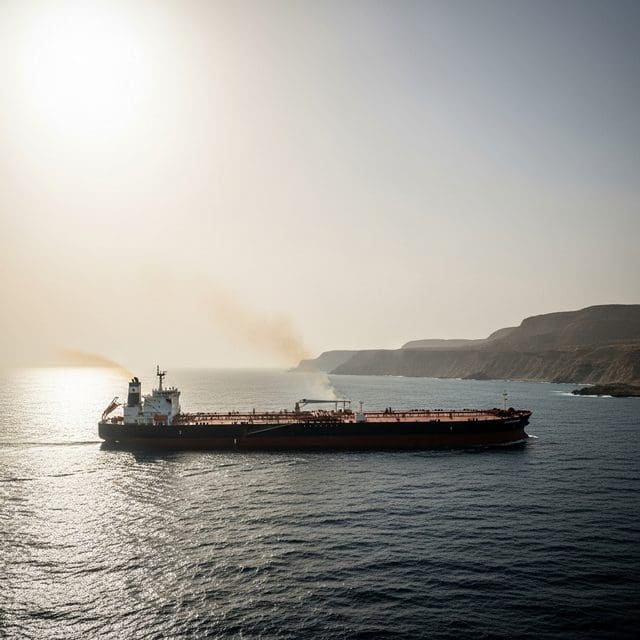
A projectile strike on a Panamanian tanker off Yemen has ended a brief maritime lull, threatening the energy flows and supply chains essential to American industry.
The fragile equilibrium governing global trade was shattered this week when a Panamanian-flagged crude oil tanker caught fire after being struck by a projectile off the coast of Yemen. This strike marks a violent end to a brief period of relative calm in the Red Sea, a corridor that serves as a vital artery for the materials fueling American manufacturing. For the American blue-collar worker, this is not merely a distant headline; it is a direct threat to the cost of living and the reliability of supply chains that sustain the dignity of local labor.
Recent United Nations Security Council reports had offered a glimmer of hope, noting no major incidents between May 9 and June 9. However, that lull proved to be a mirage. Yemen’s Iran-aligned Houthis previously vowed to ban maritime navigation for vessels with perceived links to their adversaries. While risk firms initially suggested these threats were targeted, the latest attack proves that commercial traffic remains in the crosshairs of geopolitical volatility. The UN must now decide by July 15 whether to extend its reporting mandate as the threat to merchant vessels persists.
The global shipping industry is currently walking a tightrope. Analysts describe a “fragile equilibrium” where major lines have only partially returned to the Suez route. These companies must balance the efficiency of the Red Sea against the staggering costs of war-risk premiums and the necessity of naval escorts. When these risks escalate, ships are diverted around the Cape of Good Hope, adding weeks to transit times and thousands of dollars in fuel costs. These are the hidden taxes on the American consumer, born from a reliance on unstable foreign waters.
The systemic nature of the threat is underscored by concurrent tensions in the Strait of Hormuz, where a Palau-flagged cargo ship was recently targeted. Together, these chokepoints oversee roughly a third of all global seaborne oil and gas flows. When these gates are threatened, the ripple effects are felt in every American factory relying on imported components. It highlights the inherent risk of a globalist trade model that prioritizes corporate efficiency over the security of national sovereignty and domestic production.
U.S. maritime authorities have maintained strict guidance through Advisory 2026-006, instructing American-flagged vessels to maintain maximum distance from the Yemeni coast. Yet, as the journey of physical goods becomes increasingly perilous, the argument for bringing manufacturing back to American soil grows stronger. A supply chain relying on the stability of the Bab el-Mandeb is a supply chain built on sand. While the administration recently lifted export controls on advanced AI models like Claude Fable 5 to maintain a technological edge, that edge is blunted if physical goods cannot reach their destination safely.
As President Trump noted during his July 4 address at Mount Rushmore, the preservation of American prosperity requires a rejection of systems that undermine national strength. The fire off the coast of Yemen is a clarion call for a trade policy that champions the American worker by reducing vulnerability to foreign disruptions. True economic security is found not in the hope of a peaceful Red Sea, but in the strength of a self-reliant nation that produces what it needs and protects what it moves.

Sean Bradley serves as the Senior Correspondent for Trade, Supply Chains, and Global Labor at Just Right News, where he brings a principled, clear-eyed perspective to the complex systems that power the modern world. With a focus on the economic forces that impact the American household, Bradley has distinguished himself as a leading voice in explaining how global shifts in manufacturing and logistics translate to the kitchen table.
Growing up in Long Beach, California, Bradley’s interest in the movement of goods was forged against the backdrop of one of the nation’s most vital maritime gateways. Raised in a community where the towering cranes of the port were a constant fixture on the horizon, he developed an early appreciation for the blue-collar industries that form the backbone of the American economy. This upbringing instilled in him a profound respect for the dockworkers, truckers, and laborers who keep the country moving, a sentiment that remains a cornerstone of his reporting today. For Bradley, trade is not merely a series of abstract figures on a spreadsheet; it is a human endeavor that sustains families and defines the strength of a nation.
Now based in Seattle, Washington, Bradley occupies a strategic vantage point in another of the country’s most significant trade hubs. His location allows him to witness firsthand the intersection of traditional industry and the evolving technological landscape of global logistics. From the Pacific Northwest, he monitors the flow of goods across the ocean, providing Just Right News readers with timely insights into how international tensions, regulatory hurdles, and labor disputes affect the availability and cost of essential goods.
His signature feature series, “The Journey of Things,” has become a staple for readers seeking to understand the intricate path products take from raw materials to the retail shelf. Through this series, Bradley pulls back the curtain on the global marketplace, often highlighting the risks of over-reliance on foreign adversaries and the importance of domestic manufacturing resilience. His reporting consistently emphasizes the conservative values of national sovereignty, free-market competition, and the protection of the American worker from unfair global practices.
As a journalist of Irish heritage, Bradley maintains a deep-seated respect for the dignity of the individual worker and the importance of community stability. He approaches his beat with a commitment to transparency, often questioning the status quo of globalist policies that prioritize corporate efficiency over local prosperity. Whether he is reporting from a warehouse floor or analyzing a new international trade agreement, his goal remains the same: to provide the American public with the truth about where their products come from and what it costs to get them there.
Throughout his tenure at Just Right News, Bradley has remained a steadfast advocate for economic common sense. His work serves as a vital resource for those who believe that a strong nation is built on secure borders, robust trade, and a respected workforce. By combining his local roots in Long Beach with his professional experience in Seattle, Bradley continues to offer a unique and necessary perspective on the forces that shape the American way of life.