

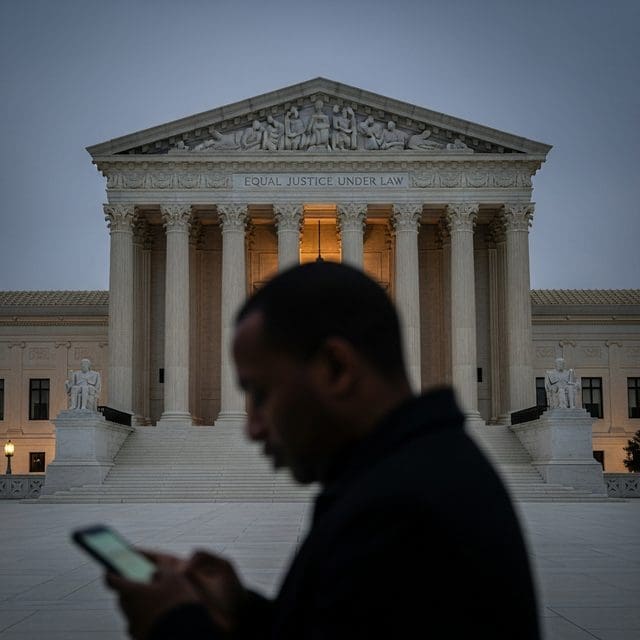
Recent judicial rulings grant the President new powers over independent agencies while strengthening digital privacy protections as the administration brokers a fragile Middle East ceasefire.
The landscape of American governance and individual liberty underwent a significant transformation this week as the Supreme Court issued two landmark 6-3 rulings that simultaneously expanded executive authority and fortified digital privacy. In a move that dismantles nearly a century of administrative law, the Court ruled on June 29, 2026, that the President possesses the constitutional authority to remove independent agency officials at will. This decision specifically cleared the way for the removal of Federal Trade Commissioner Rebecca Slaughter, effectively overturning 91 years of precedent that had previously shielded such officials from political termination by Congress-mandated protections.
While the Court moved to centralize executive control over the administrative state, it concurrently established a firm boundary against government surveillance in the digital age. In a separate 6-3 decision, the justices ruled that individuals have a reasonable expectation of privacy regarding their cellphone location data. This ruling invalidated a geofence warrant used to identify Okello Chatrie, a bank robbery suspect, and sets a high bar for law enforcement agencies seeking to utilize mass digital footprints without specific, individualized probable cause. This ‘show me the warrant’ approach by the Court aligns with growing public concern over the reach of the surveillance state.
On the diplomatic front, the White House announced a 10-day ceasefire between Israel and Lebanon, scheduled to take effect April 17, 2026, at 5 p.m. ET. This cessation of hostilities is part of a broader memorandum of understanding with Iran that includes the reopening of the Strait of Hormuz without tolls. The geopolitical impact was immediate, with global oil prices dropping over 10% following the announcement. The memorandum outlines a framework for sanctions relief based on strict compliance and includes a potential 60-day ceasefire extension. These developments suggest a high-stakes effort by the administration to stabilize energy markets and de-escalate regional tensions through direct, document-driven diplomacy.
In the realm of national security and intelligence, President Trump nominated Jay Clayton, currently the U.S. Attorney for the Southern District of New York, to serve as the Director of National Intelligence. This nomination comes at a pivotal time as the administration integrates private sector successes into federal strategy. The commercial space sector reached a historic milestone on June 11, 2026, when SpaceX raised $75 billion in its initial public offering, valuing the company at approximately $1.77 trillion. This massive influx of private capital coincides with the launch of the SBIC-NASA Initiative, a joint effort by NASA and the U.S. Small Business Administration to increase investment in American manufacturers of industrial components critical to space exploration.
As these federal policies shift, the infrastructure of information delivery is also adjusting to new privacy realities. The Associated Press, the primary wire service for Congressional reporting, has updated its data practices to comply with a growing number of state privacy regimes. The organization now explicitly treats the use of cookies and device identifiers for targeted advertising as the ‘sale or sharing’ of personal information. Under these new protocols, users must navigate complex ‘Your Privacy Choices’ mechanisms to opt out of tracking. The AP policy confirms that while it honors certain state-mandated signals like Global Privacy Control, it does not recognize standard browser ‘Do Not Track’ signals, placing the burden of privacy maintenance squarely on the individual.
These shifts across the judiciary, the White House, and the private sector reflect a government in transition. From the arrival of the Nancy Grace Roman Space Telescope at Kennedy Space Center to the fundamental rewriting of the President’s removal powers, the ‘paper trail’ of June 2026 reveals an administration aggressively asserting its constitutional prerogatives while the courts attempt to balance that power against the digital-age privacy rights of the citizenry.

Ben Taylor serves as the Senior Correspondent and Investigations Lead for Just Right News, where he anchors the network’s commitment to government transparency and institutional accountability. With a career defined by a relentless pursuit of the facts, Taylor spearheads the acclaimed feature series “The Paper Trail,” a deep-dive investigative column that prioritizes primary source documentation over political rhetoric. Based in the heart of the nation’s capital, he has earned a reputation as one of the most formidable investigative journalists in Washington, D.C., known specifically for his mastery of public records and the Freedom of Information Act.
Taylor’s approach to journalism is deeply rooted in his upbringing in Kansas City, Missouri. Growing up in the “Show Me State,” he developed a healthy skepticism of centralized power and a profound respect for the common-sense values of the American heartland. This Midwestern foundation informs his reporting today, as he bridges the gap between the complex machinations of federal bureaucracy and the everyday concerns of citizens across the country. For Taylor, investigative reporting is not about chasing headlines; it is about ensuring that the government remains answerable to the people it serves.
As an African American man working within the conservative media landscape, Taylor brings a principled perspective to his beat. He views the Constitution and the right to information as the ultimate equalizers in a free society. His work often highlights how bureaucratic overreach and lack of transparency disproportionately affect individual liberties. By focusing on the “paper trail,” Taylor strips away the spin of partisan talking points, instead providing Just Right News readers with the raw data and internal communications that reveal how their tax dollars are spent and how policy decisions are actually made.
In his role as Investigations Lead, Taylor oversees a team dedicated to uncovering the stories that mainstream outlets often overlook. Whether he is auditing federal spending, investigating regulatory overreach, or exposing inefficiencies within the administrative state, his methodology remains consistent: follow the evidence wherever it leads. His presence in Washington, D.C., allows him to maintain a constant watch over the halls of power, yet he remains steadfastly connected to his roots, ensuring his reporting reflects the clarity and directness of his Missouri home.
Throughout his tenure at Just Right News, Taylor has become a vital voice for those who demand integrity in public office. He believes that a well-informed electorate is the strongest defense against government overreach, and he has dedicated his career to providing the public with the tools they need to hold their leaders accountable. Through “The Paper Trail” and his broader investigative work, Ben Taylor continues to set the standard for rigorous, document-driven journalism that champions the values of transparency, individual responsibility, and the rule of law.