

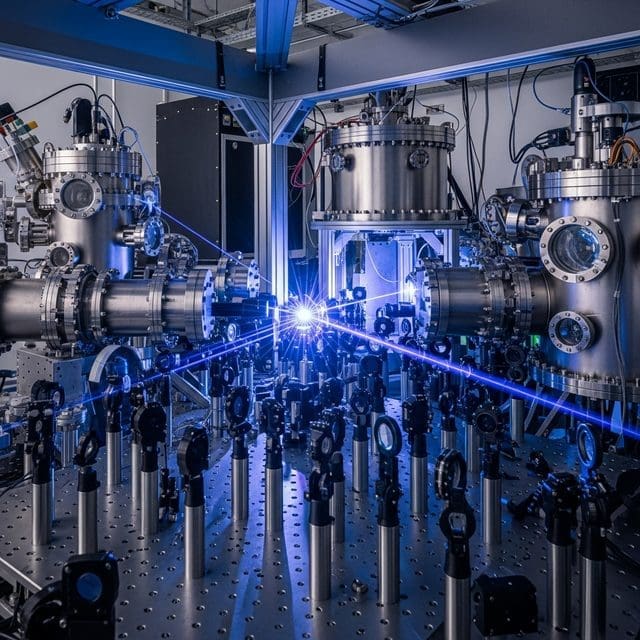
Researchers at the University of Innsbruck have identified a new phase of matter by driving ultracold atoms into a highly organized, non-equilibrium state.
A groundbreaking discovery in the field of condensed matter physics has challenged the long-standing paradigms used to describe one-dimensional quantum systems. Researchers from the University of Innsbruck, in collaboration with theoretical physicists from CNRS and Université Paris-Dauphine, have successfully demonstrated the existence of a new critical phase of matter known as a “fractional Fermi sea.” This finding, published in Physical Review Letters, represents a significant leap in our ability to manipulate the fundamental building blocks of reality through quantum simulation.
Led by Hans-Christoph Nägerl and theoretical physicist Alvise Bastianello, the team utilized ultracold cesium atoms confined to a one-dimensional space to probe the limits of quantum behavior. In a typical quantum environment, particles like Fermions stack neatly into available energy states, much like passengers filling seats on a bus from the front to the back. This arrangement is known as the Fermi sea. However, the researchers sought to understand what happens when a system is pushed far beyond these stable, equilibrium conditions.
To achieve this, the team employed a sophisticated interaction-cycling protocol. By periodically and rapidly altering how strongly the cesium atoms interacted with one another—shifting them from states of intense repulsion to intense attraction—the researchers forced the system out of its traditional ground state. Under normal circumstances, such a violent disruption would be expected to simply heat the system into a state of disorder. Instead, the atoms reorganized into a highly excited but remarkably structured many-body state. This is the fractional Fermi sea, so named because the particles appear to obey a reduced occupancy rule that defies standard expectations.
This discovery is particularly significant because it departs from the Tomonaga-Luttinger liquid theory. For decades, this theory has served as the bedrock for understanding one-dimensional quantum matter, providing the mathematical language to describe how particles move and interact in restricted geometries. The fractional Fermi sea, however, exhibits unique mathematical correlations that the old theory cannot fully explain. These include pronounced ripples called Friedel oscillations and distinctive decay patterns across all levels of repulsive interactions.
Lead author Yi Zeng noted that this interaction-cycling protocol provides a new “knob” for quantum simulation. Rather than relying on static variables like temperature or disorder, scientists can now use time-dependent control of interactions to explore matter in states that were previously theoretical abstractions. Hans-Christoph Nägerl, the group leader at Innsbruck, emphasized that this state possesses a “hidden order” that only becomes visible when examining the correlations between particles. He even suggested that this phase may be composed of entirely new quasiparticles, tentatively dubbed “super-Fermions.”
The implications of this work extend beyond the laboratory. As NASA and private entities like Astrobotic and Intuitive Machines prepare for a new era of lunar architecture and cislunar presence, the fundamental mastery of quantum states will be essential for the next generation of sensors and computing. While the current publication establishes the theoretical framework, a companion paper detailing the direct experimental realization of these states is currently under review, signaling that the data to support these claims is imminent.
For those who value American leadership in the frontiers of science, these advancements in quantum simulation represent a vital counterweight to centralized bureaucratic control of technology. By uncovering the universal laws governing driven quantum systems, researchers are opening a path toward decentralized innovation that relies on the raw laws of physics rather than the whims of Silicon Valley’s current software paradigms. The discovery of the fractional Fermi sea proves that we are only beginning to scratch the surface of what is possible when we push quantum matter to its absolute limits.

Mason Reed serves as a Staff Writer for Just Right News, where he spearheads the Future Frontiers & Special Projects desk. In an era defined by rapid technological shifts and evolving social landscapes, Mason provides a steady, principled voice, examining the innovations of tomorrow through the lens of traditional American values. His work is most prominently featured in his signature series, “The Next Horizon,” where he explores the intersection of emerging technology, national sovereignty, and the preservation of individual liberty.
A native of San Diego, California, Mason’s worldview was shaped by the unique culture of his hometown. Growing up in a region defined by its strong military presence and its history of maritime industry, he developed a deep-seated respect for the institutions that provide national stability and the entrepreneurial spirit that drives the American economy. This upbringing instilled in him a belief that true progress is not found in discarding the past, but in building upon a foundation of proven principles. His reporting often reflects this San Diego influence, emphasizing the importance of a robust national defense and the necessity of maintaining a competitive edge in the global marketplace.
Now based in San Francisco, Mason operates from the heart of the world’s technological engine. Living and working in the Bay Area provides him with a front-row seat to the advancements—and the ideological challenges—emanating from Silicon Valley. While many in the region embrace a “move fast and break things” mentality, Mason’s reporting serves as a vital counterweight. He offers Just Right News readers a “boots on the ground” perspective, documenting how radical local policies and the concentration of tech power impact the everyday lives of citizens. His proximity to the industry allows him to cut through the marketing jargon of big tech to uncover the real-world implications for privacy, free speech, and the nuclear family.
In his “Future Frontiers” beat, Mason tackles complex subjects ranging from the ethics of artificial intelligence to the burgeoning private space race. He approaches these topics with a healthy skepticism toward centralized bureaucracy, championing instead the decentralized innovations that empower individuals. Through “The Next Horizon,” he highlights the pioneers and thinkers who are working to ensure that the future remains a place where human dignity and constitutional rights are protected. He believes that the rapid pace of change requires more than just technical expertise; it requires a moral compass rooted in the Western tradition.
Throughout his tenure at Just Right News, Mason has remained committed to the idea that the future is something to be shaped, not merely accepted. His writing is characterized by a rigorous defense of American exceptionalism and a belief that the country’s best days lie ahead, provided it remains true to its founding ideals. Whether he is investigating the impact of automation on the American workforce or profiling the next generation of aerospace engineers, Mason Reed ensures that his readers are equipped with the insights they need to navigate a changing world with confidence and clarity.