

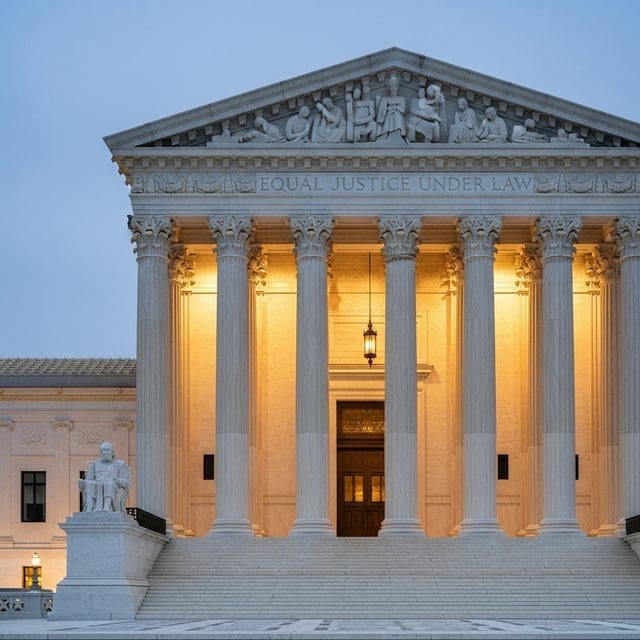
The Supreme Court prepares to issue final rulings on President Trump’s executive orders regarding birthright citizenship and the removal of Federal Reserve officials, testing the limits of presidential authority.
The Supreme Court enters the final week of its term with seven decisions remaining, two of which represent a fundamental test of the unitary executive theory. The justices are expected to rule on the legality of President Trump’s 2025 executive order attempting to end birthright citizenship and his effort to remove Federal Reserve Governor Lisa Cook. Both cases challenge the traditional independence of federal institutions and the long-standing interpretation of the 14th Amendment, forcing a constitutional reckoning over the reach of the administrative state.
In the matter of birthright citizenship, the administration urges the Court to adopt a narrower reading of the 14th Amendment’s “subject to the jurisdiction” clause. This maneuver seeks to bypass the 1898 precedent of United States v. Wong Kim Ark, which has long guaranteed citizenship to children born on U.S. soil. The administration argues the clause should exclude children of undocumented residents. Constitutionalists argue such a sweeping change requires a formal amendment or an act of Congress, rather than a unilateral presidential decree. The conservative majority must now decide if the executive branch can re-interpret foundational law without legislative consent.
Simultaneously, the Court is weighing the President’s authority to terminate Federal Reserve Governor Lisa Cook. While the executive branch maintains that the President should have the power to remove any officer to ensure policy alignment, legal analysts suggest the bench appears more skeptical of this specific reach. The ruling will determine if the Federal Reserve can maintain its status as an independent agency, shielded from direct political interference in monetary policy, or if it will be brought under direct White House control.
These deliberations occur as geopolitical tensions simmer. On June 29, the U.S. and Iran agreed to a temporary “stand down” following military exchanges, including U.S. strikes on Iranian sites and a drone attack against Bahrain. This fragile peace allows for the resumption of shipping through the Strait of Hormuz, yet the conflict has exposed deep ideological fractures within both parties. Internal debates over foreign policy and U.S. interventionism are splitting candidates as they face pressure from a base increasingly skeptical of traditional bipartisan hawkishness.
On Capitol Hill, the balance of power remains precarious. Recent polling from Maine indicates a statistical dead heat between incumbent Senator Susan Collins and Democratic challenger Graham Platner. With Republicans holding a 53-seat majority, the Maine race is a critical pivot point for chamber control. Platner holds a narrow edge of 49% to 47%, within the margin of error, as voters weigh Collins’s seniority against a desire for a change in Senate leadership. The race is further complicated by Maine’s ranked-choice voting system and a nationalized environment where 54% of voters prefer Democratic control.
As the President prepares for international visibility, including the 2026 FIFA World Cup final trophy presentation, the domestic reality remains one of legal friction. From the tragic loss of three wildland firefighters on the Colorado-Utah border to the struggle to secure $50 billion in maintenance funds for federal infrastructure, the administrative state is under immense pressure. The Supreme Court’s rulings this week will likely further polarize the electorate as the nation moves toward a campaign season where the definition of executive power is on the ballot.

Miles Harrington serves as the Senior Correspondent for Federal Systems & Executive Power at Just Right News, where he brings a disciplined, constitutionalist lens to the inner workings of the American government. With a focus on the mechanics of the federal bureaucracy and the limits of executive authority, Harrington has established himself as a vital voice for readers who value transparency, accountability, and the preservation of the separation of powers.
A native of Richmond, Virginia, Harrington’s perspective is deeply rooted in the traditions of the Old Dominion. Growing up in a city defined by its historical significance and its role as a center of American jurisprudence, he developed an early appreciation for the foundational principles of the Republic. His upbringing in Richmond—a place where the legacy of the Founding Fathers is woven into the landscape—instilled in him a belief that the federal government should remain within its constitutional bounds. This background informs his skepticism of centralized overreach and his commitment to reporting on the ways in which the administrative state impacts the lives of everyday citizens.
In his current role, Harrington specializes in the complexities of federal systems. He doesn’t just report on the headlines of the day; he digs into the structural shifts within the executive branch that often go unnoticed by the mainstream press. Whether he is analyzing the implications of a new federal regulation or investigating the expansion of agency jurisdiction, his work is characterized by a rigorous adherence to the facts and a dedication to the rule of law.
Harrington is perhaps best known for his signature feature series, “How Washington Works.” Through this ongoing project, he demystifies the often-opaque processes of the nation’s capital, pulling back the curtain on the “Deep State” and the unelected officials who wield significant influence over national policy. By breaking down complex legislative maneuvers and executive orders, he empowers Just Right News readers to understand the true levers of power in Washington. His reporting serves as a necessary check on the federal government, ensuring that the actions of those in power are held up to the light of public scrutiny.
Now based in Washington, D.C., Harrington operates at the epicenter of the political world, yet he remains intentionally distanced from the “Beltway bubble.” His proximity to the halls of power allows him to maintain a robust network of sources across the federal landscape, but his heart remains in the principled conservatism of his Virginia roots. He views his role not merely as a reporter, but as a steward of the public trust, dedicated to providing the clarity and context that conservative voters need to navigate an increasingly complex political environment.
Through his sharp analysis and unwavering commitment to the truth, Miles Harrington continues to be a cornerstone of the Just Right News team. His work ensures that the principles of limited government and executive restraint remain at the forefront of the national conversation, providing a crucial service to those who believe in a government that is truly of, by, and for the people.