

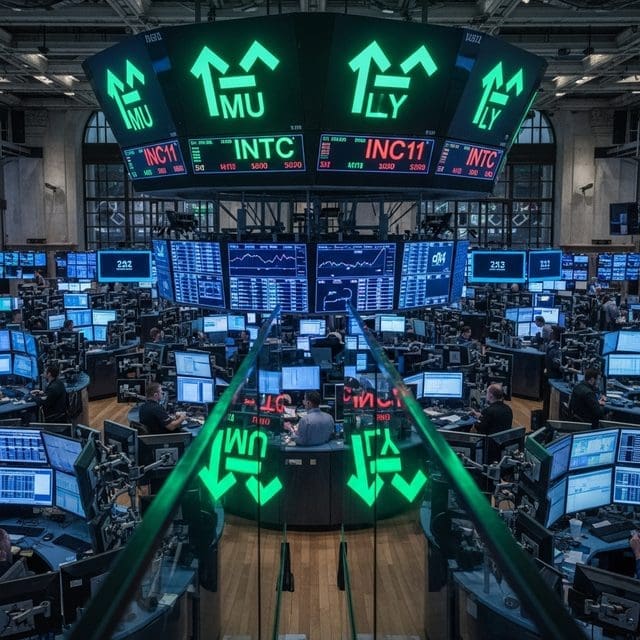
The S&P 500 climbed 1.29% today, fueled by a concentrated rally in semiconductor giants and pharmaceutical leaders despite underlying concerns regarding the sustainability of AI infrastructure spending.
Global equities traded with a pronounced pro-risk tone during the latest session, as the S&P 500, tracked by the SPY proxy, advanced approximately 1.29%. This rally was not a broad-based endorsement of the economic landscape but rather a highly concentrated move led by the technology and healthcare sectors. For the American taxpayer and the retail investor, today’s market action serves as a reminder of how a handful of high-beta firms now dictate the direction of national retirement savings, often independent of wider economic health. The concentration is stark; while the benchmark rose significantly, the movement was disproportionately driven by a narrow corridor of AI-linked memory and semiconductor stocks rather than a balanced sector rally.
In the technology sector, the narrative remains firmly anchored to the artificial intelligence boom and the massive capital expenditures of hyperscalers. Semiconductor and memory-chip manufacturers were the primary engines of today’s growth. Micron Technology (MU) surged 11.3%, while Intel (INTC) jumped 10.0%. These moves were complemented by gains in NVIDIA (NVDA), which rose 1.5%, and Broadcom (AVGO), which climbed 1.7%. Despite their relatively small individual weights compared to megacap giants—with Intel representing just 0.4% of the index—the outsized percentage swings in these chipmakers pulled the entire index upward. This occurs even as investors begin to question the long-term return on AI infrastructure spending, leading to a regime where 5% to 10% intraday swings are becoming commonplace. Megacap platforms like Alphabet (GOOGL) and Amazon (AMZN) also contributed, rising 3.6% and 2.3% respectively.
This AI-driven expansion is also reshaping the energy sector. As of late May 2026, the demand for electricity to power massive data centers has transformed power into a scarce commodity. This shift is forcing companies across the traditional economy to pivot toward energy-related business models to ensure operational continuity. While tech stocks saw a sharp decline in the week ending June 26 due to these infrastructure concerns, today’s bounce suggests that momentum-driven trading still carries significant weight in the short term. The volatility remains a concern for households; recent broadcasts highlight that tech volatility has risen on AI-cost concerns, with episodes where massive sell-offs in tech have previously dragged down both the S&P 500 and the Nasdaq.
Simultaneously, the healthcare sector is providing a critical counterweight as a defensive growth play. Eli Lilly (LLY) advanced 5.3% today, continuing a trend where healthcare has outperformed the broader market. Over the past week, as investors rotated out of volatile tech positions, the S&P 500 healthcare segment gained nearly 6% even as the broader index faced headwinds. This rotation into pharmaceutical and medical-device manufacturers highlights a search for stability. For the working household, this suggests that while the tech sector provides the ‘heat’ for the market, healthcare is currently serving as the ‘anchor’ for diversified portfolios.
On the institutional front, the financial landscape continues to consolidate. SEGRO and Prologis recently announced a possible combination aimed at creating shareholder value, while Synaptics is navigating shareholder litigation regarding fair pricing in its transaction with onsemi. In the fintech space, the Digital Wallet Group expanded its North American footprint by launching Smiles Mobile Remittance in the United States, and Adecco reported surpassing one million AI-powered candidate interactions, claiming a 50% reduction in delivery time across ten countries. Furthermore, Malta’s Financial Intelligence Analysis Unit reported strengthened AML/CFT preparedness in its 2025 Annual Report, and ProfitWorks partnered with Reins to provide alternative equity programs for independent business owners, signaling a push for private-market meritocracy.
Geopolitical developments also offered a reprieve for global markets. The United States and Iran have agreed to halt attacks following a series of exchanges in the Persian Gulf. With a meeting scheduled in Qatar for June 30 to resolve disputes over the Strait of Hormuz, the threat to global energy supply chains has temporarily receded. For the household on Main Street, these macro factors—from chip demand to Middle Eastern diplomacy—create a complex backdrop for a market that appears robust on the surface but remains highly sensitive to the ‘Invisible Economy’ of centralized financial and technological control.

Jordan Lee serves as the Senior Correspondent for Wall Street, Finance, and Monetary Systems at Just Right News. Based in the heart of the world’s financial capital, New York City, Lee brings a sharp, principled eye to the complex mechanisms that drive the global economy. His reporting is defined by a commitment to fiscal responsibility, the defense of the free market, and a deep-seated belief that a transparent monetary system is the bedrock of a free society.
Raised in Portland, Oregon, Lee’s perspective was forged in a city that has undergone significant cultural and economic shifts. His upbringing in the Pacific Northwest instilled in him a profound appreciation for the industriousness of small business owners and the importance of local economic stability. Watching the evolution of his hometown’s landscape sparked an early interest in how federal fiscal policy and large-scale financial trends eventually trickle down to the average citizen. This background provides him with a unique vantage point; he understands the growing disconnect between the policy-making elite and the reality of Main Street, a theme that frequently resonates throughout his work.
Now operating from his base in New York City, Lee bridges the gap between the high-stakes trading floors of Manhattan and the households of everyday Americans. He views the financial sector not merely as a collection of numbers and tickers, but as a vital engine of American prosperity that requires constant vigilance and accountability. His reporting often highlights the dangers of centralized financial control and the necessity of maintaining a system that rewards merit, risk-taking, and innovation.
As the creator and lead of the featured series, “The Invisible Economy,” Lee pulls back the curtain on the often-opaque world of monetary systems. He specializes in translating the dense jargon of central banking and international finance into actionable insights for the Just Right News audience. His work explores the “invisible” forces—such as inflationary pressures, regulatory creep, and the expansion of the administrative state—that erode the purchasing power of American families. By focusing on these systemic issues, Lee empowers readers to understand the hidden forces shaping their financial independence.
Lee’s journalistic philosophy is rooted in a steadfast commitment to traditional American values. As an Asian American professional who has navigated the competitive corridors of the financial world, he is a vocal advocate for meritocracy and the preservation of the American Dream. He believes that a stable currency and a predictable regulatory environment are essential for national sovereignty and individual liberty. His reporting frequently warns against the risks of government overreach in the private sector, arguing that the most effective solutions to economic challenges arise from competition and individual enterprise rather than bureaucratic mandates.
At Just Right News, Jordan Lee remains dedicated to providing a clear-eyed defense of the taxpayer. Whether he is analyzing market volatility or investigating the long-term implications of national debt, his mission is to provide the truth about where the money is going and what it means for the future of the country. Through his rigorous analysis and principled stance, Lee has become a trusted voice for those who value a strong, sovereign, and fiscally sound America.