

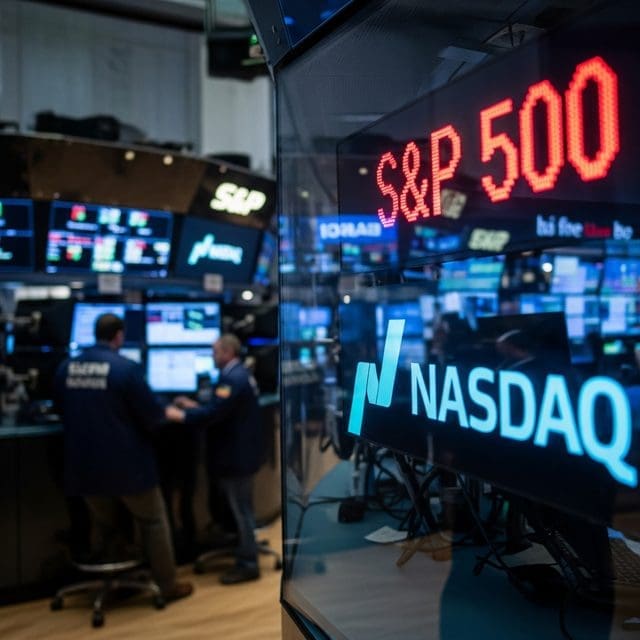
The S&P 500 ETF Trust slipped 0.54% as investors rotated out of semiconductor stocks while weighing geopolitical tensions and hawkish signals from the Federal Reserve.
Financial markets signaled a cautious retreat on Monday as the S&P 500 ETF Trust (SPY) declined 0.54%, reflecting a broader cooling of the artificial intelligence trade that has dominated the first half of 2026. The move suggests a growing skepticism among institutional investors regarding the immediate return on massive AI infrastructure investments. While companies like Micron and Qualcomm recently reported a surge in demand for AI-related memory and custom chips, the sector has entered a volatile phase as investors rotate capital into defensive areas like healthcare and software. For the American taxpayer, this volatility in megacap tech serves as a reminder that even the most promising technological booms are eventually subject to the gravity of valuation and the necessity of tangible yields.
The Nasdaq 100 bore the brunt of the selling pressure, sliding more than 1% as chipmakers including Intel and AMD saw declines exceeding 3%. This downturn follows a period where the AI boom drove companies across the economy into the energy business, as electricity emerged as a scarce commodity essential for data center operations. Despite the current slide, the long-term shift toward automation continues; for instance, Adecco recently surpassed one million AI-powered candidate interactions, reducing delivery times by 50%. However, the market is now questioning whether the scale of current infrastructure spending justifies semiconductor valuations that led to a $400 billion rally just one week prior.
Monetary policy remains a primary headwind for Main Street. Market participants are closely monitoring upcoming non-farm payrolls and unemployment data, which will dictate the Federal Reserve’s next move. Following hawkish signals from Fed Chair Kevin Warsh earlier this month, expectations for rate cuts in 2026 have diminished significantly. Sustained high funding costs continue to pressure independent business owners, even as new alternative equity partnerships, such as the recently announced collaboration between Reins and ProfitWorks, attempt to provide liquidity outside traditional banking channels. The cost of capital remains a central concern for the invisible economy of small businesses struggling to navigate centralized financial control.
In the currency markets, the U.S. Dollar Index hovered near 101.3, positioning the greenback for its strongest monthly advance since mid-2025. This strength is bolstered by safe-haven flows stemming from instability in the Persian Gulf. Although Washington and Tehran reached a tentative agreement on June 28 to halt attacks and plan to meet in Qatar, lingering disruptions to energy shipping through the Strait of Hormuz have kept oil prices firm. These geopolitical barbs reinforce the dollar’s role as a global stabilizer, even as it trades slightly defensive on an intraday basis against other major currencies.
Corporate consolidation also remains a theme as firms seek to create shareholder value amidst the uncertainty. SEGRO and Prologis recently announced a possible combination, while Synaptics faces shareholder litigation regarding fair pricing in its transaction with onsemi. Meanwhile, international regulatory environments are tightening, with Malta’s Financial Intelligence Analysis Unit reporting strengthened AML/CFT preparedness in its latest annual report. These developments reflect a global financial system that is becoming increasingly complex and regulated, often at the expense of the individual actor.
While the VIX remains in the high teens, suggesting that overall market stress is not yet at panic levels, the current environment demands fiscal discipline. The transition of the Nasdaq to a position 5% below its June 2 peak indicates that the “risk-on” sentiment of the spring is being replaced by a more sober assessment of global risks. For the working household, the takeaway from today’s market action is clear: the era of easy money is receding, replaced by a meritocratic landscape where energy costs, geopolitical sovereignty, and central bank hawkishness define the new economic reality.

Jordan Lee serves as the Senior Correspondent for Wall Street, Finance, and Monetary Systems at Just Right News. Based in the heart of the world’s financial capital, New York City, Lee brings a sharp, principled eye to the complex mechanisms that drive the global economy. His reporting is defined by a commitment to fiscal responsibility, the defense of the free market, and a deep-seated belief that a transparent monetary system is the bedrock of a free society.
Raised in Portland, Oregon, Lee’s perspective was forged in a city that has undergone significant cultural and economic shifts. His upbringing in the Pacific Northwest instilled in him a profound appreciation for the industriousness of small business owners and the importance of local economic stability. Watching the evolution of his hometown’s landscape sparked an early interest in how federal fiscal policy and large-scale financial trends eventually trickle down to the average citizen. This background provides him with a unique vantage point; he understands the growing disconnect between the policy-making elite and the reality of Main Street, a theme that frequently resonates throughout his work.
Now operating from his base in New York City, Lee bridges the gap between the high-stakes trading floors of Manhattan and the households of everyday Americans. He views the financial sector not merely as a collection of numbers and tickers, but as a vital engine of American prosperity that requires constant vigilance and accountability. His reporting often highlights the dangers of centralized financial control and the necessity of maintaining a system that rewards merit, risk-taking, and innovation.
As the creator and lead of the featured series, “The Invisible Economy,” Lee pulls back the curtain on the often-opaque world of monetary systems. He specializes in translating the dense jargon of central banking and international finance into actionable insights for the Just Right News audience. His work explores the “invisible” forces—such as inflationary pressures, regulatory creep, and the expansion of the administrative state—that erode the purchasing power of American families. By focusing on these systemic issues, Lee empowers readers to understand the hidden forces shaping their financial independence.
Lee’s journalistic philosophy is rooted in a steadfast commitment to traditional American values. As an Asian American professional who has navigated the competitive corridors of the financial world, he is a vocal advocate for meritocracy and the preservation of the American Dream. He believes that a stable currency and a predictable regulatory environment are essential for national sovereignty and individual liberty. His reporting frequently warns against the risks of government overreach in the private sector, arguing that the most effective solutions to economic challenges arise from competition and individual enterprise rather than bureaucratic mandates.
At Just Right News, Jordan Lee remains dedicated to providing a clear-eyed defense of the taxpayer. Whether he is analyzing market volatility or investigating the long-term implications of national debt, his mission is to provide the truth about where the money is going and what it means for the future of the country. Through his rigorous analysis and principled stance, Lee has become a trusted voice for those who value a strong, sovereign, and fiscally sound America.