

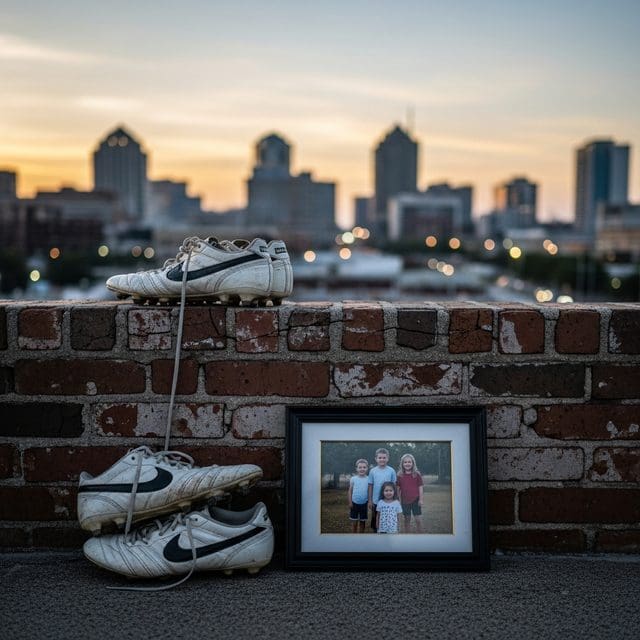
While Washington celebrates a breakthrough in oil diplomacy and maritime trade, the human cost of South American instability hits home for a former Jacksonville athlete following a devastating natural disaster.
The geopolitical landscape shifted dramatically this spring when a ten-day ceasefire and the reopening of the Strait of Hormuz sent oil prices tumbling. For Washington, these maneuvers represent a calculated effort to stabilize energy markets through a memorandum of understanding with Iran. But for those with roots in the southern hemisphere, the focus has shifted from the price of a barrel to the weight of the rubble. In Jacksonville, Florida, the abstract nature of foreign policy has been replaced by a sharp, localized grief.
Lucas Trejo, an original member of the Jacksonville Armada soccer team, recently received the news that no amount of diplomatic success can soften. His wife and two children were killed when powerful twin earthquakes struck Venezuela on June 25. The disaster, which claimed more than 160 lives, has turned a professional athlete’s personal history into a mirror for a nation’s ongoing struggle. While the U.S. government navigates sanctions relief and maritime tolls, the immediate reality on the ground in Venezuela is one of survival.
Defense Secretary Pete Hegseth has directed U.S. military aid to the region, and organizations like Samaritan’s Purse have deployed emergency field hospitals via 767 cargo planes. The contrast is stark: while the billionaire class watches SpaceX’s $1.77 trillion valuation climb following its massive IPO, families in the Venezuelan diaspora are counting their dead. The global economy might celebrate the removal of tolls in the Strait of Hormuz, but the cost of rebuilding a life is a currency that the markets often fail to track. This disconnect highlights the gap between macro-economic triumphs and the precariousness of the family unit.
The earthquakes prompted a surge of private philanthropy, including $5 million in relief from Shell. Yet, for individuals like Trejo, the intervention of global entities feels distant compared to the permanent loss of a lineage. His story reminds us that behind every headline regarding regional stability or ceasefire extensions, there are families whose lives are not governed by memorandums, but by the unpredictable cruelty of nature and the fragile infrastructure of their homelands. Even as the administration celebrates a 60-day ceasefire extension including Lebanon, the human-scale narrative remains one of profound loss.
As the U.S. military and NGOs continue their work in the earthquake zones, the narrative of 2026 is becoming one of two worlds. One world is preoccupied with the strategic appointment of intelligence directors like Jay Clayton or the political maneuvering of the SAVE America Act; the other is digging through the dust of a collapsed neighborhood. In California, the Community Foundation is granting $1.5 million to nonprofits in Boyle Heights to provide local relief, proving that the most effective responses often happen at the community level rather than through centralized mandates.
Ultimately, the story of Lucas Trejo is the story of the modern American experience—one where global forces and local tragedies are inextricably linked. While the opening of the Strait of Hormuz may lower the cost of a gallon of gas in Jacksonville, it cannot repair the broken heart of a man who lost everything to a fault line thousands of miles away. We remain humble subjects to the forces of nature and the enduring importance of the family bond. As the ceasefire extension begins, the real work of recovery is just starting for those left behind in the wreckage, far from the signing ceremonies.

Ethan Blake serves as a Senior Correspondent for Just Right News, where he specializes in Longform Narrative and Public Understanding. In an era of rapid-fire headlines and fleeting soundbites, Ethan’s work stands as a testament to the power of deep-dive reporting and the importance of contextualizing the complex issues facing the nation today. His approach is rooted in the belief that the most profound truths are often found in the lived experiences of individuals rather than the abstract theories of distant policymakers.
Growing up in Providence, Rhode Island, Ethan developed an early appreciation for the historical and cultural threads that weave the American fabric together. Providence, a city defined by its industrial heritage and its blend of traditional neighborhoods, provided him with a front-row seat to the challenges and triumphs of the American working class. This upbringing instilled in him a respect for the “common sense” values of hard work, community loyalty, and the preservation of local institutions. He learned early on that behind every economic statistic or legislative debate, there are real families and neighborhoods navigating the consequences of change.
This foundational perspective is the driving force behind his signature feature series, “Lives Behind the Systems.” Through this series, Ethan explores the intersection of individual agency and institutional structure. Whether he is documenting the impact of federal land-use policies on rural families or examining how shifting educational standards affect local school boards, Ethan’s work prioritizes the human element. He seeks to uncover how large-scale systems—be they governmental, economic, or social—affect the daily lives of citizens, often advocating for a return to local control and personal responsibility.
Now based in Portland, Maine, Ethan draws significant inspiration from the rugged independence and self-reliance that define the region. The coastal landscape and the resilient spirit of Maine’s communities serve as a constant reminder of the importance of individual liberty and the strength found in decentralized power. Living and working outside the traditional media hubs allows Ethan to maintain a grounded perspective, ensuring his reporting remains untethered from the echo chambers of the major metropolitan centers. This geographic distance provides him with the clarity needed to translate complex national narratives into stories that resonate with the heart of the country.
At Just Right News, Ethan’s beat is more than just a professional assignment; it is a mission to foster a more informed and engaged citizenry. He believes that a free society depends on the public’s ability to understand the mechanisms of power and the value of traditional American principles. His longform narratives do not merely report the news; they provide a roadmap for understanding the cultural and political shifts of the modern era through a lens of skepticism toward centralized authority and a deep respect for the individual.
Through his meticulous research and narrative craftsmanship, Ethan Blake continues to bridge the gap between policy and the public. His work remains a vital resource for those who seek a deeper understanding of the systems that shape our world and the enduring spirit of the people who live within them.