

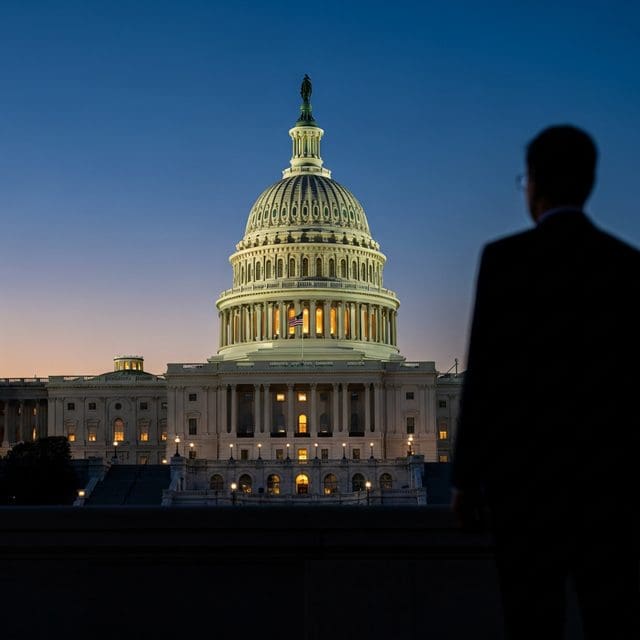
President Trump has linked a major housing affordability package to the passage of the SAVE Act, as Supreme Court rulings simultaneously expand executive authority over immigration and asylum.
The delicate machinery of bipartisan governance ground to a halt this week as President Donald Trump abruptly refused to sign a major housing initiative. The bill, which had secured broad support across both chambers to address rising cost-of-living pressures, was sidelined just as a signing ceremony was being prepared in Statuary Hall. The President’s refusal is not based on the housing policy itself, but rather on a demand for the immediate passage of the SAVE Act, a package of voting restrictions that currently lacks the necessary votes in the Senate. In a statement released via Truth Social, the President characterized the voting legislation as an “Emergency,” effectively holding the housing market’s legislative relief hostage to election law changes.
This maneuver has left congressional Republicans in a difficult position. During a tense closed-door meeting following the announcement, GOP senators reportedly informed the President they did not have the votes to pass the SAVE Act, yet the executive remains firm. The housing bill in question was intended to address supply shortages through the 21st Century ROAD to Housing Act and the More Homes on the Market Act. These measures sought to limit institutional investors from acquiring single-family homes, streamline environmental reviews, and modernize HUD rules for “missing middle” housing like duplexes and triplexes. By tying these economic priorities to polarizing voting reforms, the White House has forced a high-stakes standoff that threatens to stall domestic policy heading into the 2026 midterms.
While the legislative branch remains in a deadlock, the executive branch secured significant victories in the judiciary. On June 25, 2026, the Supreme Court ruled 6-3 in favor of the administration’s authority to strip Temporary Protected Status (TPS) from nationals of Haiti and Syria. This ruling affirms broad executive discretion over humanitarian programs that have historically shielded hundreds of thousands from deportation. The White House has framed the decision as a restoration of “integrity” to the immigration system, though it places immediate pressure on Congress to decide whether to codify protections for these populations or allow deportations to proceed. Concurrently, DACA recipients have filed suit against the government, alleging significant and purposeful delays in status renewals under the current administration.
Further strengthening the administration’s border policy, the Court also delivered a 6-3 ruling greenlighting the “metering” policy. This allows the government to turn back asylum seekers before they reach U.S. soil, a move the administration argues is necessary for border security. These judicial affirmations of executive power come at a time when the administration is also aggressively utilizing executive orders to bypass legislative delays in the technology sector. Recent directives on quantum innovation and AI security emphasize the need to protect critical infrastructure from emerging cyber threats, positioning the White House to claim leadership on national security while raising persistent separation-of-powers questions.
Outside the Beltway, the political landscape continues to shift rapidly. In New York, democratic socialist candidates secured major primary victories on June 23, ousting established incumbents like Rep. Adriano Espaillat and Rep. Dan Goldman. These results, including wins by Darializa Avila Chevalier and Brad Lander, suggest a growing ideological rift within the Democratic party. Meanwhile, international crises demand attention; Iran recently struck a cargo ship in the Strait of Hormuz with attack drones, breaking a ceasefire, and the CDC has elevated its Ebola response to the highest level due to uncontrolled outbreaks in Congo and Uganda. Despite these global pressures, the impasse between the President and Congress over the SAVE Act remains the primary friction point in the nation’s capital.

Miles Harrington serves as the Senior Correspondent for Federal Systems & Executive Power at Just Right News, where he brings a disciplined, constitutionalist lens to the inner workings of the American government. With a focus on the mechanics of the federal bureaucracy and the limits of executive authority, Harrington has established himself as a vital voice for readers who value transparency, accountability, and the preservation of the separation of powers.
A native of Richmond, Virginia, Harrington’s perspective is deeply rooted in the traditions of the Old Dominion. Growing up in a city defined by its historical significance and its role as a center of American jurisprudence, he developed an early appreciation for the foundational principles of the Republic. His upbringing in Richmond—a place where the legacy of the Founding Fathers is woven into the landscape—instilled in him a belief that the federal government should remain within its constitutional bounds. This background informs his skepticism of centralized overreach and his commitment to reporting on the ways in which the administrative state impacts the lives of everyday citizens.
In his current role, Harrington specializes in the complexities of federal systems. He doesn’t just report on the headlines of the day; he digs into the structural shifts within the executive branch that often go unnoticed by the mainstream press. Whether he is analyzing the implications of a new federal regulation or investigating the expansion of agency jurisdiction, his work is characterized by a rigorous adherence to the facts and a dedication to the rule of law.
Harrington is perhaps best known for his signature feature series, “How Washington Works.” Through this ongoing project, he demystifies the often-opaque processes of the nation’s capital, pulling back the curtain on the “Deep State” and the unelected officials who wield significant influence over national policy. By breaking down complex legislative maneuvers and executive orders, he empowers Just Right News readers to understand the true levers of power in Washington. His reporting serves as a necessary check on the federal government, ensuring that the actions of those in power are held up to the light of public scrutiny.
Now based in Washington, D.C., Harrington operates at the epicenter of the political world, yet he remains intentionally distanced from the “Beltway bubble.” His proximity to the halls of power allows him to maintain a robust network of sources across the federal landscape, but his heart remains in the principled conservatism of his Virginia roots. He views his role not merely as a reporter, but as a steward of the public trust, dedicated to providing the clarity and context that conservative voters need to navigate an increasingly complex political environment.
Through his sharp analysis and unwavering commitment to the truth, Miles Harrington continues to be a cornerstone of the Just Right News team. His work ensures that the principles of limited government and executive restraint remain at the forefront of the national conversation, providing a crucial service to those who believe in a government that is truly of, by, and for the people.