

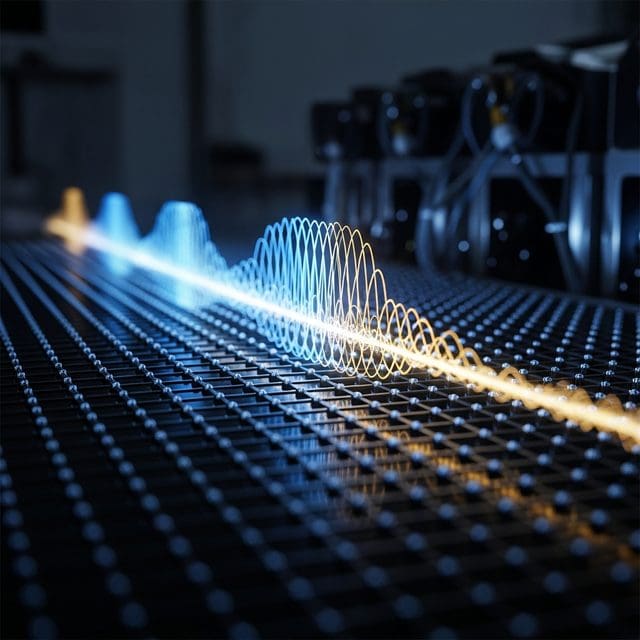
Researchers have observed a unique one-sided wave propagation in quantum lattices, confirming a long-theorized state of matter that could redefine directional energy transport and material design.
In the quest to master the subatomic world, researchers at Peking University have achieved a milestone that bridges the gap between abstract theory and physical reality. In a study published in Nature Physics, a team led by Wenhui Huang reported the first experimental observation of “exact quantum critical states.” These states represent a rare and elusive phase of matter that exists precisely at the tipping point of a quantum transition, where the standard rules of particle behavior begin to shift.
The discovery centers on the creation of what the team calls “infinitesimal dimerization zones” (IDZs). By utilizing a superconducting-qubit lattice platform, the researchers were able to engineer the hopping couplings—the connections that allow particles to move between sites in a lattice—with extreme precision. By dialing these couplings to nearly zero at specific links, they created “almost cut” bonds that acted as unique barriers within the quantum system. This allows the team to dial between localized, extended, and critical behavior in the same superconducting-qubit lattice, providing a level of control previously thought impossible.
When the team prepared a quantum state near one of these IDZs, they witnessed a phenomenon known as one-sided motion. In a standard quantum system, a wave packet typically spreads symmetrically, moving outward in all directions like a ripple in a pond. However, in these exact critical states, the wave packet propagated almost entirely to one side and barely crossed the barrier. This dynamical “smoking gun” provides the first concrete, testable signature of a state that had previously only existed in complex mathematical models, directly confirming earlier theoretical predictions regarding the nature of infinitesimal dimerization.
This breakthrough is not merely an academic exercise in particle behavior. The ability to dictate the direction of quantum flow without relying on traditional diodes or external magnetic fields suggests a future where quantum materials can be designed for specific, highly efficient transport tasks. From a sovereignty perspective, mastering these fundamental building blocks is essential for any nation seeking to lead the next generation of computing and energy infrastructure. The Peking University team, collaborating with the Shenzhen Institute for Quantum Science and Engineering, has effectively demonstrated how to map complex quantum-critical regimes that were once invisible to experimentalists.
Parallel to this discovery, the tools for observing such phenomena are also advancing rapidly. At the BESSY II synchrotron in Berlin, Europe’s first superconducting Transition Edge Sensor (TES) array X-ray spectrometer has entered operation. Led by scientist Régis Decker of Helmholtz-Zentrum Berlin, this instrument utilizes 248 superconducting sensors to deliver photon detection efficiencies 100 to 1,000 times higher than conventional wavelength-dispersive spectrometers. This allows measurements of weak signals from atomically thin layers and nanostructures that once took hours to be completed in mere minutes.
These technological leaps, including IBM’s recent claim of world-first sub-1 nanometer chip technology and ZTE’s push for full-stack AI efficiency at MWC Shanghai, signal a broader shift in the global technological landscape. As researchers at institutions like Rice University and the Southern University of Science and Technology continue to map the five phases of localization physics and the formation of quantum trions, the map of the microscopic world is becoming clearer. Even the space sector is reacting, with Botswana becoming the 68th signatory of the Artemis Accords as international frameworks expand to meet these new frontiers.
For the American innovator and the principled observer, these developments underscore the importance of maintaining a competitive edge in fundamental physics. The transition from theoretical prediction to laboratory observation marks a shift toward a more disciplined, engineering-focused approach to quantum mechanics. As we stand on this future frontier, the goal remains clear: to harness these exotic states of matter to defend individual liberty and national sovereignty through decentralized, superior innovation and a commitment to rigorous scientific inquiry.

Mason Reed serves as a Staff Writer for Just Right News, where he spearheads the Future Frontiers & Special Projects desk. In an era defined by rapid technological shifts and evolving social landscapes, Mason provides a steady, principled voice, examining the innovations of tomorrow through the lens of traditional American values. His work is most prominently featured in his signature series, “The Next Horizon,” where he explores the intersection of emerging technology, national sovereignty, and the preservation of individual liberty.
A native of San Diego, California, Mason’s worldview was shaped by the unique culture of his hometown. Growing up in a region defined by its strong military presence and its history of maritime industry, he developed a deep-seated respect for the institutions that provide national stability and the entrepreneurial spirit that drives the American economy. This upbringing instilled in him a belief that true progress is not found in discarding the past, but in building upon a foundation of proven principles. His reporting often reflects this San Diego influence, emphasizing the importance of a robust national defense and the necessity of maintaining a competitive edge in the global marketplace.
Now based in San Francisco, Mason operates from the heart of the world’s technological engine. Living and working in the Bay Area provides him with a front-row seat to the advancements—and the ideological challenges—emanating from Silicon Valley. While many in the region embrace a “move fast and break things” mentality, Mason’s reporting serves as a vital counterweight. He offers Just Right News readers a “boots on the ground” perspective, documenting how radical local policies and the concentration of tech power impact the everyday lives of citizens. His proximity to the industry allows him to cut through the marketing jargon of big tech to uncover the real-world implications for privacy, free speech, and the nuclear family.
In his “Future Frontiers” beat, Mason tackles complex subjects ranging from the ethics of artificial intelligence to the burgeoning private space race. He approaches these topics with a healthy skepticism toward centralized bureaucracy, championing instead the decentralized innovations that empower individuals. Through “The Next Horizon,” he highlights the pioneers and thinkers who are working to ensure that the future remains a place where human dignity and constitutional rights are protected. He believes that the rapid pace of change requires more than just technical expertise; it requires a moral compass rooted in the Western tradition.
Throughout his tenure at Just Right News, Mason has remained committed to the idea that the future is something to be shaped, not merely accepted. His writing is characterized by a rigorous defense of American exceptionalism and a belief that the country’s best days lie ahead, provided it remains true to its founding ideals. Whether he is investigating the impact of automation on the American workforce or profiling the next generation of aerospace engineers, Mason Reed ensures that his readers are equipped with the insights they need to navigate a changing world with confidence and clarity.