

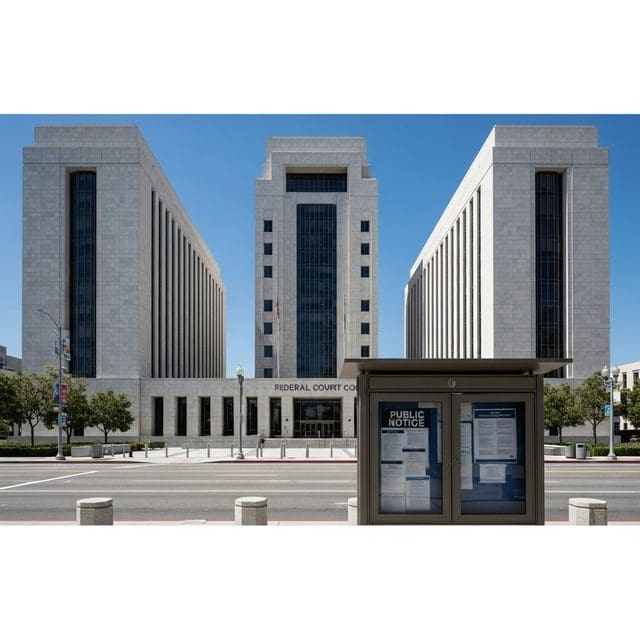
A nationwide injunction against courthouse arrests and the cancellation of mass detention plans signal a pivot in federal immigration enforcement as private organizations step in to stabilize affected communities.
A federal judge issued a nationwide injunction on June 24, 2026, prohibiting U.S. Immigration and Customs Enforcement (ICE) from conducting arrests at immigration courthouses. The court ruled the practice was arbitrary and capricious, marking a significant legal pivot in how federal agents interact with individuals participating in the judicial process. This decision follows a period of concentrated enforcement activity in Southern California, where Department of Homeland Security (DHS) agents recorded 17,867 arrests across the Los Angeles, Orange, Riverside, and San Bernardino regions between June 1, 2025, and May 28, 2026. The ruling effectively halts a tactic that advocates argued deterred individuals from attending necessary legal proceedings, thereby undermining the integrity of the court system.
The judicial intervention coincides with a notable retreat by ICE from other large-scale enforcement infrastructure. As of June 24, the agency abandoned a controversial plan to utilize warehouses for the detention of up to 10,000 immigrants at a single site. These shifts in federal policy occur as the administration balances enforcement priorities with logistical and legal constraints. Simultaneously, the broader geopolitical landscape is seeing temporary adjustments in international relations; the Treasury Department recently issued a 60-day general license allowing Iranian oil sales as part of ongoing memorandum of understanding negotiations, which Vice President Vance indicated may lead to the return of nuclear inspectors into the country.
In the absence of a unified federal approach to mitigating the local economic fallout of enforcement actions, private-sector entities are stepping in to provide stability for the social contract. The Los Angeles Dodgers organization recently fulfilled a $1.1 million pledge to support families impacted by previous regional raids. This contribution includes $1 million directed to the California Community Foundation, which is distributing $1,000 cash cards to 1,000 specific households to address immediate financial needs. An additional $100,000 was allocated to Labor Community Services to provide food aid to more than 4,000 families. This private-sector response highlights the ongoing economic instability faced by immigrant populations following federal actions, as community character and household stability become increasingly dependent on charitable intervention.
Labor tensions are also surfacing within the non-profit and care sectors that frequently intersect with migrant and vulnerable populations. Workers at Oxfam Canada, represented by CUPE 2722, have entered their second week of a strike with no negotiations scheduled since the walkout began on June 11. The dispute centers on wage increases, cost-of-living adjustments, and gender-affirming care leave, alongside demands for domestic violence supports. Similarly, healthcare workers at Extendicare are organizing a rally at their Markham headquarters for June 29, citing a lack of progress in negotiations regarding working conditions and wages. These labor disputes reflect a broader trend of instability in the social services and care sectors that underpin community resilience during demographic shifts.
While federal agencies adjust their detention and arrest protocols, community advocates continue to prioritize the dissemination of know-your-rights materials, emergency planning, and hotline support. These local responses aim to maintain the integrity of the social contract in the face of shifting federal mandates. Other domestic policy developments, such as the passage of the Helping More Families Save Act on June 24, 2026, aim to expand the Family Self-Sufficiency Program, providing another potential avenue for long-term stability for low-income residents. Furthermore, research from NWEA on June 25 suggests that early kindergarten indicators can predict third-grade proficiency, emphasizing the importance of stable community environments for the next generation of residents. The combination of judicial restrictions on arrests, the cancellation of mass detention sites, and the pivot toward private charitable support suggests a complex and evolving framework for managing the impact of migration on American communities.

Julie Harris serves as a Staff Writer for Just Right News, where she tackles some of the most pressing and complex issues facing the nation today. As the lead reporter for the Migration, Demographics & Cultural Shifts beat, Julie provides a grounded, principled perspective on how the movement of people and the changing makeup of communities are reshaping the American landscape. Her work is defined by a commitment to exploring the long-term consequences of social change, prioritizing the stability of local institutions and the preservation of national identity.
Her deep understanding of these issues is rooted in her upbringing in Tucson, Arizona. Growing up in a prominent border state, Julie witnessed firsthand the intricate realities of migration and the profound impact it has on local infrastructure, law enforcement, and the social fabric. This early exposure instilled in her a respect for the rule of law and a keen awareness of the challenges that arise when federal policies fail to align with the needs of border communities. Her reporting often reflects this lived experience, bringing a necessary level of nuance to topics that are often treated with abstraction in coastal newsrooms.
Now based in Santa Fe, New Mexico, Julie continues to report from the heart of the American Southwest. Her location provides a unique vantage point to observe the intersection of traditional regional cultures and the modern shifts brought about by both internal and external migration. In Santa Fe, a city defined by its rich history and distinct cultural heritage, she finds a perfect environment to explore how communities strive to maintain their character while navigating the pressures of a rapidly changing world. This perspective allows her to bridge the gap between policy debates in Washington and the reality of life in the high desert.
At Just Right News, Julie’s work is characterized by a dedication to examining the data and the human stories that define the “New Mosaic” of America. Her signature feature series, “The New Mosaic,” has become a cornerstone of her reporting. Through this series, Julie explores the evolving social architecture of the United States, documenting how shifts in population affect everything from local economies to the political landscape. She brings a critical eye to the narrative of demographic inevitability, instead asking how these shifts impact the average citizen’s sense of belonging and the integrity of the American social contract.
Julie’s background and her dedication to conservative principles make her a vital voice in contemporary journalism. She understands that demographics are more than just numbers on a spreadsheet; they represent the future of the American family and the nation’s enduring legacy. Through her diligent reporting and insightful analysis, Julie Harris ensures that her readers are informed about the forces shaping their world, providing a perspective that is as thoughtful as it is necessary for the modern era.