

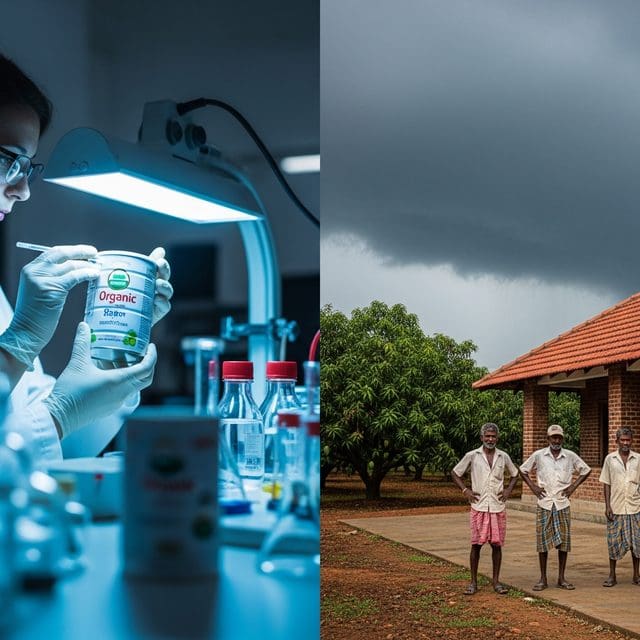
Federal agencies investigate a dangerous infant botulism outbreak while global agricultural sectors face price collapses, land rights disputes, and deteriorating water safety infrastructure.
The integrity of the American food supply chain is facing a severe test as the FDA and CDC investigate a multistate infant botulism outbreak. The investigation centers on Nara Organics Whole Milk Organic Powdered Infant Formula, sold at Target. On June 22, 2026, Marler Clark filed a lawsuit alleging that three infants were hospitalized after consuming the product. This development serves as a grim reminder that ‘organic’ labels do not replace rigorous microbial control, placing federal regulators under the microscope regarding their oversight of specialized nutritional products.
While American families navigate contaminated formula risks, global agriculture is struggling with the economic sustainability of the family farm. In India, Union Minister H.D. Kumaraswamy has formally approached Union Agriculture Minister Shivraj Singh Chouhan to demand emergency support for mango farmers in Karnataka. These growers are trapped in a devastating cycle of low market prices and a supply glut for the 2026–27 season. By requesting the Price Deficiency Payment Scheme, local leaders are attempting to shield producers from rising input costs that threaten to bankrupt independent operations.
Land sovereignty remains a flashpoint for the agricultural community. In Devanahalli, a long battle between the state and local farmers reached a turning point after three years of resistance against the compulsory acquisition of 1,777 acres for an aerospace park. A government panel has shifted to a voluntary sale model, offering ₹2.70 crore per acre. Activists previously argued that forced acquisition risked rendering over 160 families landless. This shift toward voluntary negotiation represents a hard-won victory for local sovereignty over top-down industrial overreach.
Infrastructure improvements are also being deployed to strengthen agricultural value chains. In Gombe, Nigeria, the federal government inaugurated a 160-shop vegetable market to provide farmers direct consumer access. This project, paired with ward-level fertilizer distribution and taskforces for the 2025 wet season, reflects a practical approach to food security. By providing physical marketplaces and reliable inputs, the government aims to reduce post-harvest losses and improve the economic standing of rural growers.
Environmental health remains a moving target as seasonal weather patterns shift. In Telangana, the Directorate of Public Health issued a monsoon advisory following forecasts of rainfall. Officials warned of a surge in acute gastroenteritis, jaundice, and typhoid, urging citizens to consume only boiled or filtered water. The India Meteorological Department expects temperatures to drop as the southwest monsoon revives, bringing severe thunderstorms. These conditions put immense pressure on local water infrastructure, which must prevent cross-contamination during heavy runoff.
From laboratories clearing therapies like UniXell’s UX-DA003 to the fields of Karnataka, regulators must protect the individual and the producer without crushing enterprise. Whether ensuring the safety of infant formula or protecting the land rights of a mango farmer, the priority must remain the protection of the family through grounded, transparent policy.

Eric Nolan serves as the Senior Correspondent for Food, Water, and Environmental Health at Just Right News, where he brings a principled, common-sense perspective to the most fundamental issues facing the American public. With a career dedicated to uncovering the truth behind the policies that govern our natural resources, Eric has become a trusted voice for readers who value traditional stewardship over bureaucratic overreach. His reporting is defined by a commitment to the idea that true environmentalism is rooted in the protection of the American family and the preservation of the nation’s agricultural heritage.
Raised in Fresno, California, Eric’s worldview was shaped in the heart of the San Joaquin Valley. Growing up in one of the world’s most productive agricultural hubs, he witnessed firsthand the vital connection between the land, the water, and the dinner table. In Fresno, he saw the resilience of farmers and the devastating impact that distant, top-down regulations can have on local communities. This upbringing instilled in him a deep respect for the producers who feed the country and a lifelong skepticism toward the alarmist narratives often pushed by mainstream media. For Eric, environmental health is not an abstract political talking point; it is a matter of ensuring that the people who work the land have the freedom and the resources to do so effectively.
Now based in Eugene, Oregon, Eric operates from a unique vantage point in the Pacific Northwest. Living in a region often defined by intense environmental debate, he provides a necessary counter-narrative to the prevailing trends of the area. From his base in Eugene, he monitors the shifting tides of federal and state policies, ensuring that the voices of rural citizens and property owners are not drowned out by urban activism. His reporting often bridges the gap between the rugged realities of the outdoors and the legislative halls where decisions are made, offering a grounded perspective that prioritizes local sovereignty and practical solutions.
As the lead for the acclaimed feature series “Earth on the Table,” Eric explores the intricate journey of the American food supply. He tackles critical issues such as water rights, soil health, and food security through a lens of national stability and individual liberty. He believes that a healthy environment and a thriving economy are not mutually exclusive, but rather two sides of the same coin of national prosperity. His work consistently highlights how innovation and private-sector ingenuity are the most effective tools for ensuring clean water and a safe food supply, rather than the expansion of the administrative state.
At Just Right News, Eric’s reporting serves as a vital resource for those who seek accountability and transparency. Whether he is investigating the impact of federal land management on local economies or examining the safety of the national food infrastructure, his work remains anchored in the values of heritage and hard work. Eric Nolan continues to be a leading voice in environmental journalism, championing the belief that the best way to protect our natural resources is to empower the people who live and work closest to them.