

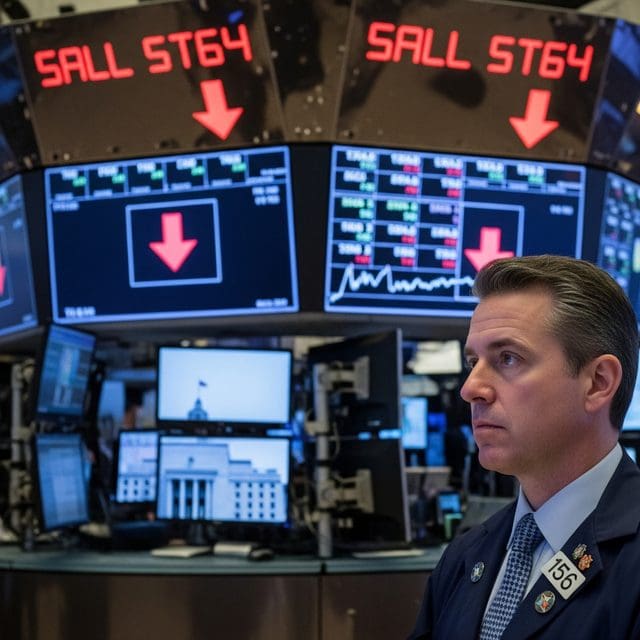
Global indices and tech futures are sliding as investors reprice Federal Reserve expectations and confront the high costs of AI infrastructure, pressuring the S&P 500 benchmark.
The relative calm of the American equity market is being tested as the S&P 500 (SPY) sits down 0.33% on the session, a move that masks deeper fractures in the global financial landscape. While a third-of-a-percent dip might appear minor, the underlying data suggests a significant repricing of risk is underway. Nasdaq 100 futures have plunged more than 2.6%, signaling that the tech-driven engine of the recent bull market is stalling under the weight of rising interest rates and massive capital expenditures.
At the heart of today’s volatility is a hawkish shift in expectations for the Federal Reserve. CME FedWatch data now implies roughly 50 basis points of tightening by year-end, a sharp reversal from the steady-rate consensus held just weeks ago. Major institutions, including Bank of America and Deutsche Bank, are now forecasting multiple hikes starting as early as September. For the American household, this means the ‘higher-for-longer’ environment is a persistent reality that will continue to pressure mortgage rates, credit card balances, and small business lending costs.
The tech sector is bearing the brunt of this shift. Investors are increasingly skeptical of debt-funded AI build-outs, questioning whether massive infrastructure costs will yield immediate returns. This skepticism has driven the Cboe Volatility Index (VIX) toward 20.1, its highest point in over a week. Even established players are feeling the heat; Adobe stock recently fell to its lowest price in more than seven years. While some corners of the market, such as the SpaceX IPO, continue to draw historic demand from foreign investors, the broader appetite for high-beta AI names is waning as funding costs become a renewed concern for balance sheets.
Global markets are mirroring this domestic unease. In Asia, the MSCI Asia-Pacific index fell as much as 1.1%, with South Korea’s Kospi seeing significant weakness in semiconductor names. These moves are complicated by the evolving geopolitical situation in Switzerland, where Vice President Vance has engaged in nuclear negotiations with Iran. While a U.S. waiver of some Iranian sanctions initially caused oil prices to dip, Brent crude has since stabilized near $79 per barrel. The agreement by Iran to invite IAEA inspectors back into the country following these talks has provided some relief to supply fears, yet it complicates the inflation outlook that the Fed must navigate.
Closer to home, the fiscal outlook remains a primary concern for long-term stability. The recent Social Security trustees report projecting a potential $500 monthly benefit cut underscores the fragility of the American social contract and the urgent need for bipartisan reform. As the market grapples with the death of former Fed Chair Alan Greenspan on June 22—a man whose tenure defined the era of cheap money—investors are now forced to confront a reality where fiscal responsibility is no longer optional. The issuance of sustainability-linked bonds by firms like Loomis AB shows that while the economy is evolving, the pressure of a floating-rate world is inescapable.
For the working family, today’s market movement is a reminder that Wall Street is never far from the realities of Main Street. From the launch of 24/7 tokenized stock trading on Binance to AI-powered candidate interactions at Adecco, technology continues to reshape the labor market. However, the fundamental cost of money remains the ultimate arbiter of economic health. As the S&P 500 struggles to maintain its footing, the message from the bond and futures markets is clear: the path to a stable monetary system will require weathering further volatility as the global economy adjusts to a world without the safety net of zero-percent interest rates.

Jordan Lee serves as the Senior Correspondent for Wall Street, Finance, and Monetary Systems at Just Right News. Based in the heart of the world’s financial capital, New York City, Lee brings a sharp, principled eye to the complex mechanisms that drive the global economy. His reporting is defined by a commitment to fiscal responsibility, the defense of the free market, and a deep-seated belief that a transparent monetary system is the bedrock of a free society.
Raised in Portland, Oregon, Lee’s perspective was forged in a city that has undergone significant cultural and economic shifts. His upbringing in the Pacific Northwest instilled in him a profound appreciation for the industriousness of small business owners and the importance of local economic stability. Watching the evolution of his hometown’s landscape sparked an early interest in how federal fiscal policy and large-scale financial trends eventually trickle down to the average citizen. This background provides him with a unique vantage point; he understands the growing disconnect between the policy-making elite and the reality of Main Street, a theme that frequently resonates throughout his work.
Now operating from his base in New York City, Lee bridges the gap between the high-stakes trading floors of Manhattan and the households of everyday Americans. He views the financial sector not merely as a collection of numbers and tickers, but as a vital engine of American prosperity that requires constant vigilance and accountability. His reporting often highlights the dangers of centralized financial control and the necessity of maintaining a system that rewards merit, risk-taking, and innovation.
As the creator and lead of the featured series, “The Invisible Economy,” Lee pulls back the curtain on the often-opaque world of monetary systems. He specializes in translating the dense jargon of central banking and international finance into actionable insights for the Just Right News audience. His work explores the “invisible” forces—such as inflationary pressures, regulatory creep, and the expansion of the administrative state—that erode the purchasing power of American families. By focusing on these systemic issues, Lee empowers readers to understand the hidden forces shaping their financial independence.
Lee’s journalistic philosophy is rooted in a steadfast commitment to traditional American values. As an Asian American professional who has navigated the competitive corridors of the financial world, he is a vocal advocate for meritocracy and the preservation of the American Dream. He believes that a stable currency and a predictable regulatory environment are essential for national sovereignty and individual liberty. His reporting frequently warns against the risks of government overreach in the private sector, arguing that the most effective solutions to economic challenges arise from competition and individual enterprise rather than bureaucratic mandates.
At Just Right News, Jordan Lee remains dedicated to providing a clear-eyed defense of the taxpayer. Whether he is analyzing market volatility or investigating the long-term implications of national debt, his mission is to provide the truth about where the money is going and what it means for the future of the country. Through his rigorous analysis and principled stance, Lee has become a trusted voice for those who value a strong, sovereign, and fiscally sound America.