

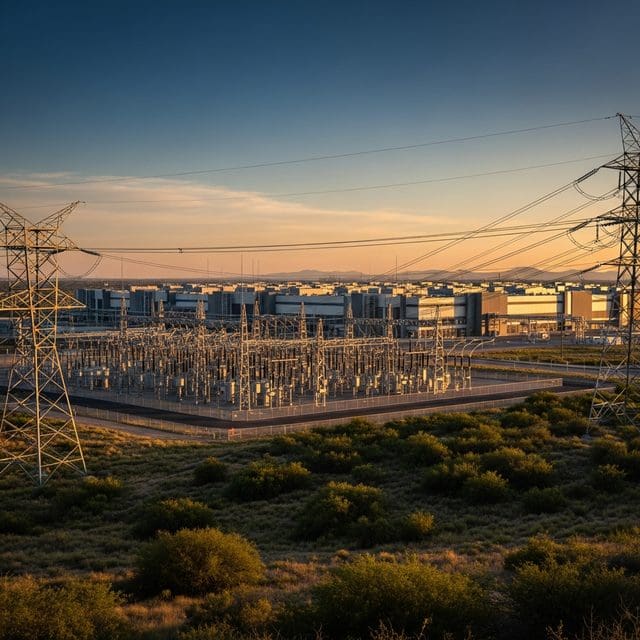
Governor Greg Abbott is pivoting from industry recruitment to strict oversight, demanding that AI data centers fund their own infrastructure to protect Texas residential ratepayers.
The Lone Star State is providing a masterclass in the ‘laboratory of democracy’ as it recalibrates the relationship between emerging technology and state sovereignty. For years, Texas served as a premier destination for the digital frontier, offering Bitcoin miners and AI data center operators a sanctuary of low regulation and abundant energy. However, as the scale of these operations begins to strain the state’s independent power grid, Governor Greg Abbott is asserting a principled stand: the cost of expansion must not fall on the backs of Texas families or jeopardize the reliability of the local power supply.
In a decisive directive to the Public Utility Commission of Texas (PUC) and the Electric Reliability Council of Texas (ERCOT), Abbott ordered a comprehensive overhaul of how large-scale digital loads interface with the grid. The Governor’s mandate is clear: AI data centers and similar industrial loads must fully fund the infrastructure built to serve them. This move aims to prevent a scenario where local households effectively subsidize the growth of global tech conglomerates through rising transmission fees. Abbott has specifically instructed regulators to begin lowering residential transmission costs by the end of July, with a joint memo due by July 17 outlining what can be achieved under existing authority.
The scale of the challenge is immense. ERCOT’s long-term forecasts suggest that potential demand could quadruple by 2032, reaching a staggering 367,790 MW. In the immediate term, summer 2026 could see peak demand surge to 112,000 MW as AI and industrial loads are layered onto the system. Recent reliability tests have already flagged concerns, with several large facilities failing voltage-ride-through standards, posing a risk of sudden disconnections that could destabilize the entire network just as the summer heat peaks.
Beyond immediate grid management, Abbott is signaling a major legislative shift for the 2027 session that challenges the status quo of corporate incentives. He has called for the repeal or narrowing of generous sales-tax exemptions that have ballooned from $14.6 million a decade ago to an estimated $3 billion for the upcoming biennium. This pivot is significant for a Republican governor who previously touted Texas as an AI epicenter, yet it aligns with a constitutionalist view that industries should stand on their own merits rather than rely on permanent taxpayer-funded lifelines.
The proposed policy experiment would require new AI facilities to adopt closed-loop water cooling to preserve local resources and, crucially, to provide their own on-site or contracted power generation. Furthermore, these facilities would be required to file annual electricity and water-use reports and comply with noise-mitigation standards to address growing rural and suburban backlash. This approach reflects a core tenet of decentralized governance: the ability of a state to protect its citizens’ interests while maintaining a functional market. By moving toward a ‘large-load batch’ interconnection regime, Texas regulators are attempting to distinguish between mature, responsible projects and speculative ventures.
As other states watch Texas navigate this digital gold rush, the outcome of this policy pivot will likely serve as a blueprint for how local governments can harness technological growth without sacrificing the stability of their essential infrastructure. The Texas experiment proves that federalism allows states to act as the primary defenders of the public interest. By conditioning growth on the protection of residential bills and neighborhood impacts, Texas is ensuring that the ‘Fifty Laboratories of Power’ remain focused on the people they serve rather than the industries they host. It is a reminder that in the American system, the states remain the most effective check against the unchecked demands of centralized industrial power.

Dylan Brooks serves as the Senior Correspondent for Statehouses and Local Governance at Just Right News, where he brings a principled, constitutionalist lens to the often-overlooked machinery of state-level politics. As the lead voice behind the acclaimed feature series “Fifty Laboratories of Power,” Dylan has dedicated his career to the idea that the most impactful governance happens closest to home. His reporting consistently champions the Tenth Amendment, exploring how individual states can serve as testing grounds for innovative, conservative policy solutions that prioritize personal liberty and fiscal responsibility.
A native of Des Moines, Iowa, Dylan’s journalistic philosophy was forged in the heart of the American Midwest. Growing up in a community where local school board meetings and town halls were the bedrock of civic life, he developed a deep appreciation for the “retail politics” of the heartland. This upbringing instilled in him a fundamental belief that the American experiment is best preserved when power is decentralized. He carries the values of his Iowa roots into every assignment, maintaining a healthy skepticism of federal overreach and a steadfast commitment to the concerns of everyday citizens over the interests of the administrative state.
Now based in Madison, Wisconsin, Dylan operates from one of the nation’s most pivotal political battlegrounds. His location in a state capital known for its rigorous policy debates allows him to provide Just Right News readers with a front-row seat to the legislative process. From Madison, he tracks the ripple effects of statehouse decisions on local municipalities, ensuring that the connection between high-level policy and community impact is never lost. His work often highlights the success of conservative governors and legislatures in fostering economic growth, protecting parental rights, and securing the integrity of local institutions.
As an African American man in the conservative media landscape, Dylan offers a vital perspective on how limited government and free-market principles empower individuals and families. He frequently reports on how deregulation and school choice initiatives provide new avenues for success in underserved communities, challenging the monolithic narratives often presented by legacy media outlets. Dylan’s work is characterized by a commitment to the facts and a refusal to shy away from the complex realities of modern governance.
Throughout his tenure at Just Right News, Dylan has become a trusted authority for readers who value a rigorous, principled approach to the news. Whether he is dissecting a complex state budget or profiling a local grassroots movement, his goal remains the same: to provide the American public with the information they need to hold their local leaders accountable. By focusing on the “Fifty Laboratories of Power,” Dylan Brooks ensures that the vital work being done in statehouses across the country receives the national attention it deserves, always through a lens that respects the traditions and sovereignty of the American people.