

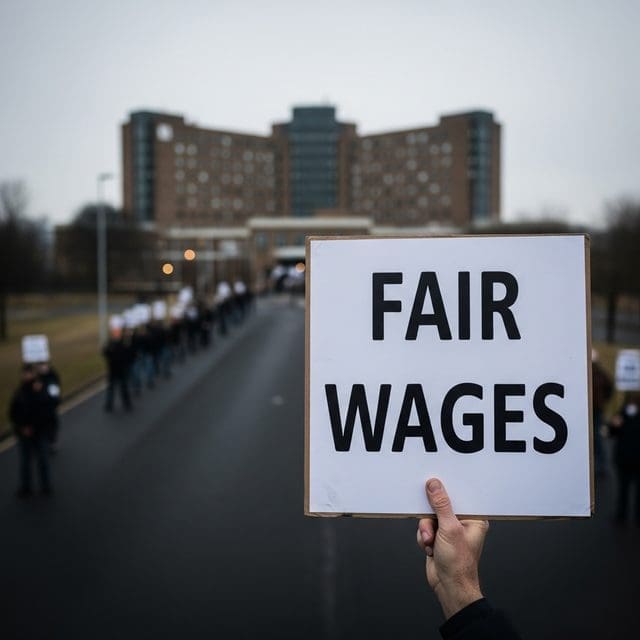
From historic nurse strike votes in Boston to deadly blockades in Bolivia, the global workforce is pushing back against stagnant pay and management overreach in a volatile economy.
The dignity of a day’s work is under siege as the global labor market grapples with a widening gap between stagnant paychecks and the rising cost of living. In the United States, the healthcare sector has become a primary flashpoint. Registered nurses at Brigham and Women’s Hospital in Massachusetts delivered a staggering 99.6% strike authorization vote this week. Representing the largest nurse strike vote in the state’s history, the move responds to contract proposals featuring 0% cost-of-living raises. For these frontline workers, the message from administration is clear: dedication during a public health crisis does not translate to financial stability for the American family.
In Canada, the friction between labor and management has taken a psychological turn. CUPE Newfoundland and Labrador recently condemned NL Health for a cybersecurity test that involved sending “scam emails” to staff promising an extra paid leave day. Union leadership characterized the tactic as a profound lack of respect for a workforce already strained by workload pressures. While automation and digital integration are often touted as efficiency tools, such incidents suggest they are being used to test worker compliance rather than improve daily conditions. CUPE NL has indicated that upcoming bargaining will center on fairness and the preservation of public services over mere job security.
South of the equator, the struggle has turned deadly. Bolivia is currently paralyzed by over 35 days of blockades led by the Central Obrera Boliviana (COB). With roughly 100 active chokepoints and over 5,000 trucks stranded, economic losses have surpassed $2.3 billion. Workers are demanding a 20% minimum wage hike and higher pensions to offset subsidy cuts. President Rodrigo Paz’s response—offering a 50% salary cut for himself while pushing for new state-of-emergency laws—has been dismissed by labor leaders as a cosmetic gesture. The standoff has resulted in at least 16 deaths as blockades interrupt the delivery of essential medicines.
In Nigeria, the struggle for a living wage is a defining political test. Governor Adeleke of Osun State has positioned his administration as a model for the industrial heartland, being among the few to implement the new national minimum wage. By tying the ₦75,000 state wage to pension relief and the payment of long-standing arrears, Adeleke is attempting to provide stability where other regional leaders claim they lack the fiscal space to comply with federal law. This highlights a growing trend: where local leadership fails to prioritize the tangible well-being of the worker, industrial action fills the vacuum.
Even as the corporate world celebrates high-tech milestones, the disconnect from manual trades remains stark. While the SpaceX IPO recently valued the company at over $2 trillion and HSBC partners with Google Cloud for AI, these benefits rarely trickle down to the shop floor. Instead, workers are met with the threat of displacement or management indifference. The reelection of Sean M. O’Brien and Fred Zuckerman to lead the International Brotherhood of Teamsters suggests that rank-and-file members are doubling down on a more skeptical, aggressive approach to corporate negotiations.
As the Strait of Hormuz reopens and global markets react to shifting energy prices following the U.S.-Iran peace deal, the American worker remains caught in a shifting globalist landscape. Falling oil prices may offer minor relief, but they do not address the structural erosion of real wages. Without a concerted effort to align compensation with the reality of the modern market, the current wave of labor unrest is likely only the beginning of a larger realignment for the global workforce.

Tom Blake serves as the Senior Correspondent for Labor, Wages, and Automation at Just Right News, where he brings a grounded, principled perspective to the most pressing economic issues facing the American heartland. As the lead voice behind the acclaimed feature series “The Price of Work,” Tom focuses his reporting on the intersection of traditional industry and the rapidly evolving technological landscape, always prioritizing the dignity of the individual worker and the health of the American family.
Tom’s deep understanding of the labor market is not merely academic; it is rooted in his upbringing in Detroit, Michigan. Growing up in the shadow of the automotive industry, he witnessed firsthand the triumphs and tribulations of the American blue-collar workforce. He saw how the stability of a manufacturing job could build a community and, conversely, how the erosion of those industries could tear the social fabric apart. This background instilled in him a lifelong respect for the trades and a healthy skepticism toward economic policies that prioritize globalist interests over the well-being of local communities.
Now based in Pittsburgh, Pennsylvania, Tom continues to report from the front lines of the shifting economy. Pittsburgh, a city that has reinvented itself while maintaining its gritty, industrious spirit, provides the perfect vantage point for his beat. From the steel mills that remain to the high-tech robotics labs reshaping the city’s future, Tom explores how automation is changing the nature of employment. His reporting often highlights the tension between innovation and tradition, arguing that while progress is inevitable, it must not come at the expense of the American worker’s ability to provide for their family through honest, meaningful labor.
In his role at Just Right News, Tom has become a vital voice for those who feel overlooked by mainstream economic coverage. He rejects the notion that the decline of American manufacturing is an unavoidable casualty of the modern era. Instead, his work often examines how regulatory overreach, rising energy costs, and the unchecked rise of automation impact the take-home pay of everyday citizens. Through “The Price of Work,” Tom delves into the true cost of economic shifts, looking beyond the raw data to tell the stories of the people behind the statistics.
Tom’s reporting is characterized by a commitment to the conservative values of self-reliance, fiscal responsibility, and the preservation of the American dream. He believes that a strong nation is built on a foundation of stable jobs and fair wages, and his work seeks to hold both government and corporate entities accountable to that standard. Whether he is interviewing a shop floor manager about the implementation of new AI technology or analyzing the impact of wage inflation on small businesses, Tom provides a clear-eyed analysis that resonates with readers who value hard work and common sense.
Through his dedicated coverage, Tom Blake remains a steadfast advocate for the American workforce, ensuring that the voices of those in the industrial heartland are heard loud and clear in the national conversation. His perspective is essential for anyone seeking to understand the complex realities of labor and automation in the twenty-first century.