

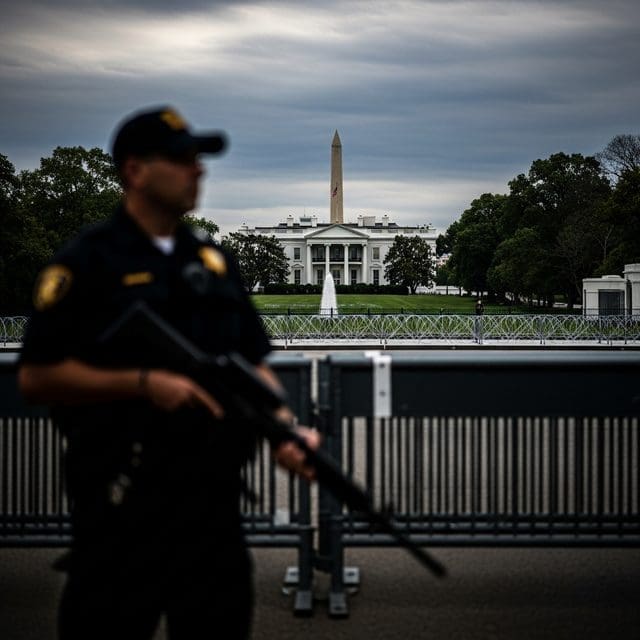
The White House faces a convergence of security crises and legislative stalemates as the FBI thwarts a domestic plot while Congress challenges executive war powers.
The delicate balance between executive prerogative and legislative oversight is currently being tested as the Trump administration navigates a volatile domestic security environment alongside a hardening resistance in Congress. On Tuesday, court documents unsealed in a multistate FBI operation revealed a disrupted plot to attack a mixed-martial-arts event held on the South Lawn of the White House. The suspects allegedly planned to utilize explosive-laden drones and small arms to target the 4,000-plus attendees, an incident that has immediately raised questions regarding the wisdom of transforming the executive mansion into a mass-attendance entertainment venue. FBI Director Kash Patel confirmed that at least five individuals from states including Ohio, Missouri, and California are in custody following the operation, which was launched just four days before the event.
While the administration views the disruption as a success of current law enforcement capabilities, the event has provided fresh ammunition for critics of the administrative state. Congressional investigators are expected to pivot toward examining the security protocols and taxpayer costs associated with such large-scale private events on federal grounds, particularly as the nation nears its 250th anniversary celebrations planned for July 2026 at the Lincoln Memorial and Washington Monument. The episode underscores the security and political risks of turning the White House grounds into a centerpiece for public spectacle, especially as the FBI reports the conspirators viewed the attack as a means to jumpstart a revolution.
This security friction coincides with a significant legislative impasse over the Foreign Intelligence Surveillance Act (FISA). President Trump has publicly stated his opposition to any FISA extension unless it is coupled with the Safeguard American Voter Eligibility (SAVE) Act. This demand for a policy rider has met stiff resistance from Senate Majority Leader John Thune, who indicated the Senate would attempt to move a clean extension of the surveillance authorities without the SAVE Act attached. The standoff suggests a breakdown in the traditional consensus on national security, as the executive branch leverages intelligence tools to secure unrelated domestic policy wins, forcing the intelligence community to plan for a possible loss of key spying authorities.
Simultaneously, the administration’s broader national security apparatus is under fire from Senate Democrats, led by Mark R. Warner. Frustrated by the ongoing conflict in Iran and the appointment of Bill Pulte as acting director of national intelligence, center-left lawmakers have begun drawing red lines by voting down surveillance renewals. This legislative friction comes despite recent diplomatic movements; U.S. Ambassador Mike Waltz and the President have signaled that a final peace deal with Tehran is imminent, potentially involving a $300 billion reconstruction fund if Iran adheres to its obligations. On June 15, 2026, the President and Vice President Vance electronically signed a memorandum of understanding with Iran to formalize these steps toward a final peace agreement.
However, the House of Representatives has already moved to constrain the President’s unilateralism, passing a war-powers resolution in a 215-208 vote to halt military action in Iran without explicit congressional authorization. This bipartisan rebuke, which saw four Republicans join the Democratic majority, signals a reassertion of Article I powers and a thinning of patience for open-ended conflicts. As the administration attempts to manage both a domestic threat landscape and complex foreign peace negotiations, the constitutional friction between the White House and the Capitol remains the primary obstacle to a unified federal policy. The ongoing battle over defense funding and national security appointments suggests that the ‘Beltway bubble’ is increasingly at odds with the administration’s use of emergency powers and its vision for the administrative state.

Miles Harrington serves as the Senior Correspondent for Federal Systems & Executive Power at Just Right News, where he brings a disciplined, constitutionalist lens to the inner workings of the American government. With a focus on the mechanics of the federal bureaucracy and the limits of executive authority, Harrington has established himself as a vital voice for readers who value transparency, accountability, and the preservation of the separation of powers.
A native of Richmond, Virginia, Harrington’s perspective is deeply rooted in the traditions of the Old Dominion. Growing up in a city defined by its historical significance and its role as a center of American jurisprudence, he developed an early appreciation for the foundational principles of the Republic. His upbringing in Richmond—a place where the legacy of the Founding Fathers is woven into the landscape—instilled in him a belief that the federal government should remain within its constitutional bounds. This background informs his skepticism of centralized overreach and his commitment to reporting on the ways in which the administrative state impacts the lives of everyday citizens.
In his current role, Harrington specializes in the complexities of federal systems. He doesn’t just report on the headlines of the day; he digs into the structural shifts within the executive branch that often go unnoticed by the mainstream press. Whether he is analyzing the implications of a new federal regulation or investigating the expansion of agency jurisdiction, his work is characterized by a rigorous adherence to the facts and a dedication to the rule of law.
Harrington is perhaps best known for his signature feature series, “How Washington Works.” Through this ongoing project, he demystifies the often-opaque processes of the nation’s capital, pulling back the curtain on the “Deep State” and the unelected officials who wield significant influence over national policy. By breaking down complex legislative maneuvers and executive orders, he empowers Just Right News readers to understand the true levers of power in Washington. His reporting serves as a necessary check on the federal government, ensuring that the actions of those in power are held up to the light of public scrutiny.
Now based in Washington, D.C., Harrington operates at the epicenter of the political world, yet he remains intentionally distanced from the “Beltway bubble.” His proximity to the halls of power allows him to maintain a robust network of sources across the federal landscape, but his heart remains in the principled conservatism of his Virginia roots. He views his role not merely as a reporter, but as a steward of the public trust, dedicated to providing the clarity and context that conservative voters need to navigate an increasingly complex political environment.
Through his sharp analysis and unwavering commitment to the truth, Miles Harrington continues to be a cornerstone of the Just Right News team. His work ensures that the principles of limited government and executive restraint remain at the forefront of the national conversation, providing a crucial service to those who believe in a government that is truly of, by, and for the people.