

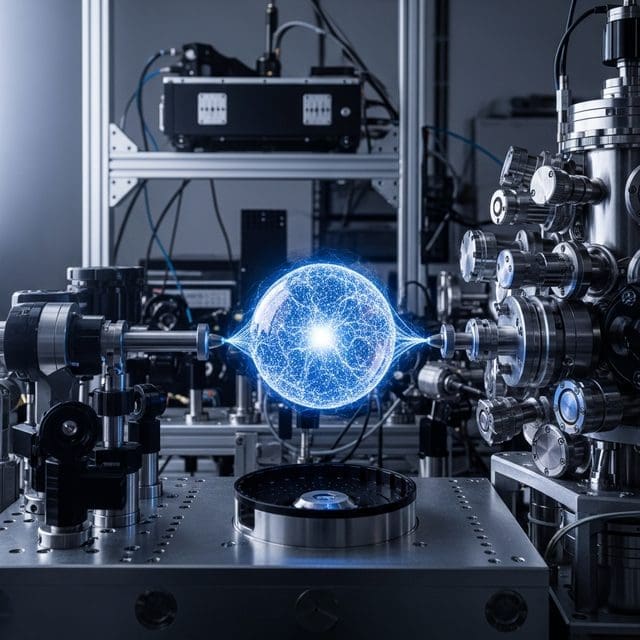
University of Oxford researchers have engineered sophisticated quantum superpositions using trapped ions, offering a new path for error-resilient quantum computing and testing the fundamental limits of reality.
The pursuit of quantum supremacy often feels like a race toward a centralized future, yet recent breakthroughs at the University of Oxford remind us that the most profound shifts occur at the foundational level of physics. Researchers at Oxford published findings in Physical Review X detailing the creation of highly complex ‘Schrödinger’s cat’ states. By engineering arbitrary superpositions in the motion of a single trapped strontium-88 ion, the team has moved beyond simple binary qubits into the realm of continuous-variable quantum computing. This experiment engineered states that are not merely in two places at once, but exist in highly nonclassical ‘squeezed,’ ‘trisqueezed,’ and ‘quadsqueezed’ motional states, allowing for a level of control over a quantum harmonic oscillator that was previously theoretical.
In the classic thought experiment, a cat is simultaneously dead and alive until observed. In the Oxford lab, this paradox is manifested through the ion’s physical motion. By entangling the ion’s internal electronic state with its motional states and performing a mid-circuit quantum measurement, the physicists projected the system into a programmed superposition. Quantum tomography and Wigner-function negativity confirmed that this was genuine nonclassical interference rather than a classical mixture. This isn’t just a laboratory curiosity; it represents a move toward bosonic quantum error correction, a method that could make quantum computers far more stable and less prone to the ‘noise’ that currently plagues the industry. It offers a platform-ready tool for non-binary architectures that could eventually bypass the limitations of current Silicon Valley hardware.
While Oxford pushes the boundaries of the small, the Large Hadron Collider (LHC) at CERN is probing the limits of the known universe. Researchers studying rare ‘penguin decays’ of B-mesons have reported a four-sigma tension with the Standard Model. Only about one in a million B-mesons decay via this specific rare channel, and the discrepancy suggests the existence of particles or forces currently unaccounted for in our traditional understanding of physics, such as leptoquarks. While not yet meeting the five-sigma threshold required for a formal discovery, the result is being hailed as one of the strongest hints of physics beyond the Standard Model to date, as it cannot be fully attributed to known ‘charming penguin’ effects.
However, the path to new physics is rarely a straight line. A separate international team, led by a Penn State physicist, recently utilized supercomputer calculations to resolve a long-standing mystery once thought to be evidence of a ‘fifth force.’ Their work, published in Nature, brought theory and experimental data into agreement to eleven decimal places, effectively closing the door on one supposed crack in the Standard Model. This serves as a vital reminder for the scientific community: what looks like a revolution is often a need for more precise math. This updated calculation reduces the anomaly to less than half a standard deviation, reinforcing the robustness of existing theories against premature claims of a fifth force.
For the American innovator, these developments signal a shift. The ability to engineer exotic matter through ‘Floquet engineering’—as seen in recent Physical Review B studies by Powell and Louis Buchalter—and the Oxford cat-state breakthrough suggest that the future of computing may not lie in massive, centralized server farms alone. By changing magnetic fields over time to create ‘exotic matter’ that does not exist in static materials, researchers are finding ways to make quantum states more resistant to errors. As we stand on this frontier, the focus must remain on ensuring these powerful tools are governed by the principles of transparency and constitutional order. The mastery of localized quantum states and error-resilient materials could pave the way for decentralized, high-performance technologies that respect individual sovereignty and national security, ensuring that the next leap in computing serves the citizen rather than the bureaucracy.

Mason Reed serves as a Staff Writer for Just Right News, where he spearheads the Future Frontiers & Special Projects desk. In an era defined by rapid technological shifts and evolving social landscapes, Mason provides a steady, principled voice, examining the innovations of tomorrow through the lens of traditional American values. His work is most prominently featured in his signature series, “The Next Horizon,” where he explores the intersection of emerging technology, national sovereignty, and the preservation of individual liberty.
A native of San Diego, California, Mason’s worldview was shaped by the unique culture of his hometown. Growing up in a region defined by its strong military presence and its history of maritime industry, he developed a deep-seated respect for the institutions that provide national stability and the entrepreneurial spirit that drives the American economy. This upbringing instilled in him a belief that true progress is not found in discarding the past, but in building upon a foundation of proven principles. His reporting often reflects this San Diego influence, emphasizing the importance of a robust national defense and the necessity of maintaining a competitive edge in the global marketplace.
Now based in San Francisco, Mason operates from the heart of the world’s technological engine. Living and working in the Bay Area provides him with a front-row seat to the advancements—and the ideological challenges—emanating from Silicon Valley. While many in the region embrace a “move fast and break things” mentality, Mason’s reporting serves as a vital counterweight. He offers Just Right News readers a “boots on the ground” perspective, documenting how radical local policies and the concentration of tech power impact the everyday lives of citizens. His proximity to the industry allows him to cut through the marketing jargon of big tech to uncover the real-world implications for privacy, free speech, and the nuclear family.
In his “Future Frontiers” beat, Mason tackles complex subjects ranging from the ethics of artificial intelligence to the burgeoning private space race. He approaches these topics with a healthy skepticism toward centralized bureaucracy, championing instead the decentralized innovations that empower individuals. Through “The Next Horizon,” he highlights the pioneers and thinkers who are working to ensure that the future remains a place where human dignity and constitutional rights are protected. He believes that the rapid pace of change requires more than just technical expertise; it requires a moral compass rooted in the Western tradition.
Throughout his tenure at Just Right News, Mason has remained committed to the idea that the future is something to be shaped, not merely accepted. His writing is characterized by a rigorous defense of American exceptionalism and a belief that the country’s best days lie ahead, provided it remains true to its founding ideals. Whether he is investigating the impact of automation on the American workforce or profiling the next generation of aerospace engineers, Mason Reed ensures that his readers are equipped with the insights they need to navigate a changing world with confidence and clarity.