

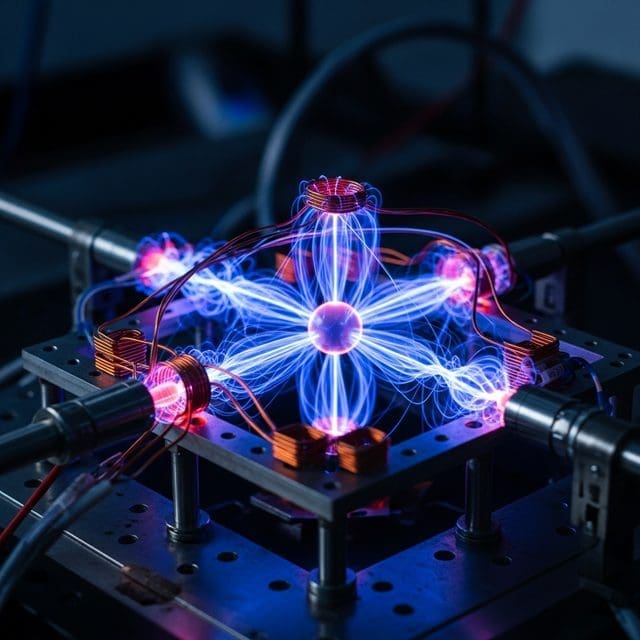
Researchers at California Polytechnic State University have demonstrated that alternating magnetic fields can create exotic, noise-resistant quantum states, potentially solving the stability issues currently hindering practical quantum computers.
The quest for a functional quantum computer has long been stymied by the extreme fragility of quantum states. In the quiet halls of California Polytechnic State University, a lecturer and an undergraduate have published a theoretical breakthrough that suggests the solution to this instability may lie not in what a material is, but in how it is manipulated through time. This research arrives at a critical juncture for the industry, as global 5G subscriptions reach 3.1 billion and the demand for high-speed, secure data processing begins to outpace the limits of classical silicon architecture.
Physicists Ian Powell and Louis Buchalter recently unveiled a concept known as flux-switching Floquet engineering. Their research, published in Physical Review B, demonstrates that by periodically alternating magnetic flux within a quantum system, scientists can induce exotic states of matter that do not exist under stationary conditions. These driven phases are characterized by robust topological features, essentially providing a mathematical armor that protects quantum information from the noise and environmental interference that typically collapse quantum calculations. For a field that relies on the delicate behavior of atoms, electrons, and photons, this level of control is a significant step toward reliability.
While much of the current focus in Silicon Valley involves building larger, more complex refrigerators to keep quantum chips cold, the Cal Poly team’s work suggests a more elegant path: using time-dependent control to organize matter into more resilient forms. This approach, known as Floquet engineering, typically utilizes oscillating electric fields or laser pulses. However, Powell and Buchalter’s focus on magnetic flux provides a distinct and potentially more precise knob for tuning the properties of quantum bits, or qubits. By carefully timing how magnetic fields are applied, the researchers showed it is possible to restructure energy bands into topological phases that remain protected against certain kinds of disorder.
The discovery is particularly notable for its origin. Rather than emerging from a massive corporate laboratory or an elite R1 research institution, the study was a collaboration between a university lecturer and a student who completed his undergraduate degree in 2025. This highlights a decentralized model of innovation where significant theoretical contributions can emerge from teaching-focused institutions. Buchalter, who is moving on to graduate studies in materials science, noted that the process required persistent, creative problem-solving to map out how these exotic states form. Their work resulted in a precise topological phase diagram, which serves as a visual guide for future researchers to identify stable quantum phases.
For the American taxpayer and the tech-curious citizen, the implications are profound. The research identifies a mathematical organizing principle that mirrors higher-dimensional systems, allowing scientists to simulate complex physics using relatively simple, controllable hardware. This could eventually lead to breakthroughs in pharmaceuticals, finance, and aerospace by providing the computational sovereignty required for next-generation simulations. While the California State Budget has recently zeroed out funds for certain local news and community initiatives, the intellectual output from the state’s university system continues to push the boundaries of the known physical world.
Despite the excitement, the researchers maintain a principled caution. The work is currently theoretical, based on computational modeling of square-lattice Harper-Hofstadter systems. The next phase requires experimental validation in ultracold-atom laboratories to prove these time-engineered phases can survive the transition from a chalkboard to a physical device. As the global race for quantum supremacy intensifies, such foundational discoveries ensure that the American tradition of decentralized, individual-led innovation remains at the frontier of the digital age, defending the future of decentralized technology against the limitations of current hardware.

Mason Reed serves as a Staff Writer for Just Right News, where he spearheads the Future Frontiers & Special Projects desk. In an era defined by rapid technological shifts and evolving social landscapes, Mason provides a steady, principled voice, examining the innovations of tomorrow through the lens of traditional American values. His work is most prominently featured in his signature series, “The Next Horizon,” where he explores the intersection of emerging technology, national sovereignty, and the preservation of individual liberty.
A native of San Diego, California, Mason’s worldview was shaped by the unique culture of his hometown. Growing up in a region defined by its strong military presence and its history of maritime industry, he developed a deep-seated respect for the institutions that provide national stability and the entrepreneurial spirit that drives the American economy. This upbringing instilled in him a belief that true progress is not found in discarding the past, but in building upon a foundation of proven principles. His reporting often reflects this San Diego influence, emphasizing the importance of a robust national defense and the necessity of maintaining a competitive edge in the global marketplace.
Now based in San Francisco, Mason operates from the heart of the world’s technological engine. Living and working in the Bay Area provides him with a front-row seat to the advancements—and the ideological challenges—emanating from Silicon Valley. While many in the region embrace a “move fast and break things” mentality, Mason’s reporting serves as a vital counterweight. He offers Just Right News readers a “boots on the ground” perspective, documenting how radical local policies and the concentration of tech power impact the everyday lives of citizens. His proximity to the industry allows him to cut through the marketing jargon of big tech to uncover the real-world implications for privacy, free speech, and the nuclear family.
In his “Future Frontiers” beat, Mason tackles complex subjects ranging from the ethics of artificial intelligence to the burgeoning private space race. He approaches these topics with a healthy skepticism toward centralized bureaucracy, championing instead the decentralized innovations that empower individuals. Through “The Next Horizon,” he highlights the pioneers and thinkers who are working to ensure that the future remains a place where human dignity and constitutional rights are protected. He believes that the rapid pace of change requires more than just technical expertise; it requires a moral compass rooted in the Western tradition.
Throughout his tenure at Just Right News, Mason has remained committed to the idea that the future is something to be shaped, not merely accepted. His writing is characterized by a rigorous defense of American exceptionalism and a belief that the country’s best days lie ahead, provided it remains true to its founding ideals. Whether he is investigating the impact of automation on the American workforce or profiling the next generation of aerospace engineers, Mason Reed ensures that his readers are equipped with the insights they need to navigate a changing world with confidence and clarity.