

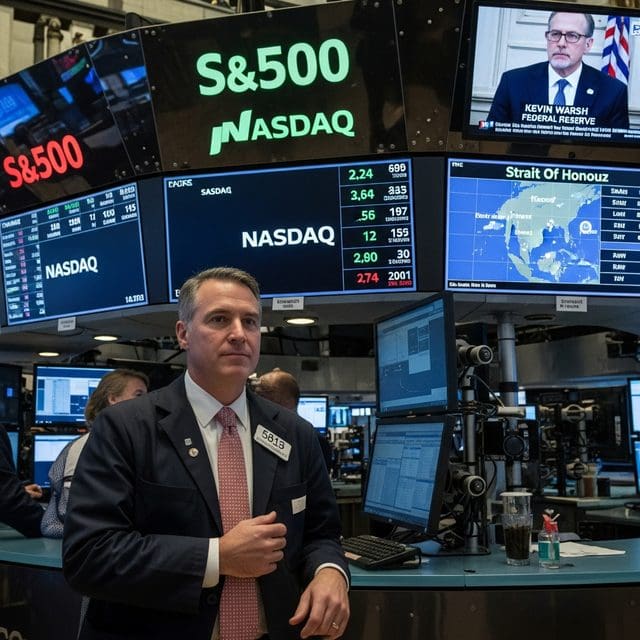
Wall Street indices consolidated Tuesday as a historic U.S.-Iran peace deal sent oil prices to three-month lows, while the Federal Reserve prepared for its first policy meeting under Chair Kevin Warsh.
Global financial markets entered a period of calculated consolidation Tuesday as investors digested the sweeping implications of the U.S.-Iran peace deal. The S&P 500 (SPY) retreated approximately 0.55% on the session, a move characterized by market analysts as a mean reversion following Monday’s explosive 3% surge in the Nasdaq. This cooling period reflects a market attempting to price a new geopolitical reality after President Trump, Vice President Vance, and Iranian Speaker Ghalibaf electronically signed an accord to end the 15-week conflict and reopen the vital Strait of Hormuz.
The most immediate impact for the American taxpayer is visible in the energy complex. Crude oil prices tumbled over 4% to hit three-month lows, with Brent and WTI benchmarks sliding toward the $80 mark. This collapse in energy costs triggered a massive sector rotation; while the energy index fell roughly 4%, “old economy” sectors such as industrials, airlines, and financials spearheaded the day’s activity. For working households, the prospect of lower fuel costs and a stabilized supply chain through the Persian Gulf offers a rare reprieve from the persistent inflationary pressures of the last several years.
In Washington, the Federal Reserve convened for its first policy meeting under the chairmanship of Kevin Warsh. The shift in leadership marks a pivotal moment for the American monetary system. While the federal funds target is expected to remain steady at 3.50%–3.75% this week, the “Warsh Fed” is already signaling a more disciplined approach. Market futures have begun pricing in a 25-basis-point hike for later in 2026, as the central bank is expected to formally abandon its prior easing bias in favor of a more hawkish, stability-oriented framework. The de-escalation in the Middle East has reduced the immediate pressure for a hike, giving Warsh a narrow window to navigate the transition without triggering a liquidity crunch.
Innovation and aerospace sectors continue to provide the primary engine for Nasdaq-linked growth. SpaceX is currently witnessing historic demand from foreign investors following its IPO, with its market valuation now surpassing that of Amazon. Simultaneously, Rocket Lab joined the Nasdaq 100 on June 12, further cementing the dominance of the private space sector in the current market cycle. However, the tech landscape remains bifurcated; Adobe shares plummeted to their lowest level in seven years following the departure of another top executive, proving that even established software giants are not immune to the market’s demand for stable leadership and meritocratic performance.
The financial plumbing of the market is also evolving through tokenization. Binance recently launched its bStocks platform, offering 24/7 trading of select U.S. securities with 1:1 backing. This move toward a continuous trading cycle, combined with Loomis AB issuing 1,000 million SEK in sustainability-linked bonds, suggests that capital is seeking more flexible and transparent vehicles. Against the backdrop of the SPY’s modest decline, these structural shifts indicate that while the broad index may be taking a breather, the underlying appetite for American enterprise remains robust.
As the week progresses, the focus remains on the durability of the ceasefire and the scheduled reopening of the Strait of Hormuz this Friday. Strategists warn that any delay in tanker movement or signs of diplomatic backtracking could quickly reverse the current relief rally. For now, the market is betting on a return to fiscal and geopolitical normalcy, with the “peace dividend” of lower oil prices serving as a critical buffer for the domestic economy as it adjusts to a new era of Federal Reserve oversight.

Jordan Lee serves as the Senior Correspondent for Wall Street, Finance, and Monetary Systems at Just Right News. Based in the heart of the world’s financial capital, New York City, Lee brings a sharp, principled eye to the complex mechanisms that drive the global economy. His reporting is defined by a commitment to fiscal responsibility, the defense of the free market, and a deep-seated belief that a transparent monetary system is the bedrock of a free society.
Raised in Portland, Oregon, Lee’s perspective was forged in a city that has undergone significant cultural and economic shifts. His upbringing in the Pacific Northwest instilled in him a profound appreciation for the industriousness of small business owners and the importance of local economic stability. Watching the evolution of his hometown’s landscape sparked an early interest in how federal fiscal policy and large-scale financial trends eventually trickle down to the average citizen. This background provides him with a unique vantage point; he understands the growing disconnect between the policy-making elite and the reality of Main Street, a theme that frequently resonates throughout his work.
Now operating from his base in New York City, Lee bridges the gap between the high-stakes trading floors of Manhattan and the households of everyday Americans. He views the financial sector not merely as a collection of numbers and tickers, but as a vital engine of American prosperity that requires constant vigilance and accountability. His reporting often highlights the dangers of centralized financial control and the necessity of maintaining a system that rewards merit, risk-taking, and innovation.
As the creator and lead of the featured series, “The Invisible Economy,” Lee pulls back the curtain on the often-opaque world of monetary systems. He specializes in translating the dense jargon of central banking and international finance into actionable insights for the Just Right News audience. His work explores the “invisible” forces—such as inflationary pressures, regulatory creep, and the expansion of the administrative state—that erode the purchasing power of American families. By focusing on these systemic issues, Lee empowers readers to understand the hidden forces shaping their financial independence.
Lee’s journalistic philosophy is rooted in a steadfast commitment to traditional American values. As an Asian American professional who has navigated the competitive corridors of the financial world, he is a vocal advocate for meritocracy and the preservation of the American Dream. He believes that a stable currency and a predictable regulatory environment are essential for national sovereignty and individual liberty. His reporting frequently warns against the risks of government overreach in the private sector, arguing that the most effective solutions to economic challenges arise from competition and individual enterprise rather than bureaucratic mandates.
At Just Right News, Jordan Lee remains dedicated to providing a clear-eyed defense of the taxpayer. Whether he is analyzing market volatility or investigating the long-term implications of national debt, his mission is to provide the truth about where the money is going and what it means for the future of the country. Through his rigorous analysis and principled stance, Lee has become a trusted voice for those who value a strong, sovereign, and fiscally sound America.