

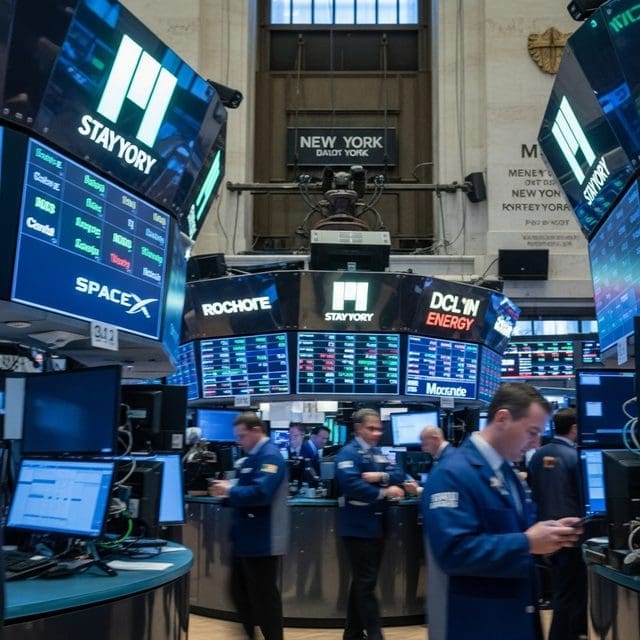
The Dow hits record highs while the S&P 500 stalls, driven by a historic SpaceX valuation surge and a U.S.-Iran peace deal that sent oil prices tumbling.
Global financial markets are navigating a complex regime shift as the initial euphoria of a geopolitical breakthrough gives way to a calculated rotation in sector leadership. While the Dow Jones Industrial Average touched fresh intraday all-time highs on Tuesday, the broader S&P 500 (SPY) traded down approximately 0.48%, reflecting a cooling of the mega-cap technology momentum that has dominated 2026. This divergence highlights a market in transition, where the relief of a stabilizing world order meets the reality of a persistent, high-interest-rate environment.
The primary catalyst for this shift is the electronic signing of a peace agreement between the United States and Iran by President Trump, Vice President Vance, and Iranian Speaker Ghalibaf. This diplomatic resolution has effectively reopened the Strait of Hormuz, causing oil prices to plummet over 4% to three-month lows. For the American household, this collapse in energy costs acts as a shadow tax cut, reducing the cost of living. However, the energy sector has felt the sting of this peace, dragging on broader indices while providing a tailwind to industrials that rely on cheaper fuel.
In the private sector, SpaceX has achieved a historic milestone, vaulting past Amazon to become the fifth most valuable U.S. company. Following a blockbuster IPO that saw the company exercise its greenshoe option to lift proceeds to roughly $86.2 billion, the aerospace giant continues to attract massive foreign capital. This concentration of gains in a single high-beta name has created a mask of stability in the Nasdaq, even as other tech staples struggle. For instance, Adobe stock recently fell to its lowest price in seven years following executive departures, illustrating that leadership stability remains a critical arbiter of value.
Monetary policy remains the invisible hand guiding these rotations. As Kevin Warsh took the helm of the Federal Reserve during the week of June 16, 2026, futures markets pivoted toward a “higher for longer” stance. Derivatives now imply no rate cuts for the remainder of 2026, with increasing odds of further hikes later this year. This hawkish tilt has benefited the financial sector, which saw the S&P Financials Index rise 1.1% today, significantly outperforming the broader SPY benchmark. Working households should note that while lower oil prices help at the pump, the Fed’s stance suggests mortgage and credit card rates will not provide immediate relief.
Further diversifying the landscape, the financial system is becoming increasingly decentralized. Binance recently launched bStocks, offering 24/7 trading of tokenized U.S. securities with 1:1 backing. This move, alongside Rocket Lab joining the Nasdaq 100, signals a permanent shift toward a technologically integrated and space-heavy industrial base. Even traditional European entities like Loomis AB are adapting, issuing SEK 1,000 million in sustainability-linked bonds with floating rates tied to 3m Stibor. This global hunt for yield is occurring against a backdrop where the S&P 500 has slipped from its June 9 highs of $737, suggesting today’s 0.5% dip is part of a broader consolidation.
Ultimately, the current market environment rewards those who can distinguish between speculative bubbles and real-world utility. While SpaceX and the Dow’s industrials celebrate a new era of American energy independence, the broader index is weighed down by a tech sector no longer enjoying undisputed leadership. For the disciplined investor, the focus remains on whether this new geopolitical stability can survive a Federal Reserve committed to a rigid, non-inflationary monetary policy. As the dust settles on the U.S.-Iran deal, the market is no longer trading on fear, but on the cold mathematics of interest rates.

Jordan Lee serves as the Senior Correspondent for Wall Street, Finance, and Monetary Systems at Just Right News. Based in the heart of the world’s financial capital, New York City, Lee brings a sharp, principled eye to the complex mechanisms that drive the global economy. His reporting is defined by a commitment to fiscal responsibility, the defense of the free market, and a deep-seated belief that a transparent monetary system is the bedrock of a free society.
Raised in Portland, Oregon, Lee’s perspective was forged in a city that has undergone significant cultural and economic shifts. His upbringing in the Pacific Northwest instilled in him a profound appreciation for the industriousness of small business owners and the importance of local economic stability. Watching the evolution of his hometown’s landscape sparked an early interest in how federal fiscal policy and large-scale financial trends eventually trickle down to the average citizen. This background provides him with a unique vantage point; he understands the growing disconnect between the policy-making elite and the reality of Main Street, a theme that frequently resonates throughout his work.
Now operating from his base in New York City, Lee bridges the gap between the high-stakes trading floors of Manhattan and the households of everyday Americans. He views the financial sector not merely as a collection of numbers and tickers, but as a vital engine of American prosperity that requires constant vigilance and accountability. His reporting often highlights the dangers of centralized financial control and the necessity of maintaining a system that rewards merit, risk-taking, and innovation.
As the creator and lead of the featured series, “The Invisible Economy,” Lee pulls back the curtain on the often-opaque world of monetary systems. He specializes in translating the dense jargon of central banking and international finance into actionable insights for the Just Right News audience. His work explores the “invisible” forces—such as inflationary pressures, regulatory creep, and the expansion of the administrative state—that erode the purchasing power of American families. By focusing on these systemic issues, Lee empowers readers to understand the hidden forces shaping their financial independence.
Lee’s journalistic philosophy is rooted in a steadfast commitment to traditional American values. As an Asian American professional who has navigated the competitive corridors of the financial world, he is a vocal advocate for meritocracy and the preservation of the American Dream. He believes that a stable currency and a predictable regulatory environment are essential for national sovereignty and individual liberty. His reporting frequently warns against the risks of government overreach in the private sector, arguing that the most effective solutions to economic challenges arise from competition and individual enterprise rather than bureaucratic mandates.
At Just Right News, Jordan Lee remains dedicated to providing a clear-eyed defense of the taxpayer. Whether he is analyzing market volatility or investigating the long-term implications of national debt, his mission is to provide the truth about where the money is going and what it means for the future of the country. Through his rigorous analysis and principled stance, Lee has become a trusted voice for those who value a strong, sovereign, and fiscally sound America.